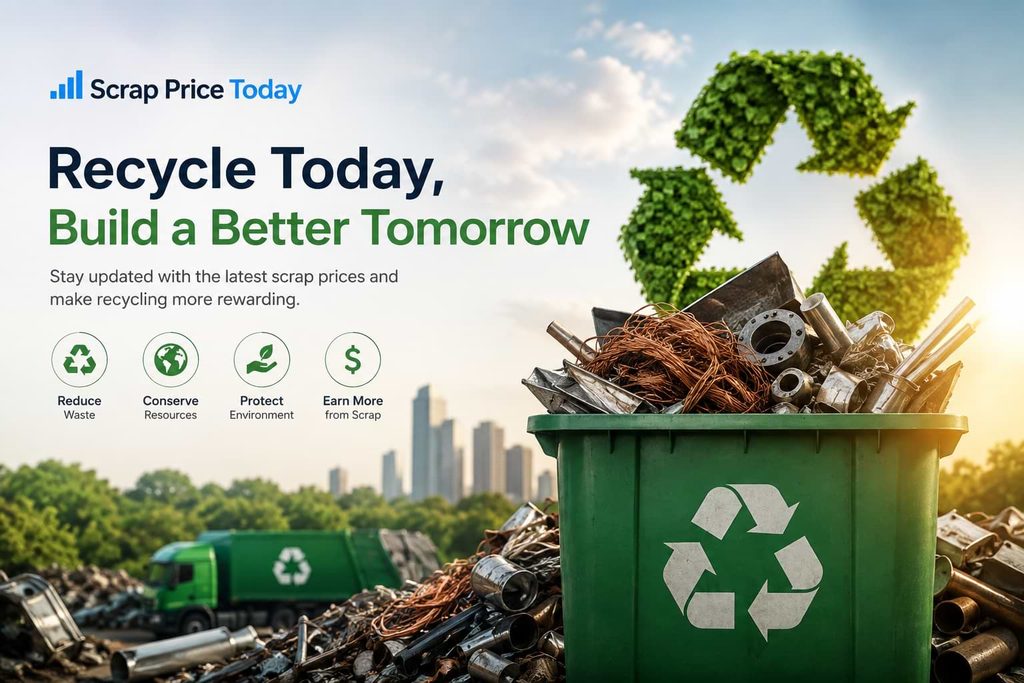
Metal is the part of recycling that pays. Steel and aluminium have a market price every day, which is why a scrap yard hands you money and a kerbside bin does not. The practical question is therefore not whether something is recyclable but which stream it belongs to: kerbside collection, a scrap yard, a specialist processor, or a hazardous waste route. Choosing wrong is why loads get refused.
This hub sets out the five streams, what belongs in each, and the rules that decide acceptance. For what an individual item is worth, see our scrap value index.
The five streams, and how to tell them apart
| Kerbside bin | Scrap yard | Specialist processor | Hazardous route | Take-back scheme | |
|---|---|---|---|---|---|
| Measurement | What it costs or pays you | Same | Same | Same | Same |
| Typical material | Food and drink cans, foil, small clean metal | Appliances, pipe, cable, vehicles, bulk steel | Electronics, converters, lithium cells | Refrigerant, asbestos, PCBs, fuels, full cylinders | Retailer or manufacturer programmes |
| You are paid | No | Yes, by weight and grade | Sometimes, by content | No, you usually pay | No, but removal is free |
| Volume that makes sense | Any | Loads worth more than about $30 | Any, but grouped | Any | Any |
| Refuses | Large or bulky metal, anything pressurised | Untagged cooling units, sealed cylinders, undocumented cable | Mixed household waste | Nothing in its category | Anything outside the scheme |
The boundary that catches most people is between the first two. A tin can goes in the bin because handling it individually costs more than the steel is worth. A washing machine does not, because at 160 pounds it is worth about $48 and the yard wants it.
Why metal is different from the rest of recycling
Steel and aluminium have a continuous market price, so every step in the chain is paid to move them. That is the mechanism, and it explains the outcomes.
Recycled aluminium uses about 95 percent less energy than primary production and recycled copper about 85 percent less. Electric arc furnaces, which run almost entirely on scrap, produce close to 30 percent of world steel. More than 600 million tonnes of steel scrap are recycled each year, the largest recycled stream of any material.
None of that is true of most other household materials, which is the honest answer to whether recycling works: for metal, demonstrably yes, because somebody pays for it.
What goes where
Household metal and packaging
Food cans, drink cans, foil trays and jar lids belong in kerbside collection where a programme exists. Cans are steel with a thin tin coating and a magnet proves it; drink cans are aluminium and are the most valuable common packaging by weight. Our note on metal in the recycling bin covers the sorting rules and the deposit schemes that pay far more than scrap value.
Appliances
Washing machines, dryers, dishwashers, cookers and water heaters are scrap yard material. Cooling appliances need certified refrigerant recovery before anything else happens, which is federal law rather than yard policy. See recycling appliances for values, the refrigerant rule and what to remove first.
Gas cylinders
No yard accepts a sealed pressure vessel. A helium cylinder becomes ordinary steel once it is verifiably empty and the valve is removed, and until then it is refused everywhere. The procedure matters and is set out in helium tank disposal.
Electronics
Whole devices are specialist material rather than yard material. Manufacturer and retailer take-back schemes, municipal e-waste events and licensed e-scrap processors are the routes; general yards rarely want them, and cathode ray tube televisions usually carry a fee because of the leaded glass. Our page on recycling electronics covers the four routes, the data rule and what certification means.
Batteries
Lead-acid batteries are sold by weight at any yard or auto parts retailer. Lithium cells are a separate market with separate buyers and a genuine fire risk in a mixed load. Alkaline batteries have no scrap value at all. Our scrap battery prices article covers all three.
Vehicles
A car is a scrap yard transaction with paperwork attached: title or deregistration, refrigerant recovery, and the parts worth removing first. The arithmetic is in what a junk car is worth.
Fluids and hazardous material
Used oil, old fuel, refrigerant, asbestos-containing material and pre-1979 transformer oil all have their own lawful routes and none of them is a scrap yard. Handling them wrongly costs more than the metal is worth, and our page on oil, fuel and refrigerant sets out where each one goes.
The rules that decide acceptance
- Refrigerant must be recovered by a certified technician before a cooling appliance is scrapped.
- Pressure vessels must be verifiably empty with the valve removed.
- Identification is recorded for non-ferrous everywhere, with fingerprints, photographs and posted payment in the strictest states.
- Provenance is checked for cable, converters and anything with utility or municipal markings.
- Vehicle paperwork must be complete, and the destruction designation cannot be reversed.
- Age matters: wiring and pipe lagging from before the late 1980s and transformers from before 1979 need testing rather than dismantling.
Common mistakes
- Putting a bulky metal item in a kerbside bin, where it is left behind and the collection is contaminated.
- Bringing a cooling appliance without a refrigerant recovery tag.
- Taking a cylinder to a yard with the valve still fitted.
- Mixing lithium cells into a lead-acid battery load.
- Assuming heavy means valuable. A 300 pound cast iron bath is worth less than 12 pounds of copper pipe.
- Paying for removal of a load that a collector would have taken free.
Every guide in this section
Fifty guides, grouped by the stream each item belongs to. Each one covers what the material is, where it actually goes, and what it is worth if anything.
How the system works
- How Does Recycling Work? Five Stages and Where Material Leaks Out
- What Recycled Materials Become: Which Recycling Routes Are Real
Metal and cans
- Can You Recycle Metal? Follow the Two Machines That Sort It
- Aluminum Can Recycling: Auditing the Five Famous Numbers
- Are Tin Cans Recyclable? The Coating Is the Whole Story
- Are Aluminum Cups Recyclable? The Product That Answered Itself
- How to Recycle Bottle Caps and Pull Tabs: Small Metal, One Rule
- Can Crushers for Recycling: The Right Tool in Exactly Two Situations
- Are Clothes Hangers Recyclable? Wire, Plastic, Wood and Velvet
Batteries
- How to Dispose of Batteries: Every Type, One Fire Rule
- Car Battery Recycling Near Me: The One System That Actually Works
- How to Dispose of Lithium Batteries: First Identify Which Lithium
- How to Dispose of Alkaline Batteries: Legal to Trash, Better Not To
- How to Dispose of Vapes: The Product No Bin Can Legally Take
Electronics
- How to Recycle Electronics: Battery Out, Data Off, Then Choose a Route
- Where to Recycle Old Electronics: Limits, Fees and What Gets Refused
- How to Dispose of an Old Computer: Wipe It Before You Recycle It
- How to Dispose of Old Printers: The Cartridge Is the Valuable Part
- How to Recycle Cables and Chargers: Six Cents Each, Millions Together
- Where to Dispose of an Old TV: Three State Recycling Systems
- Recycling Appliances: What Each One Is Worth and the Refrigerant Rule
Paper and card
- Cardboard Recycling Prices: What a Ton Pays, and Why Indexes Disagree
- Can You Recycle Pizza Boxes? Right on Chemistry, Wrong on Amount
- Are Milk Cartons Recyclable? Better Fibre, Worse Access
- Can You Recycle Shredded Paper? Same Pile, Two Different Endings
- Are Magazines Recyclable? Deinking Mills Actually Want Them
- Are Books Recyclable? Paperbacks Whole, Hardbacks Only in Pieces
- Can You Recycle Egg Cartons? Where Paper Fibre Goes to Retire
- Recycled Paper Towels: What to Buy, and Why Used Ones Never Recycle
Plastic
- Recycling Numbers Explained: The Code Is Only Chemistry
- Recycling Plastic Bottles for Cash: Only Ten States Pay
- Plastic Bag Recycling: Never Kerbside, and the Evidence Is Weak
- Is Bubble Wrap Recyclable? Tear a Corner of the Mailer to Check
- Are Trash Bags Recyclable? The Bag Is Not the Problem, the Bagging Is
- Is Plasticware Recyclable? A Shape Problem, and How to Decline It
- Is Styrofoam Recyclable? Technically Yes, Practically Almost Never
- How to Dispose of Styrofoam: Three Piles, Three Different Answers
- Is Foam Recyclable? Five Foams, and Only One Has a Real Market
Glass
- Can You Recycle Glass? Yes, and Your City May Still Say No
- How to Dispose of Broken Glass: The First Ten Minutes, Then the Box
Fluids and hazardous
- Recycling Oil, Fuel and Refrigerant: What Comes Out First
- How to Dispose of Motor Oil: Follow the Gallon to Its Two Endings
- How to Dispose of Old Gas: Diagnose It Like a Small Engine Shop
- How to Dispose of Paint: Four Doors Out of the Garage
- How to Dispose of Light Bulbs: The Last Mercury in the House
- How to Dispose of a Fire Extinguisher: Two Checks Before Anything
- How to Dispose of a Helium Tank: Three Questions Decide Everything
Textiles and bulky items
- Where to Donate Clothes: What Happens at the Sorting Table
- How to Dispose of a Couch: Every Route, Ranked by Who Pays
- Mattress Recycling: Why 75 Percent Recyclable Still Costs You
What Scrap Price Today is
We publish daily indicative prices for fifteen scrap grades across twenty countries and thirty-one cities, derived from public exchange settlements and published index data. The full method is on our editorial policy page.
We do not buy or sell scrap, run a directory, rank yards or take referral fees. This section exists so you can work out what something is worth and where it should go before anyone quotes you a price.
Where this goes in other countries
The route depends on which national system covers you. Most markets place the duty on producers and retailers rather than on households, which is why free drop-off points exist at all. The table below sets out the system, the rule that creates it, and the official locator for each market we cover.
| Market | National system | What creates it | What a household does | Official locator |
|---|---|---|---|---|
| United States | State e-waste programmes | More than 25 states plus DC ban covered electronics from landfill; several fund recycling through an advance recovery fee at purchase | Retailer drop-off, manufacturer take-back, or a municipal collection event | Earth911 locator, by postcode |
| United Kingdom | WEEE Regulations and retailer take-back | Shops with a large enough electricals floor area must accept a like-for-like item free when you buy a replacement, and small items under 25 cm free without purchase | Council recycling centre, or any large electricals retailer | Recycle Your Electricals locator, around 30,000 points |
| Germany | ElektroG, implementing the EU WEEE Directive | Large retailers must take back small devices free without purchase and one-for-one on larger items | Municipal collection point, or retailer take-back | Local authority Wertstoffhof listings |
| France | Eco-organisme system under EU WEEE | Producers fund collection through an eco-contribution shown on the receipt | Déchèterie, retailer take-back, or a scheme collection point | Scheme operator locator |
| India | E-Waste (Management) Rules with portal-based EPR | Producers must meet collection targets across 106 categories of equipment, tracked on a central portal and enforced by environmental compensation | Brand take-back, an authorised dismantler, or a producer collection centre | CPCB list of authorised recyclers and dismantlers |
| Australia | National Television and Computer Recycling Scheme | Industry-funded scheme covering televisions, computers, printers and peripherals | Free drop-off at scheme collection points | Scheme site and council listings |
| Canada | Provincial stewardship programmes | Provincial regulations require producers to fund collection and recycling | Free drop-off at registered depots | Provincial programme locator |
| United Arab Emirates | Municipality e-waste collection | Emirate-level waste authorities operate collection points and campaigns | Municipal drop-off, or a licensed private collector | Municipality waste services |
| Saudi Arabia | National waste authority framework | Regulator-licensed collectors handle electrical and electronic waste | Licensed collector or municipal campaign | Waste authority listings |
| Bangladesh | Hazardous Waste (E-Waste) Management Rules | Producers and importers carry collection duties under the rules, with much collection still informal in practice | Authorised recycler, or a brand collection point where one exists | Department of Environment listings |
| South Africa | Mandatory EPR for electrical and electronic equipment | Producers must register and fund a producer responsibility organisation | PRO collection point, or a registered recycler | PRO and municipal listings |
| Japan | Home Appliance Recycling Law and Small Appliance Law | Consumers pay a recycling fee for four major appliance categories at disposal; small appliances collected by municipalities | Retailer collection with a recycling ticket, or municipal box collection | Municipal and retailer guidance |
Frequently asked questions
Can you recycle all metal?
Technically yes; every common metal is recyclable without loss of quality. The practical question is which route it takes. Small clean packaging goes in a kerbside bin, larger items and non-ferrous metal go to a scrap yard where they are paid for by weight and grade.
Does metal go in the recycling bin?
Food and drink cans, foil and jar lids do where a kerbside programme exists. Appliances, pipe, cable, cylinders and anything bulky do not; they either jam the sorting line or are simply left behind, and they are worth money at a yard instead.
Which recycling actually works?
Metal, because there is a market price behind it. Recycled aluminium saves about 95 percent of the energy of primary production and electric arc furnaces running on scrap produce close to 30 percent of world steel. Somebody pays to move metal at every step, which is not true of most other household streams.
Why did the scrap yard refuse my item?
The five common reasons are an untagged cooling appliance, a sealed gas cylinder, cable or a converter without proof of ownership, material with utility or municipal markings, and anything suspected of containing asbestos. Each has a separate lawful route.
Is it worth taking metal to a scrap yard?
It depends on the value per pound, not the size. Light steel is about $0.13 a pound and clean copper about $5.79, so you need roughly 230 pounds of the first or five pounds of the second to clear the cost of a typical trip.
What should never go in a scrap load?
Full or partially full gas cylinders, unrecovered refrigerant appliances, lithium cells mixed with lead-acid batteries, and any material with unknown asbestos or PCB content. These are safety issues rather than grading issues.