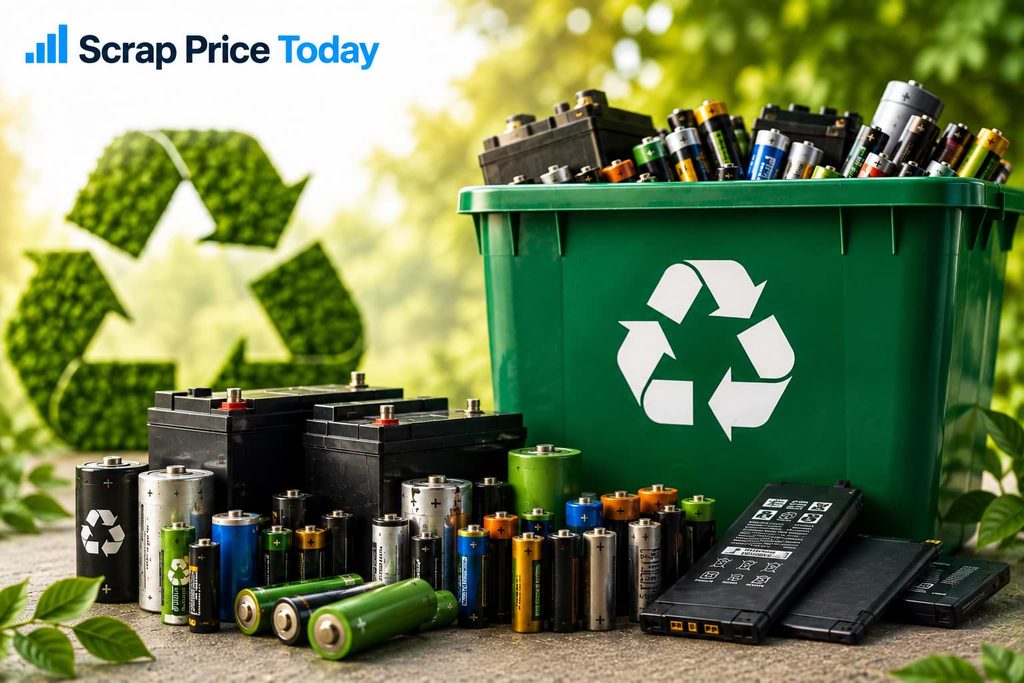
No household battery belongs in any bin, recycling or trash. Every type, from AA alkalines to phone batteries to coin cells, goes to a drop-off point instead: retail collection boxes, household hazardous waste sites, or the producer-funded networks now rolling out. The reason is fire. Batteries are the leading cause of fires at waste facilities, and one California sorting plant found eleven loose lithium batteries entering its stream every hour.
The rules differ slightly by chemistry. The destinations barely differ at all, which makes this simpler than it looks.
Why the bin is banned
A battery that looks dead still holds charge. Crushed in a truck or plant, a lithium cell short-circuits, overheats and ignites material around it.
The measured scale of the problem:
- 11 loose lithium batteries per hour found entering one sorting facility’s waste stream in a California workflow study.
- 20 of 26 facilities surveyed in the state had at least one fire within two years. 65 percent were attributed to batteries.
- One battery fire closed a San Carlos facility for 90 days and caused $8.5 million in damage. The operator could only re-insure through seven separate policies at seven times the premium.
- An estimated 75 to 92 percent of lithium-ion batteries are discarded improperly.
- Californians alone use about 822 million batteries a year, with over 7,000 tons reaching the state’s landfills annually.
That fire history, covered across our electronics pages, is why every legitimate answer routes around the bin.
The four battery families
| Alkaline | Lithium-ion rechargeable | Lithium coin and button cells | Lead-acid | |
|---|---|---|---|---|
| Measurement | What it powers, the risk it carries, and where it goes | Same | Same | Same |
| Typical home | AA, AAA, C, D, 9V | Phones, laptops, power tools, earbuds | Watches, key fobs, hearing aids | Cars, mowers, boats |
| Fire risk | Low, except 9V terminals | The one causing the facility fires | Low fire, high child-swallowing danger | Acid and short-circuit |
| Trash legal? | In some states, never in California | No, anywhere | No | No, nearly every state |
| Preparation | Tape 9V terminals | Tape terminals, bag each battery | Tape both faces | Upright, terminals covered |
| Destination | Retail box or hazardous waste site | Retail box, never damaged ones | Retail box | Any battery counter, which pays you |
Lead-acid is the odd one out because it has real value. That system, and the money in it, has its own page.
Where drop-off actually is
Retail collection boxes. Hardware chains, electronics retailers and many supermarkets host free battery boxes near the entrance, fed into an industry-funded national collection scheme. This is the everyday answer for taped household batteries.
Household hazardous waste sites and events. The catch-all, and the required route for anything damaged, swollen or leaking. Municipal sites take every chemistry without question.
Producer-funded networks. Where state law makes battery makers run collection, drop-off density is rising fast. California’s new system is the largest example, below.
A swollen or damaged battery goes to none of the boxes. Sand or kitty litter in a metal container, then a hazardous waste site, and never a retail bin where it sits crushed under others.
What changed in 2026
California switched on the broadest battery rules in the country this year, and they preview where other states are heading.
- From 1 January 2026, retailers collect a recycling fee at the till on battery-embedded products, meaning any device whose battery cannot be removed with common tools: wireless earbuds, smartwatches, toothbrushes, many toys.
- Manufacturers must now display brand and battery chemistry on such products or their websites.
- From 1 April 2026, approved recyclers claim processing payments from the state fund, with fees adjustable annually from August.
- The Responsible Battery Recycling Act makes producers fund and run statewide collection for every chemistry, single-use and rechargeable alike, replacing the older rechargeable-only law, which goes inoperative at the end of September 2026.
Together the two laws put nearly every battery sold in the state under a recycling programme. Vermont pioneered single-use battery producer responsibility and the District of Columbia extended it to embedded products; California’s version now covers the lot, and several states have bills tracking it.
Questions people actually ask
Can I throw AA batteries in the trash? In some states legally yes, since alkalines have been mercury-free for decades. It is still the worst answer available, and in California it is illegal for every battery.
Do I really need to tape the terminals? Yes, and it is the cheapest fire prevention there is. A 9V in a drawer of coins, keys or other batteries is a classic ignition story.
My phone battery is swollen. What do I do? Stop charging it, do not press or puncture it, move it somewhere non-flammable, and take it to hazardous waste. Not a retail box.
Where do dead vape batteries go? Nowhere good yet: vapes are sealed lithium devices with their own mess of rules, covered on our electronics hub and in this cluster shortly.
Common mistakes
- Binning rechargeables because the device looks dead. Dead to a charger is not dead to a short-circuit.
- A jar of mixed loose batteries, terminals touching, waiting months for a trip.
- Skipping the tape on 9Vs and coin cells, the two highest-contact-risk shapes.
- Dropping swollen batteries in retail boxes, where they get crushed under the next handful.
- Assuming button cells are harmless. Their danger is children swallowing them, which is why child-resistant packaging rules now apply; tape both faces and keep them high.
- Paying to dispose of a car battery. That one pays you, at the counter or the yard.
- Storing a backlog indoors near the dryer or in the car in summer.
Where this fits
The lead-acid system that actually pays is on car battery recycling, the fires that batteries cause inside sorting plants run through how to recycle electronics, and the lithium market behind the rules is on lithium battery scrap. The wider stream question sits on the recycling hub.
Frequently asked questions
How do I dispose of household batteries?
Never in any bin. Tape the terminals, bag lithium batteries individually, and use a retail collection box, a household hazardous waste site, or a producer-funded drop-off. Damaged or swollen batteries go only to hazardous waste, never a retail box.
Why can batteries not go in the trash or recycling?
Fire. A battery that looks dead still holds charge, and crushed in a truck or plant a lithium cell short-circuits and ignites what surrounds it. Batteries are the leading cause of waste facility fires, and one plant found eleven entering its stream every hour.
Are alkaline batteries safe to throw away?
They have been mercury-free for decades, and some states allow it, but it remains the worst available answer and is illegal in California for every battery. Retail boxes take them free, so the drop-off costs one errand.
Which batteries cause the facility fires?
Overwhelmingly lithium-ion rechargeables from phones, tools, earbuds and vapes. In one state survey, 20 of 26 facilities had a fire within two years, 65 percent attributed to batteries, and estimates put 75 to 92 percent of lithium-ion batteries in the wrong stream.
How should I store dead batteries before drop-off?
Terminals taped, lithium cells bagged individually, in a non-metal container away from heat, and not for months. A 9V loose in a drawer with coins and keys is the classic ignition story, and coin cells get tape on both faces.
What do I do with a swollen battery?
Stop charging, never press or puncture it, stand it in sand or kitty litter in a metal container away from anything flammable, and take it to household hazardous waste. Retail boxes are for healthy batteries only.
What changed in California in 2026?
Two laws switched on. Retailers now collect a recycling fee on battery-embedded products like earbuds and smartwatches, and producers must fund statewide collection for every battery chemistry, replacing the older rechargeable-only scheme by the end of September 2026.
What is a battery-embedded product?
Any device whose battery cannot be removed with common tools: wireless earbuds, smartwatches, electric toothbrushes, many toys. In California these now carry a point-of-sale recycling fee and must display brand and battery chemistry.
Do any batteries have scrap value?
Lead-acid does: car, mower, motorcycle and boat batteries bring core refunds, store credit or cash by weight, as our car battery page details. Household alkalines and lithium cells cost the system money instead, which is why producers now fund their collection.
Why are button batteries treated specially?
The danger is children swallowing them, which causes severe internal burns within hours, so child-resistant packaging rules now apply and both faces get taped before drop-off. Their fire risk is low; the swallowing risk is the emergency.