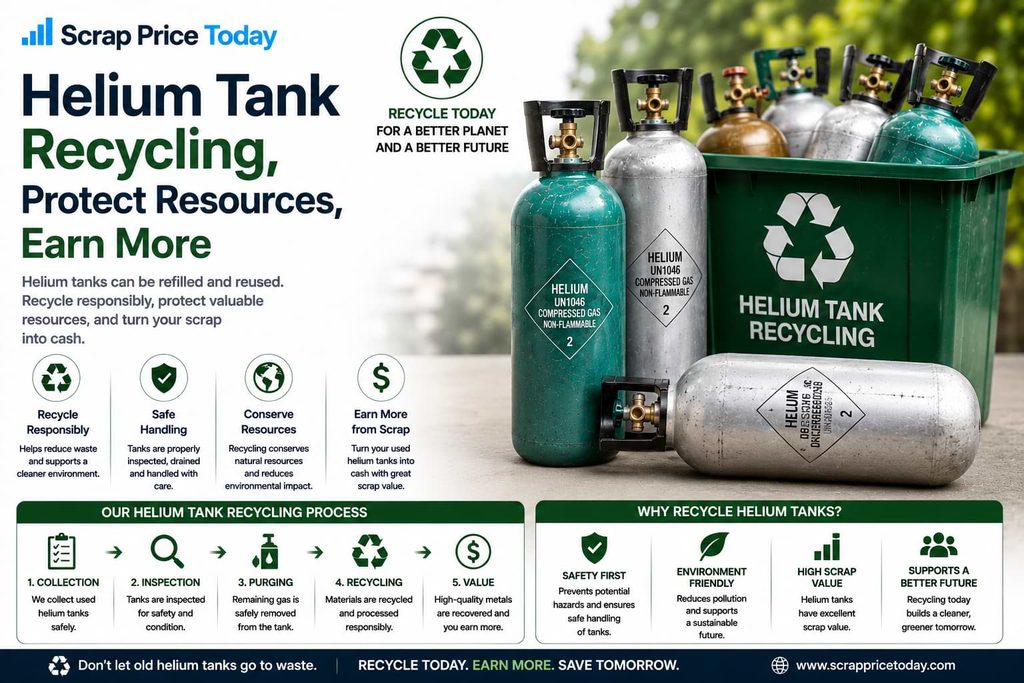
A party helium tank is recycled as scrap steel, but only after two things are true: every wisp of pressure is vented through the valve, and the small relief disc on the shoulder is punctured and removed so the tank is visibly safe. That disc procedure comes from the manufacturer’s own instructions, and it is what turns a refused cylinder into an accepted piece of steel at a kerbside bin or a yard. A rented refillable cylinder follows none of this and simply goes back to the supplier.
Three questions about the tank in your hands decide everything. Answer them in order.
Question one: does it still hiss?
Press the nozzle, outdoors, and listen.
If it hisses, the tank is not done. Helium keeps for years with the valve closed tight, so a part-used tank is next birthday’s tank, stored upright somewhere cool. And a part-full cylinder must never reach any bin, because a compactor finds the pressure for you.
If you want it gone anyway, empty it first: valve fully open, nozzle held down, in open air, until sound and sensation both stop. Helium is inert and non-toxic, and venting it outdoors is completely safe.
If it is silent, move to question two.
Question two: disposable or refillable?
Read the tank, because the two lives end at different doors.
Disposable party tanks, the light printed cylinders from supermarkets and party shops in the familiar sizes around 9 and 15 cubic feet, are single-use by design and marked non-refillable. Never refill one with anything; the tank was not built for a second pressurisation. These are yours to prepare and recycle, question three.
Refillable cylinders, the heavy industrial type from a gas supplier or balloon company, belong to that supplier. Return them, collect the deposit, and do nothing else to them. A yard will refuse them and the supplier wants them back, the same ownership logic as every rented cylinder in our gas cylinder guide.
Question three: bin or yard?
An empty, disc-removed disposable tank is plain steel, and it has two doors.
- Kerbside metal recycling, where your programme accepts prepared tanks. Many do once the disc is visibly out; check your council’s list for pressurised container rules.
- A scrap yard, which takes it as light steel without ceremony. The tank holds roughly $0.98 of steel at today’s board price, so this is a make-safe errand rather than a payday, though some yards hand over small change for it.
Either way, the preparation below is what makes the tank acceptable, because no facility takes a sealed cylinder on faith.
The disc procedure, from the maker’s own sheet
The manufacturer publishes the method, and municipal recycling pages reproduce it. In order:
- Vent completely. Valve counter-clockwise until it stops, nozzle pressed until all hissing ends. Outdoors.
- Remove the nozzle by turning its white collar nut counter-clockwise.
- Gloves and eye protection on.
- Puncture the relief disc, the small round seal on the tank’s shoulder, with a flat screwdriver and hammer. Work around its ring, pry, and lift the disc out by hand, minding sharp edges.
- Write EMPTY on the tank in marker.
One rule governs the order: the puncture always comes after the venting, never instead of it. Guides that say never puncture a helium tank are protecting you from doing step four to a tank that still holds pressure. The maker’s sequence and that warning are the same rule read from two ends.
The strange element you just released
A short aside, because helium is the only party supply with a cosmic backstory.
Helium on Earth is made underground by radioactive decay, trapped in natural gas fields over millions of years. Released, it rises through the atmosphere and leaves the planet permanently. It is genuinely non-renewable in a way even oil is not, and periodic global shortages ration it toward the uses nothing else can do, cooling hospital scanners above all.
Venting a party tank’s remnant is harmless and correct, and the honest place for that discomfort is the purchase decision, not the disposal: air-filled balloon displays have improved precisely because event helium keeps getting dearer.
Questions people actually ask
Can I just put the tank in the trash? Empty and disc-removed, some areas allow it, but the same preparation makes it recyclable steel, so the bin gains you nothing. Sealed or part-full, never: compactors and cylinders end badly.
My tank has no relief disc I can find. Some models vary. Vent it fully, remove the nozzle, and take it to a scrap yard or hazardous waste site, telling them it is vented; they handle the rest.
Will a scrap yard pay me for it? A few pounds of steel is small change at best, and some yards take prepared tanks free. The value is the clear garage, not the payout.
Is it dangerous to keep a half-full tank? Not upright, cool and valve-closed; that is exactly how it shipped. Heat is the enemy, so lofts and car boots in summer are the storage mistakes.
Common mistakes
- Binning a tank that still hisses, the compactor rupture scenario every rule exists to prevent.
- Puncturing before venting, the same scenario moved into your garage.
- Trying to refill a disposable, which its cylinder rating explicitly forbids.
- Scrapping a rented cylinder that a supplier owns and a yard will refuse.
- Skipping the marker, since EMPTY written large is what a hauler believes.
- Storing part-full tanks in hot places between parties.
Where this fits
Propane, fire extinguishers and every other pressurised vessel follow the ownership-and-venting logic in our gas cylinder guide, the aerosol cousins are covered on can you recycle metal, and the prepared tank’s steel joins the market priced live across our metal pages.
Frequently asked questions
How do I dispose of a helium tank?
Vent it completely outdoors through the valve, remove the nozzle, puncture and remove the small relief disc on the shoulder using the manufacturer's published method, write EMPTY on it, then kerbside metal recycling where accepted or any scrap yard. Rented refillable cylinders just go back to the supplier.
Is it safe to puncture a helium tank?
Only in the correct order: the puncture always comes after complete venting, never instead of it. The manufacturer's own instructions have you open the valve until all hissing stops, then remove only the relief disc with gloves and eye protection.
Can helium tanks go in the trash?
Never sealed or part-full, because a compactor finds the pressure. Fully vented and disc-removed, some areas allow trash, but the same preparation makes the tank acceptable steel at recycling, so the bin gains nothing.
Is releasing leftover helium harmful?
Locally, not at all: helium is inert and non-toxic, and venting outdoors is the correct first step. The element itself is finite, made by underground radioactive decay and lost to space once released, which is a purchase consideration rather than a disposal one.
Can I refill a disposable helium tank?
No, with anything, ever. Party tanks are single-use cylinders marked non-refillable and are not built for a second pressurisation. Refillable service belongs to the heavy supplier-owned cylinders that return for a deposit.
How do I know if my tank is disposable or rented?
Read it. Disposable tanks are the light printed cylinders around 9 or 15 cubic feet marked non-refillable. Rented cylinders are heavy industrial bottles from a gas or balloon supplier, and they go back to that supplier, who will refund the deposit.
What is a helium tank worth as scrap?
A few pounds of light steel, about a dollar at board prices, which is why this is a make-safe errand rather than a payday. Some yards accept prepared tanks free and some hand over small change.
Can I keep a half-used tank for the next party?
Yes. Helium keeps for years with the valve closed tight, stored upright and cool. Heat is the enemy, so avoid lofts and hot car boots, and vent and recycle only when you are actually done.
Why do recycling centres refuse sealed cylinders?
Because nobody can verify what a closed pressure vessel holds, and crushed cylinders rupture. The removed relief disc is the visible proof of safety that turns a refused cylinder into accepted steel.
My tank design has no removable disc. What now?
Vent it completely, remove the nozzle, and take it to a scrap yard or household hazardous waste site and say it is vented. Facilities have the tools for nonstandard cylinders; the bin does not.