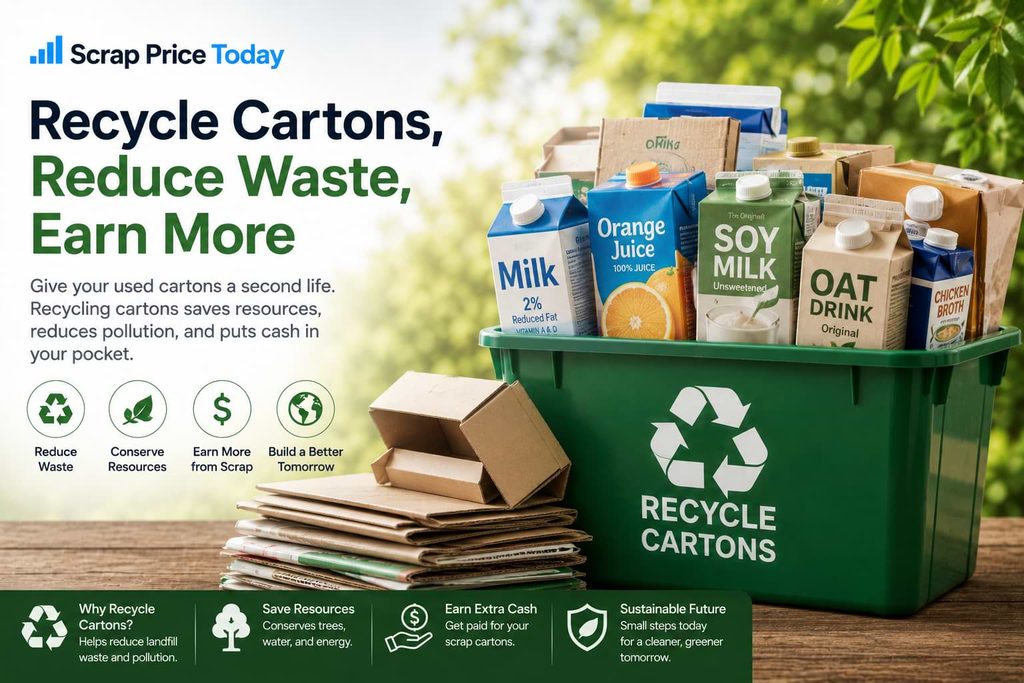
Cartons are recyclable, and the surprise is how well. A paper mill putting a tonne of carton board through a hydrapulper recovers 68 to 73 percent as usable fibre, which is at or better than the yield from office paper, even after dealing with the plastic and aluminium layers. The constraint is access rather than technology: about 61 percent of US households can currently recycle them through a local programme, so more than a third cannot. Check your own before assuming.
The layers that make people assume a carton is unrecyclable are exactly what makes the fibre inside worth recovering.
Two cartons, different layers
| Gable-top | Aseptic | |
|---|---|---|
| Measurement | Composition, use and where it is found | Same |
| Shape | Peaked roof, refrigerated | Rectangular brick, shelf-stable |
| Paper | About 80 percent | About 74 percent |
| Polyethylene | About 20 percent, in two internal layers | About 22 percent, in four layers |
| Aluminium | None | About 4 percent, a very thin foil |
| What the layers do | Seal against liquid | Seal, and block light and oxygen |
| Typical contents | Milk, juice, cream | Broth, soup, juice, shakes, long-life milk, wine |
| Typical weight | About 28 g | About 10 g |
The aluminium foil is the reason an aseptic carton sits on a shelf for months without refrigeration. It is also why people assume it cannot be recycled, and that assumption is what the process below disproves.
One detail worth knowing: the colourful printing is applied to the thin plastic layer, not to the paper. When that layer is removed, clean fibre is what remains.
What actually happens in a hydrapulper
- A hydrapulper is an industrial blender the size of a room, mixing cartons with water.
- The agitation separates the paper fibre from the combined polyethylene and aluminium, which the industry calls PolyAl.
- The fibre floats free and is screened out. It is long, strong and clean, and goes into tissue, kitchen towel, printing paper and new paperboard.
- The PolyAl is recovered separately and used for energy generation or as a binder.
- At a full carton recycling facility, the whole carton is used instead: the entire composite becomes building materials such as wallboard, roof cover board and ceiling tiles.
- Cartons trade under their own industry grade, and the number of North American facilities taking that grade has grown from one to six.
That second route is the interesting one, because it removes the separation problem entirely by making the composite the product.
The number that surprises people
The fibre yield is the fact that changes the argument.
- A tonne of carton board through a hydrapulper nets 68 to 73 percent usable material.
- That is at or better than office paper, which nobody questions the recyclability of.
- Carton fibre is long and strong because it is made for wet strength, which makes it valuable rather than marginal.
So a mill’s interest in cartons is commercial. It wants the fibre, and it tolerates the PolyAl to get it. That is the same relationship our analysis of what actually gets recycled finds behind every functioning stream.
Where access stands, honestly
The progress is real and the gap is also real.
- 61 percent of US households can recycle cartons through a local programme, up from 37 percent when the industry group formed.
- That is more than 77 million households.
- States with household access have grown from 24 to 49.
- The carton recycling rate has risen from 6 percent to about 20 percent.
- In California specifically, roughly 72 percent of households have access for aseptic cartons and 74 percent for gable-top.
Read the two headline figures together and the picture is honest: access has nearly doubled, and the recycling rate is still 20 percent. Access is necessary and not sufficient, because a route existing does not mean people use it.
It also means roughly a third of American households genuinely cannot recycle a carton, and for them the correct answer is general waste rather than hopeful bin use.
How to prepare one
- Empty it completely. Liquid is the main reason a carton load gets downgraded.
- Do not rinse heavily. A quick shake is enough; cartons do not need to be washed out.
- Leave the cap on where your programme accepts it, since loose caps are too small for sorting lines and fall through the screens.
- Do not flatten unless your programme asks. Optical sorters identify cartons partly by their three-dimensional shape, and a flattened carton can be misread as paper.
- Do not crush the aseptic bricks into a ball for the same reason.
- Keep straws and plastic pour spouts out where they detach easily.
- Do not compost them. Neither the polyethylene nor the aluminium composts, and facilities have to remove both mechanically.
The flatten instruction is the opposite of the advice for cardboard boxes, which is worth remembering because the two sit in the same bin.
The myths worth killing
- “Cartons are waxed.” They are not, and have not been for many years. The coating is polyethylene, which is why the modern process works at all.
- “Multilayer packaging cannot be recycled.” Multilayer makes it harder, not impossible. Hydrapulping recovers three quarters of the weight, and the full-carton route uses everything.
- “The aluminium ruins it.” Aluminium is about 4 percent of an aseptic carton and is separated with the polyethylene rather than lost.
- “You have to take them somewhere special.” In areas with access, cartons go in ordinary household recycling. Special drop-off is the exception, not the rule.
- “They compost because they are mostly paper.” The 20 to 26 percent that is not paper does not compost, and composting operations screen it out.
Where this fits
The wider question of which stream any household item belongs to sits on the recycling hub. Why some paper items are refused despite being paper is covered in our page on greasy pizza boxes, and why the plastic layer on other packaging behaves differently is explained on the plastic film page.
How we produced this
The composition percentages, hydrapulper yield, household access figures, state counts, recycling rate and facility numbers come from the industry body that promotes carton recycling and from trade press reporting on its work.
That body is funded by four carton manufacturers, which we state plainly because it has an interest in the conclusion that cartons are recyclable. We have reported its figures with that attached rather than presenting them as independent. The yield comparison with office paper, in particular, is its own framing.
The composting limitation and the waste stream tonnages come from separate industry commentary. Composition figures vary slightly between sources, with one older account giving 70 percent paper, 24 percent polyethylene and 6 percent aluminium for aseptic cartons against the more commonly cited 74, 22 and 4; we have used the figures the industry body currently publishes and noted the variation here.
Access differs by council and is the only rule that applies to your bin. Check before changing what you do.
Frequently asked questions
Are milk cartons recyclable?
Yes, where your programme accepts them, and the fibre recovery is unusually good. A mill putting a tonne of carton board through a hydrapulper recovers 68 to 73 percent as usable material, which is at or better than the yield from office paper.
What is a carton actually made of?
A gable-top refrigerated carton is about 80 percent paper and 20 percent polyethylene. A shelf-stable aseptic carton is about 74 percent paper, 22 percent polyethylene in four layers, and 4 percent aluminium foil that blocks light and oxygen.
How are the layers separated?
In a hydrapulper, an industrial blender that mixes cartons with water. The agitation frees the paper fibre from the combined polyethylene and aluminium, known as PolyAl. The fibre goes into tissue, kitchen towel and new paperboard, and the PolyAl into energy or binder.
Can everyone recycle cartons?
No. About 61 percent of US households can through a local programme, up from 37 percent when the industry group formed, which still leaves more than a third who cannot. Where there is no access, general waste is the correct answer.
Should I flatten cartons?
Not unless your programme asks. Optical sorters identify cartons partly by their three-dimensional shape, and a flattened carton can be misread as paper. This is the opposite of the advice for cardboard boxes, which share the same bin.
Cap on or off?
On, where your programme accepts cartons with caps. A loose cap is too small for a sorting line and falls through the screens, so it is more likely to be recovered attached to the carton than separately.
Do I need to rinse them out?
A quick shake is enough. Cartons do not need washing, but they must be empty, because residual liquid is the main reason a carton load gets downgraded.
Are cartons waxed?
No, and they have not been for many years. The coating is polyethylene, which is exactly why the modern separation process works. The wax belief is the most persistent myth in this category.
Can cartons be composted?
No. The 20 to 26 percent that is not paper, meaning the polyethylene and any aluminium, does not compost, and composting operations have to remove it mechanically. Cartons belong in recycling where accepted, not in a compost bin.
What happens at a full carton recycling facility?
The whole carton is used rather than separated. The complete composite becomes building materials such as wallboard, roof cover board and ceiling tiles. The number of North American facilities handling cartons this way has grown from one to six.