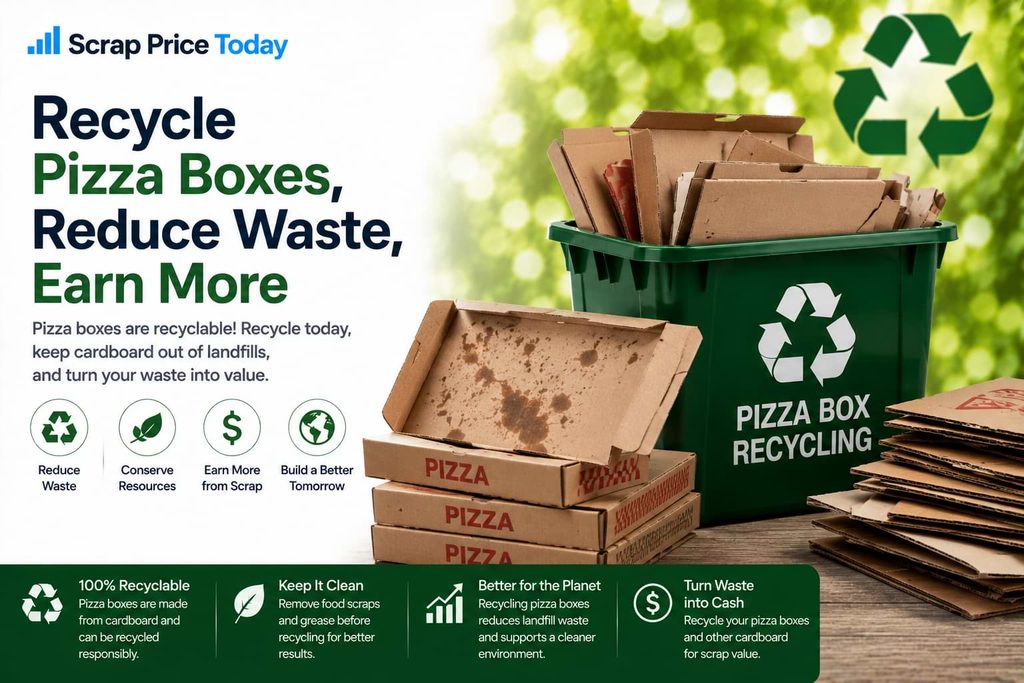
Yes, a greasy pizza box can be recycled, and the industry formally said so after testing the assumption that had governed the advice for decades. A corrugated packaging company measured the grease on boxes arriving at sorting facilities at about 1 to 2 percent by weight, and found that paper strength is not significantly affected until grease reaches nearly 20 percent. Cheese behaves differently again and is largely screened out during pulping. What must come out is actual food: crusts, slices, pepperoni and napkins.
The old rule was not foolish. It identified a real mechanism and applied it at the wrong concentration.
The old rule was right about chemistry and wrong about quantity
What grease actually does
Grease is hydrophobic. In high enough concentration it can interfere with the hydrogen bonding between fibres that gives recycled paper its strength, so a heavily oil-soaked board really would weaken the finished product.
That was the reasoning behind the folk rule, and it was sound reasoning. The question nobody had answered was: how much grease is actually on a pizza box?
When several single-stream sorting facilities pulled pizza boxes out of their incoming streams and measured them, the answer came back at roughly 1 to 2 percent by weight. The threshold at which strength and durability are meaningfully affected sits near 20 percent, about ten times what a typical box carries.
What cheese actually does
Cheese was assumed to be the same problem, and it is not.
Cheese is made of fats and proteins, and proteins are hydrophilic, so they do not hinder the fibre bonding that grease can. Small amounts have no negative effect, and larger chunks are screened out during pulping rather than travelling through the process.
The study’s conclusion was blunt: there is no significant technical reason to prohibit post-consumer pizza boxes from the recycling stream.
The numbers behind the reversal
- 3 billion pizza boxes are placed on the US market annually, equal to about 600,000 tons of corrugated board.
- That is 1.7 percent of the 35.9 million tons of corrugated containerboard produced in the country each year.
- If every one were recovered they would make up about 2.6 percent of the old corrugated container stream, or 2.2 percent of that stream combined with mixed paper.
- The measured effect on recovered fibre is minimal at typical grease levels of under 2 percent, and at pizza box inclusion of under 3 percent of the furnish.
- At the time of the study, 73 percent of the US population had access to a programme accepting pizza boxes: 27 percent with explicit acceptance and 46 percent implicitly.
- The paper industry association later put access at 82 percent of Americans.
Two pieces of context make the case stronger. Corrugated board has an annual recovery rate of around 96 percent, and more than 80 percent of US containerboard mills use recycled fibre from old corrugated containers. This is one of the most functional recycling streams that exists, which is precisely why keeping a legitimate input out of it was costly.
The same board can be recycled up to seven times before the fibre degrades.
What still has to come out
The revised guidance is not permission to bin the whole meal.
- Leftover pizza, crusts and slices. Food is food, and it belongs in general waste or a food caddy.
- Loose toppings, including that one pepperoni stuck to the lid.
- Napkins, paper plates and greaseproof liners. These are separate items, not part of the box.
- Plastic pizza savers, the little three-legged table in the middle.
- Standing liquid or pooled oil. Absorbed grease is fine; a pool of it is not.
The industry association’s own phrasing is worth repeating: boxes free from food are widely accepted by member mills that take corrugated. The word doing the work is food, not grease.
If the base of a box is genuinely saturated rather than stained, tearing off the clean lid and recycling that is a reasonable compromise, and the same principle our page on what actually gets recycled applies elsewhere: put in what the system can use, not what you hope it can.
Why your council may still say no
This is the part that confuses people, and it is administrative rather than technical.
- Guidance lags evidence. Changing a municipal rule means committee approval, public outreach and new signage for an item most households encounter once a week.
- A minority of facilities genuinely cannot. Most mills are equipped with the screening that removes food residue, but a small number are not, and a city contracting with one of those has a legitimate reason to refuse.
- Local rules override national guidance. A study cannot make your kerbside bin accept something your programme excludes.
So the instruction is unchanged even though the science moved: check your own programme, and if it still refuses, that is the rule that applies to you regardless of what the industry has concluded.
Where a programme has not updated, contacting the waste department and pointing at the published study is a reasonable thing to do. Several have changed on exactly that basis.
What to do tonight
- Take the food out. Every crust, every stray topping, and the plastic saver.
- Leave the grease. Stains and absorbed oil are not a problem at real-world levels.
- Check the base. If it is soaked through rather than marked, tear off the clean lid for recycling and bin the bottom.
- Flatten it. A flat box sorts correctly; a folded one full of air does not.
- Check your programme once, then stop thinking about it. The answer will not change week to week.
Where this fits
The wider question of which stream any item belongs to is on the recycling hub. Why shape and contamination decide outcomes elsewhere is covered in our pages on disposable cutlery and bagged recycling, and the relationship between markets and collection runs through what actually gets recycled.
How we produced this
The grease and cheese measurements, the strength threshold, the tonnage figures and the population access percentages come from a study conducted by a corrugated packaging manufacturer, published in full, and from the guidance the national paper industry association issued on the back of it. Both are industry sources with an interest in the conclusion, which we state plainly rather than obscure.
We have reported the study’s own numbers rather than its framing, including the detail that its findings rest on typical grease levels below 2 percent and pizza box inclusion below 3 percent of the fibre furnish. Those bounds matter: the conclusion is about ordinary boxes at ordinary volumes, not about oil-soaked cardboard in quantity.
The reasons municipal guidance lags are described from published commentary on programme change processes. Acceptance still differs by council and is the only rule that applies to your bin, whatever the science says.
Frequently asked questions
Can a greasy pizza box be recycled?
Yes. Testing found that boxes arriving at sorting facilities carry about 1 to 2 percent grease by weight, and paper strength is not significantly affected until grease reaches nearly 20 percent. The industry association issued guidance confirming it.
Why did people say grease ruined recycling?
Because the mechanism is real. Grease is hydrophobic and at high concentration can interfere with the hydrogen bonding between fibres that gives recycled paper its strength. The rule was sound reasoning applied at roughly ten times the concentration a real box carries.
What about the cheese stuck to the lid?
Not a problem. Cheese is fats and proteins, and proteins are hydrophilic so they do not hinder fibre bonding the way grease can. Small amounts have no effect and larger chunks are screened out during pulping.
What has to be removed before recycling?
Actual food. Crusts, slices, loose toppings, napkins, paper plates and the plastic pizza saver all come out. The industry wording is that boxes free from food are widely accepted, and the word doing the work is food rather than grease.
What if the bottom is soaked through?
Absorbed grease is fine; pooled oil and saturation are not. If the base is genuinely soaked rather than stained, tear off the clean lid, recycle that and bin the bottom.
Why does my council still refuse pizza boxes?
Usually administration rather than technology. Changing a rule requires committee approval, public outreach and new signage. A small number of facilities also lack the screening to remove food residue, which is a legitimate reason to refuse.
Can I do anything if my programme has not updated?
Yes. Contacting the waste department and pointing at the published study is reasonable, and several programmes have changed on that basis. Until they do, the local rule is the one that applies to your bin.
How many pizza boxes are we talking about?
About 3 billion a year in the United States, equal to roughly 600,000 tons of corrugated board. That is 1.7 percent of national containerboard production, and if all were recovered they would be about 2.6 percent of the old corrugated container stream.
Is cardboard recycling generally successful?
Unusually so. Corrugated board has an annual recovery rate of around 96 percent, more than 80 percent of US containerboard mills use recycled fibre from old corrugated containers, and the same fibre can go round up to seven times before it degrades.
Should I flatten the box?
Yes. A flat box sorts correctly on a moving line, while a folded box full of air behaves unpredictably and takes up collection space that nobody is paid for.