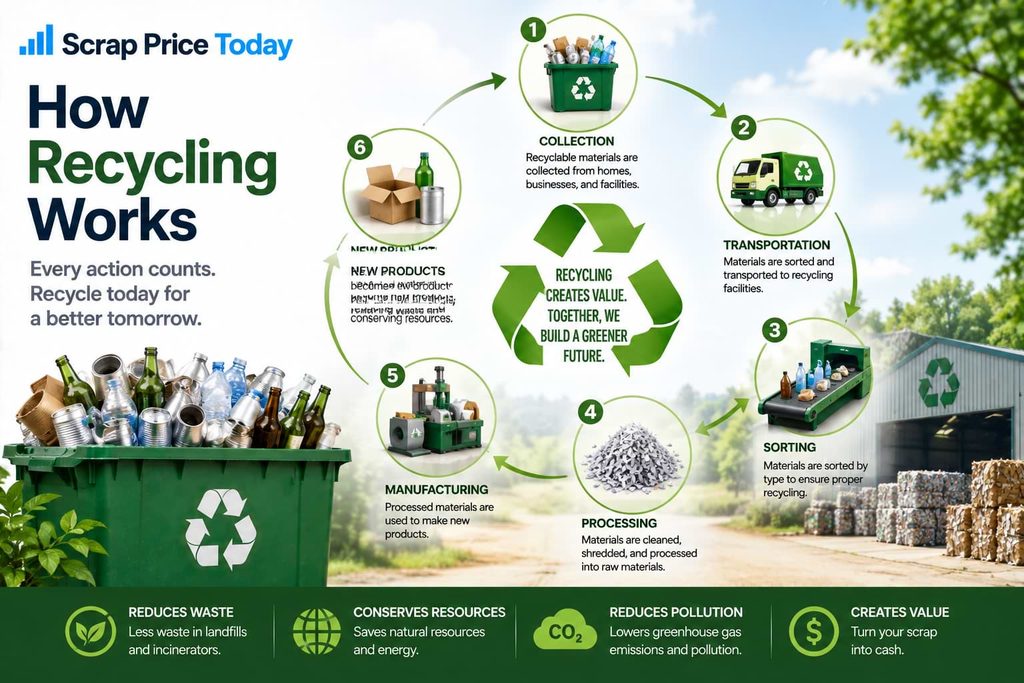
Recycling works in five stages: you sort at the bin, a truck collects and compacts, a sorting facility separates materials by size, magnetism, conductivity and infrared signature, the output is baled and sold as a commodity, and a manufacturer melts or pulps it into something new. Material leaks out at every one of those stages, which is why the American recycling and composting rate sits at about 32 percent while half of all household waste is still landfilled. Understanding where the leaks are tells you which of your habits actually matter.
Follow one bin through the system and the whole industry becomes legible.
The five stages, and what leaves at each
| Stage | What happens | What leaves the system here |
|---|---|---|
| Measurement | Each step of the journey and its main loss point | Same |
| Your bin | You decide what goes in | Recyclables binned as waste, and waste binned as recyclables |
| Collection | A truck compacts a mixed load | Glass breaks, batteries ignite, wet material spoils paper |
| Sorting facility | Machines separate by property | Items too small, too flat or too tangled for the machines |
| Baling and sale | Output is graded and priced | Bales rejected or discounted for contamination |
| End market | A mill or furnace remakes it | Anything with no buyer at any price |
Stage one: the bin
This is the only stage you control, and it sets a ceiling on everything downstream. Sorting facilities can remove contamination, but they cannot recover a material that was never put in.
Two mistakes matter more than all the rest: wet or food-soaked items, which spoil the paper around them, and wish-cycling, where hopeful guesses become the next stage’s problem.
Stage two: the truck
Collection is not neutral transport. Compaction is where a mixed load starts losing value.
- Glass breaks, embedding shards in paper and downgrading those bales, the whole reason many cities dropped kerbside glass, as our glass recycling guide documents.
- Lithium batteries crush and ignite. A National Academies review found sorting facilities average around 18 fires a year each, with catastrophic fires causing over $10 million in damage striking about 1 percent of facilities annually, pushing insurance costs up by an estimated $8 to $40 per ton recycled against processing costs of $100 to $200 a ton. That is the arithmetic behind every rule on our battery pillar.
- Liquids spread. One unemptied bottle wets the paper packed around it.
Stage three: the sorting facility
A modern facility is a sequence of machines, each exploiting one physical property, and knowing the order explains nearly every household rule.
- Manual pre-sort pulls the obvious hazards: bags, hoses, propane cylinders, textiles that would tangle.
- Screens size the material, dropping anything small through with the grit. This is why crushed cans, loose caps and shredded paper are lost, per our metal recycling guide.
- An overhead magnet lifts steel out of the stream.
- An eddy current separator induces a current in aluminium and physically throws it into its own chute.
- Optical sorters read the infrared signature of each plastic and fire jets of air to divert them by polymer, the machinery behind the resin codes.
- Manual quality control catches what the machines missed before baling.
The industry measures its own losses with a distinction worth borrowing: residue rate is not contamination rate. Residue is everything leaving as waste, and it has two parts, incoming contamination and processing residuals, which the industry itself defines as lost product, meaning glass, plastic, aluminium and paper that belonged in the system and slipped out anyway.
Facilities sorting genuinely clean material push residue toward 5 percent. Facilities that pull recyclables out of general rubbish recover only 5 to 45 percent, which is why separate collection exists at all.
Stage four: the bale
What leaves a sorting facility is a commodity, sold by grade at a price that moves daily, exactly like the metals priced on this site.
Buyers dock or reject bales for contamination, so the incentive runs backwards up the chain to your bin. Processing costs roughly $100 to $200 a ton, and commodity revenue has to cover as much of that as possible, which is why a low-value material with a high processing cost gets quietly dropped from collection lists.
Stage five: the end market
Nothing is recycled until somebody buys it and remakes it. This stage decides everything, and its successes and failures are equally instructive.
- Paper works. The recovered paper rate runs around 65 to 69 percent, supported by domestic mills, roughly 80 percent of which use some recycled fibre. Bales go into a pulper, get screened of ink and glue, and become new paper.
- Metals work. Aluminium and steel have furnaces waiting and prices attached, which is why they are the most reliably recovered materials in any bin.
- Glass works only when clean, which requires collection that keeps it whole.
- Most plastic struggles, because sorting cost plus low resin value rarely beats virgin production.
- Textiles mostly leave the country rather than the system, as our clothes donation page traces to the far end.
The rule that predicts the whole system
Across the fifty topics on this hub, one pattern holds almost without exception: the recycling rate of a material tracks the value of what comes out of it.
Lead-acid batteries recycle at 99 percent because lead pays. Aluminium cans are the most valuable thing in a household bin and are the most recovered container. Mattresses are 75 percent recyclable and need a legislated fee because teardown labour exceeds material value. Vapes have negative value and almost no collection at all.
Where the material cannot pay, someone must be made to, which is what producer responsibility laws now arriving for paint, batteries and textiles actually do. Our page on what actually gets recycled puts numbers against each material.
Nationally the picture is roughly this: about 292 million tons of household waste generated, 94 million recycled and composted for a 32 percent rate, 12 percent burned for energy, and 50 percent landfilled. Federal analysis concludes that infrastructure investment could lift recycling toward 61 percent, against a national goal of 50 percent by 2030.
What you actually control
- Empty and dry. Liquids and food ruin the paper travelling with them.
- Whole, not crushed or flattened, so the screens do not drop it.
- Loose, never bagged. Bagged recyclables are pulled at pre-sort and landfilled unopened.
- Nothing smaller than a few inches unless it is inside something bigger.
- Batteries and cylinders never, in any bin, for the fire arithmetic above.
- Check your local list once a year, because collection follows end markets and end markets move.
Questions people actually ask
Does my recycling actually get recycled? Most of what you put in correctly does, and rates differ hugely by material rather than by effort. Metals and paper are reliable, plastics much less so.
Is single stream a scam? No, it is a trade: more participation for more contamination. It genuinely raised volumes and genuinely damaged glass, which is why glass increasingly moves to separate collection.
Why does my council keep changing the rules? Because collection lists follow end markets. When a buyer disappears, the material comes off the list, however recyclable it remains in theory.
Does one wrong item ruin a whole load? Rarely a whole load, but one wrong item can downgrade a bale, and some items, batteries above all, can stop a facility entirely.
Common mistakes
- Bagging recyclables, the single most common way good material is landfilled unopened.
- Wish-cycling anything unfamiliar, which moves your uncertainty onto a sorter.
- Crushing containers flat in the belief it helps.
- Leaving liquid in bottles, which wets everything packed around them.
- Binning batteries and cylinders, the items behind facility fires and closures.
- Assuming rules are national. Collection is local because end markets are regional.
Where this fits
The machines that sort metal are detailed on can you recycle metal, why glass fails in mixed collection is on glass recycling, the fire risk driving facility costs is on the battery pillar, and the rate for each material is on what actually gets recycled.
Frequently asked questions
How does recycling work?
In five stages: you sort at the bin, a truck collects and compacts, a sorting facility separates materials by size, magnetism, conductivity and infrared signature, output is baled and sold as a commodity, and a mill or furnace remakes it. Material leaks out at every stage.
What happens at a recycling sorting facility?
A sequence of machines each exploiting one property: manual pre-sort for hazards, screens that size material, an overhead magnet for steel, an eddy current separator that throws aluminium, optical sorters reading plastic infrared signatures, and manual quality control before baling.
Why do small items get lost in recycling?
Screens size material early in the line and drop anything small through with the grit. That is why crushed cans, loose bottle caps and shredded paper are lost, and why the rule is to keep containers whole and pinch small metal inside larger metal.
Does my recycling actually get recycled?
Most correctly sorted material does, but rates vary enormously by material rather than by effort. Paper runs around 65 to 69 percent and metals are the most reliably recovered, while most plastics struggle because sorting cost plus low resin value rarely beats virgin production.
What is the US recycling rate?
About 32 percent for recycling and composting combined, from roughly 292 million tons of household waste, with around 12 percent burned for energy and 50 percent landfilled. Federal analysis concludes infrastructure investment could lift recycling toward 61 percent.
Why is bagging recyclables such a problem?
Bags are pulled at manual pre-sort because they tangle machinery, and they are landfilled unopened. Everything inside is lost regardless of how carefully it was sorted, which makes bagging the most common way good material never enters the system.
How much damage do batteries do to recycling facilities?
A National Academies review found sorting facilities average around 18 fires a year each, with catastrophic fires above $10 million in damage hitting about 1 percent of facilities annually. Insurance costs rose an estimated $8 to $40 per ton against processing costs of $100 to $200 a ton.
What is the difference between contamination and residue?
The industry distinguishes them carefully. Residue is everything leaving as waste, made of incoming contamination plus processing residuals, which it calls lost product: glass, plastic, aluminium and paper that belonged in the system but slipped out during sorting.
Why do recycling rules keep changing?
Because collection lists follow end markets. When a buyer for a material disappears or its price falls below processing cost, it comes off the list regardless of how recyclable it remains in theory, which is also why rules are local rather than national.
What single rule predicts whether something gets recycled?
Value. The recycling rate of a material tracks what comes out of it: lead-acid batteries hit 99 percent because lead pays, aluminium cans are the most valuable thing in a bin, and mattresses need a legislated fee because teardown labour exceeds material value.