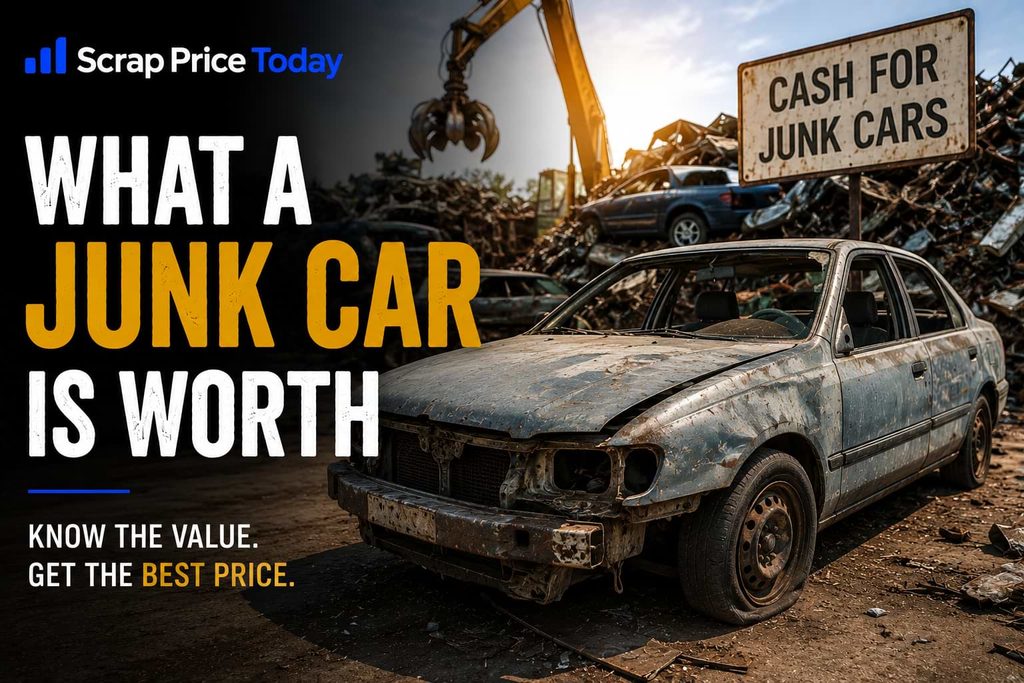
A midsize sedan weighing about 3,400 pounds is worth roughly $612 as shredder feed at our current car body price of $360 a short ton. Pull the converter, battery, alloy wheels, radiator and harness first and the same car is worth closer to $900 before the shell is even weighed. Most quotes people accept are for the first number while the buyer keeps the second.
Scrap Price Today market analysis, written from exchange settlement data, mill and refiner pricing practice and published policy documents. Figures are examples; today’s numbers are on the live scrap price board.
This page gives you the arithmetic rather than a form to fill in. We do not buy cars, we do not take referral fees, and nothing below is a bid.
What the shell alone is worth
Complete car bodies are bought by weight as shredder feed. Our board has them at $360 a short ton today, which is above the plain heavy melting steel price because a car contains recoverable non-ferrous metal the shredder will separate.
| Small hatchback | Midsize sedan | Crossover SUV | Full-size pickup | |
|---|---|---|---|---|
| Measurement | Kerb weight and value as shredder feed | Same | Same | Same |
| Typical kerb weight | About 2,700 lb | About 3,400 lb | About 4,100 lb | About 5,200 lb |
| Weight in short tons | 1.35 | 1.70 | 2.05 | 2.60 |
| Value at $360 a ton | About $486 | About $612 | About $738 | About $936 |
Those are reference figures, not offers. A yard subtracts collection if it tows the vehicle, and pays less for a car missing its drivetrain or already stripped of non-ferrous parts.
What the parts add
Here is where the money actually sits, priced from today’s board.
- Catalytic converter: a mid-range original unit holding three grams of platinum, 1.5 grams of palladium and 0.3 grams of rhodium contains about $337 of metal at current prices. You will be offered a fraction of that, but it is still the most valuable single component on most vehicles.
- Wiring harness: around 35 pounds of insulated wire at $2.81 is roughly $98.
- Starter and alternator: about 25 pounds of motors, worth around $70 at motor and wire grades.
- Radiator: a copper and brass unit at about 15 pounds is roughly $50; aluminium and copper units from newer cars less.
- Four alloy wheels: about 80 pounds of aluminium at $0.84 is roughly $67, and often more if sold as clean wheels rather than mixed.
- Lead-acid battery: about 40 pounds at $0.23 is roughly $9, which is small but takes thirty seconds.
Add the non-converter parts and you have about $295 on a sedan, on top of the $612 shell. The converter sits on top of that again.
Why the gap between the two numbers is so wide
A buyer paying a single price for a complete car is paying shredder value and keeping everything else. That is a legitimate business model, and for someone who cannot lift a wheel it is a reasonable trade.
But it means the difference between a good outcome and a poor one is decided before you make the call, not during the negotiation. A stripped sedan delivered on a trailer and a complete sedan collected from a driveway are two different transactions at two different prices, and only one of them keeps the converter money with you.
What moves your quote up or down
- Complete versus stripped: yards pay a premium for complete cars precisely because of the parts. Removing them yourself is worth more than the premium, provided you can sell them separately.
- Delivered versus collected: towing typically costs a yard $75 to $150 and comes out of your price.
- Ferrous market timing: our board shows car bodies up 11.7 percent over twelve months, tracking the ferrous scrap index rather than finished steel, as our steel analysis sets out.
- Local competition: a metro with several licensed dismantlers pays more than a town with one, a spread our local prices analysis quantifies at over 20 percent across markets.
- Paperwork in order: a clean title in your name shortens the transaction and removes the risk discount some buyers apply.
The parts most people leave behind
The converter is the obvious one, and legislation now controls how it can be sold, which our converter laws article covers. Beyond it, the commonly forgotten items are the harness behind the dashboard, the heater matrix, the aluminium intake manifold, the wheel weights and the small motors in the seats and windows.
None of them is worth an hour each. Together on a sedan they are worth more than a day’s wages in many markets.
What not to do
Do not remove a converter from a vehicle that is still road registered and going back into use. Do not drain fluids onto the ground; yards and licensed dismantlers have interceptors for exactly this reason. Do not hand over a vehicle without completing the transfer or deregistration paperwork, because liability follows the registration in most jurisdictions until you do.
And do not accept a phone quote that does not say whether it includes collection.
Key numbers
- Car bodies are $360 a short ton on our board today, up 11.7 percent over twelve months (Scrap Price Today series).
- A 3,400 lb sedan is about $612 as shredder feed at that price.
- Recoverable parts on the same sedan, excluding the converter, are worth roughly $295 at current grade prices.
- A mid-range converter contains about $337 of platinum group metal at $1,895.60 platinum, $1,422.50 palladium and $8,850 rhodium.
- Insulated wire is $2.81 a pound, aluminium $0.84, copper and brass radiators $3.34, lead-acid batteries $0.23.
- Towing typically costs a yard $75 to $150, which is reflected in a collected price.
What this metal pays around the world
Scrap is a global market priced in US dollars, but what reaches a seller depends on trade position, freight to the nearest consumer and how many buyers compete locally. The table below converts the same grade into each market’s own currency and units at the day’s exchange rate, and shows the factor we apply.
| Market | Local price | USD per ton | Market factor |
|---|---|---|---|
| Turkey | ₺20,488 / tonne | $374 | 1.04 |
| Germany | €360 / tonne | $367 | 1.02 |
| United States | $360 / ton | $360 | 1.00 |
| China | CN¥2,601 / tonne | $353 | 0.98 |
| Canada | C$491 / ton | $349 | 0.97 |
| United Kingdom | £284 / tonne | $346 | 0.96 |
| Australia | A$537 / tonne | $342 | 0.95 |
| United Arab Emirates | AED1,384 / tonne | $342 | 0.95 |
| Saudi Arabia | SAR1,384 / tonne | $335 | 0.93 |
| India | ₹34,535 / tonne | $331 | 0.92 |
| Bangladesh | ৳43,200 / tonne | $317 | 0.88 |
| South Africa | R5,523 / tonne | $306 | 0.85 |
How we produced these figures
The shell values are our current car body board price multiplied by published typical kerb weights for each vehicle class. The parts values are our current grade prices multiplied by common component weights; both weights and grade mixes vary between models, so treat the totals as a structure for your own calculation rather than a quote.
The converter figure is contained metal value, not what a buyer pays. Buyers settle on assayed content less refining and recovery charges, a chain we set out in how converter recycling works.
All grade prices come from our own daily series, documented on the editorial policy page, with current levels on the live board and a weight calculator at scrap value calculator. We publish these numbers precisely so you can check any offer against them; we have no commercial relationship with any buyer.