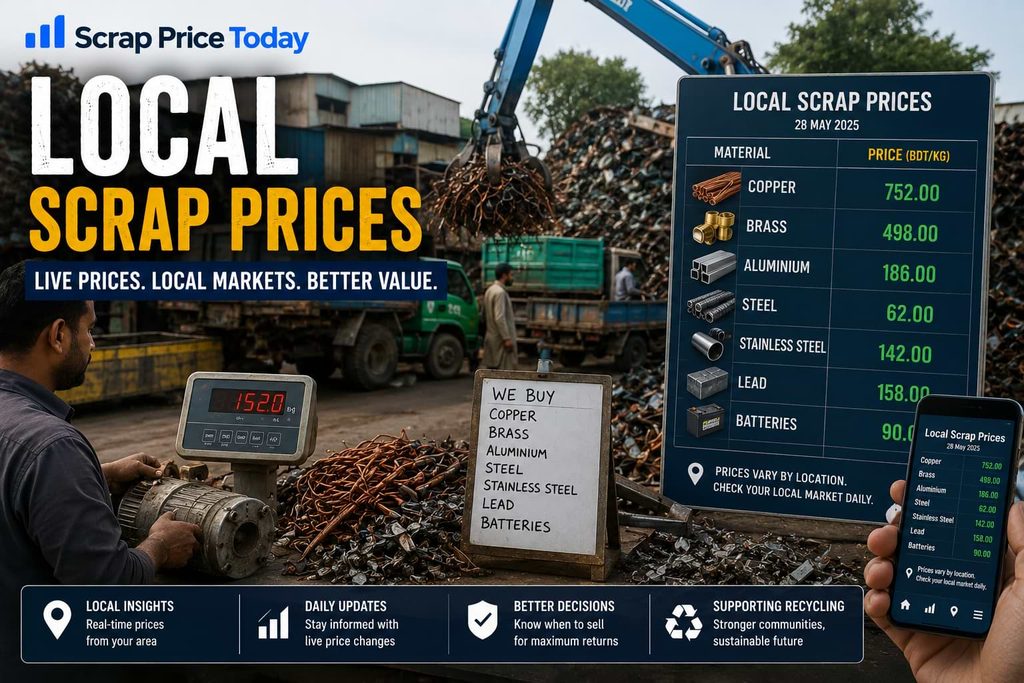
The same copper, on the same day, is worth about 22 percent more in Turkey than in South Africa once local market conditions are applied. Nothing about the metal differs. The gap is trade policy, distance to a consumer and local competition, and it is the reason a national price is only ever a starting point for what a yard near you will pay.
Scrap Price Today market analysis, written from exchange settlement data, mill and refiner pricing practice and published policy documents. Figures are examples; today’s numbers are on the live scrap price board.
We publish boards for 20 countries and detailed pages for 30 cities. This explains what actually drives the differences between them, and how to use the pages.
Why the same metal fetches different money
Four forces set the gap between a world benchmark and a local board, and they operate in a predictable order.
- Trade position. Importing markets pay above world parity because local mills and refiners compete with imports. Markets with export restrictions pay below it, because scrap cannot chase the international bid.
- Freight to the consumer. Scrap is heavy and low in value per truck, so distance to the nearest mill, smelter or export dock comes straight out of the seller’s price.
- Competition. A city with six yards pays more than a town with one, because margin is competed away rather than protected.
- Currency. Benchmarks are set in US dollars, so a weakening local currency lifts the local board even when the metal has not moved.
What that looks like across our markets today
| Turkey | United States | United Kingdom | India | Bangladesh | South Africa | |
|---|---|---|---|---|---|---|
| Measurement | Local copper board expressed in USD per lb | Same | Same | Same | Same | Same |
| Effective level | About $6.05 | $5.82 | About $5.59 | About $5.35 | About $5.12 | About $4.95 |
| Local quote | 643 TRY per kg | $5.82 per lb | 9.06 GBP per kg | 1,128 INR per kg | 1,391 BDT per kg | 174 ZAR per kg |
| Position versus world | Above parity | At parity | Slightly below | Below | Further below | Furthest below |
| Main reason | Large importer, mills compete for material | Deep domestic market | Export-facing, freight to consumers | Import demand offset by informal supply chain | Import-dependent mills, thin margins | Export restrictions and a price preference system |
The extremes tell the story. Turkey is the world’s largest importer of ferrous scrap and a strong buyer of non-ferrous, so its board sits above world parity. South Africa requires scrap to be offered to domestic consumers below export parity before it can be exported, which holds prices down by design.
Why two yards in one city differ
Within a market, the spread between yards is often wider than sellers expect, and it comes from the same logic at a smaller scale.
One yard sells copper to an exporter loading containers this month; another sells to a domestic refiner on a formula price. One is ten miles from a mill and one is three hundred. One has a shredder and wants light iron; one has none and pays little for it.
That is why the standing advice on every page here is the same: describe your grades and weights to two or three buyers before you load. In cities with a dense yard belt, such as Birmingham or Sharjah, the second call routinely changes the number.
The city pages, by region
Each page carries the local board in local currency and units, the areas where yards cluster, what pays well locally, the identification and payment rules that apply, and the questions people in that market actually ask.
- United States: Houston, Chicago, Los Angeles, New York, Dallas, Miami.
- United Kingdom: London, Birmingham, Manchester, Glasgow.
- Middle East: Dubai, Sharjah, Abu Dhabi, Riyadh, Jeddah.
- Africa: Johannesburg, Cape Town, Durban.
- South Asia: Delhi, Mumbai, Kolkata, Chennai, Dhaka, Chittagong.
- Canada and Australia: Toronto, Vancouver, Montreal, Sydney, Melbourne, Brisbane.
The full set of national boards is on the scrap prices hub.
What these pages are not
They are not a yard directory and they do not rank buyers. We do not take payment to list, feature or recommend any yard, dealer or recycler, and no company has influenced a price on this site.
That matters because most local scrap content online is lead generation with a price attached. Ours is a reference you can check against whatever a buyer tells you, which is only useful if it is independent. The full position is set out in our editorial policy.
Key numbers
- The spread between our strongest and weakest market for copper is about 22 percent on the same day, from roughly $6.05 to $4.95 a pound equivalent (Scrap Price Today country boards).
- We publish boards for 20 countries and detailed pages for 30 cities.
- Turkey imports roughly 20 million tonnes of ferrous scrap a year, more than any other country, which is why its board sits above parity (Bureau of International Recycling).
- Recycled metal supplies roughly a third of world copper demand and close to 30 percent of world steel output (World Steel Association and industry data).
What this metal pays around the world
Scrap is a global market priced in US dollars, but what reaches a seller depends on trade position, freight to the nearest consumer and how many buyers compete locally. The table below converts the same grade into each market’s own currency and units at the day’s exchange rate, and shows the factor we apply.
| Market | Local price | USD per lb | Market factor |
|---|---|---|---|
| Turkey | ₺633.98 / kg | $5.79 | 1.04 |
| Germany | €11.15 / kg | $5.68 | 1.02 |
| United States | $5.57 / lb | $5.57 | 1.00 |
| China | CN¥80.50 / kg | $5.46 | 0.98 |
| Canada | C$7.59 / lb | $5.40 | 0.97 |
| United Kingdom | £8.80 / kg | $5.35 | 0.96 |
| Australia | A$16.60 / kg | $5.29 | 0.95 |
| United Arab Emirates | AED42.84 / kg | $5.29 | 0.95 |
| Saudi Arabia | SAR42.83 / kg | $5.18 | 0.93 |
| India | ₹1,069 / kg | $5.12 | 0.92 |
| Bangladesh | ৳1,337 / kg | $4.90 | 0.88 |
| South Africa | R170.92 / kg | $4.73 | 0.85 |
How we produced this
Each country board takes our USD reference price, applies a local market factor reflecting trade position, freight and competition, and converts at the day’s exchange rate. The factor and the rate are printed on every country page, so the arithmetic is visible rather than hidden.
The factors are our own assessment, reviewed against published dealer information and reader corrections. They are the most judgement-based element on this site, which is why we publish them openly and invite challenge. If a yard in your market is consistently paying away from our level, tell us at info@scrappricetoday.com and we will look at the factor rather than defend it.
Today’s global figures are on the live board, and the calculator converts a weight into an expected figure in your own currency.