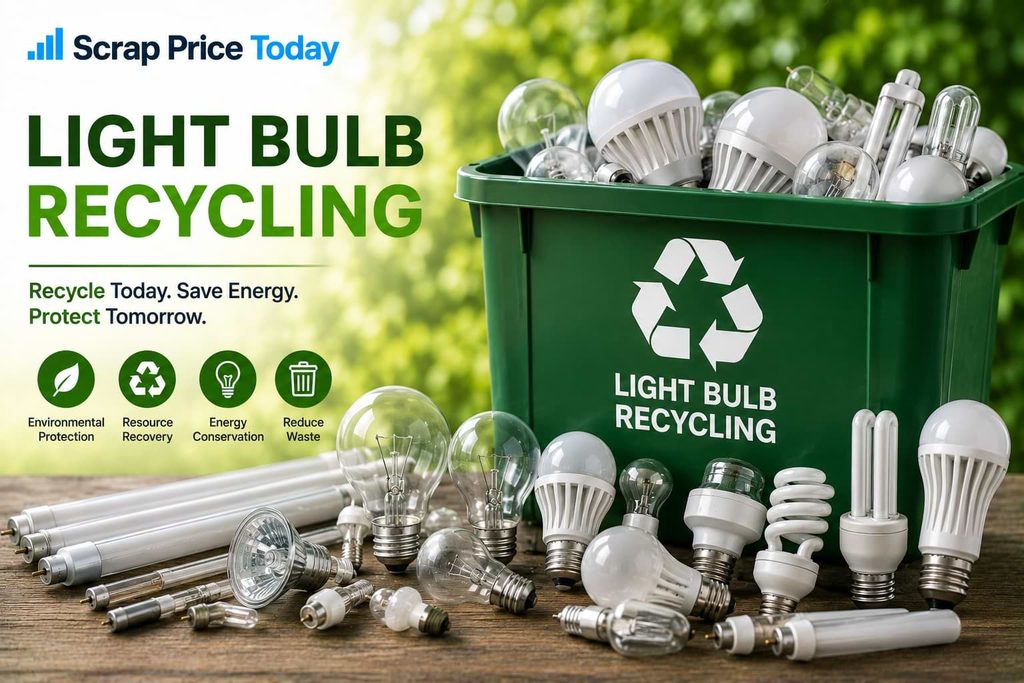
Light bulb disposal splits four ways. Incandescent and halogen bulbs go in ordinary trash, wrapped, because nothing in them is worth recovering. CFLs and fluorescent tubes contain mercury and go to drop-off: large hardware retailers take CFLs free, and tubes go to hazardous waste sites or mail-back kits. LEDs contain no mercury but carry a circuit board, so electronics collection beats the bin. And ten states have now banned fluorescent sales outright, which makes this a sunset problem: years of attic tubes leaving homes as the technology dies.
The mercury deserves respect without panic, and the numbers below show exactly where both reactions go wrong.
Identify the four bulbs
| Incandescent and halogen | CFL | Fluorescent tube | LED | |
|---|---|---|---|---|
| Measurement | What each contains and where it goes | Same | Same | Same |
| Contains | Tungsten wire, glass | About 5 mg mercury, phosphor, electronics | Mercury, phosphor powder, sometimes more per lamp | Circuit board, driver, no mercury |
| Kerbside recycling | Never, the glass melts wrong | Never | Never | Never |
| Trash | Yes, wrapped | No, and illegal in several states | No, and illegal for every business | Legal most places, wasteful |
| Right door | Bin | Retail take-back, free | Hazardous waste site or mail-back | Electronics collection |
| Breakage response | Sweep it up | The protocol below | The protocol, more so | Sweep it up |
The kerbside no is universal for a simple reason: bulb glass has different chemistry from bottle glass and ruins the melt, and everything else in a bulb is either worthless or regulated.
How much mercury is actually in one
An average CFL holds about 5 milligrams of mercury, a droplet that would barely cover a ballpoint pen tip. An old fever thermometer held about 100 times that. A four-foot tube sits in the same low-milligram range, higher in older lamps.
Small, then, but volatile: mercury in a lamp is vapour-ready, and vapour is the exposure route that matters. Which is why the interesting question is not the amount but the night one breaks.
The night one breaks
A state environmental agency broke lamps in a test room across forty-five trials and measured the air. Its findings built the national cleanup protocol, and they cut both ways.
The alarming half: air concentrations frequently exceeded the ambient guideline of 300 nanograms per cubic metre, with spikes over 25,000, sometimes over 50,000, and in a worst case possibly over 100,000. Vacuuming spread the vapour and could make levels rebound for days afterwards, especially from carpet.
The calming half: the occupational short-exposure limit is 100,000 nanograms, and in 34 of 35 breakage scenarios even the spikes never approached it, while the 300 figure is calibrated for lifetime continuous exposure, not a one-hour event. Brief venting collapsed concentrations quickly in almost every trial.
So the honest reading is: follow the protocol, skip the panic. The protocol, from the federal guidance:
- People and pets out. Air the room 5 to 10 minutes, window or door open.
- Central heating and cooling off, so the vapour is not distributed.
- Scoop with stiff paper or cardboard, never hands, never a broom.
- Dab up fragments and powder with duct tape.
- Everything into a glass jar with a metal lid or a sealed bag, tape included.
- Do not vacuum, unless glass remains after every other step, and then vent again.
- The sealed jar goes out of the house and travels with your next hazardous waste run.
Where each bulb goes
- CFLs: the large hardware chains run free take-back bins at the entrance, the same shelf of stores hosting the battery boxes. Intact bulbs only.
- Tubes: retail usually refuses length; household hazardous waste sites, collection events and prepaid mail-back boxes are the routes.
- Any business is barred federally from binning mercury lamps: tubes from a shop, office or school are regulated universal waste with paperwork, exactly like the vape thresholds on our vape page.
- Broken mercury lamps never enter a take-back bin; jarred, they go to hazardous waste.
- LEDs carry a board and driver, so electronics drop-off recovers something where the bin recovers nothing.
- Incandescents and halogens: wrap and bin, and the halogen goes cold first.
The sunset laws
The deeper story is that the mercury bulb is being legislated out of existence.
Ten states have enacted broad bans on selling fluorescent lamps, screw-base, pin-base and linear alike: California and Vermont moved first, followed by Colorado, Hawaii, Maine, Oregon and Rhode Island, then Washington, Minnesota and Illinois. Most phase-outs landed over the last two years, the stragglers finish shortly, and the final major deadline is Washington’s full linear ban at the end of the decade.
As of this year, some fifteen states plus the capital restrict fluorescent sales in some form. New York’s version has passed its Senate twice and waits in committee, while another state’s broad bill died this summer, the same law-by-argument map the paint programmes grow across.
Two practical consequences follow. Replacement fluorescents are drying up even in states without bans, since manufacturers are exiting the technology wholesale. And every fixture retrofit shakes loose a box of old tubes, which is precisely the decade-long exit this page routes safely.
What the recycler recovers makes the trip worthwhile: distillation pulls the mercury back out for reuse, the glass becomes aggregate, the aluminium ends join the metal stream, and the phosphor powder has at times been mined for its rare earth content.
Questions people actually ask
Can I put light bulbs in the glass recycling? No bulb of any kind, ever. Bulb glass ruins the container-glass melt, and the mercury types contaminate far more than that.
Are LEDs really worth a special trip? As a single bulb, add it to your next electronics run rather than driving for it. The board and driver make it e-waste in miniature.
I broke a CFL on carpet years ago and vacuumed. Should I worry? The measured concern is elevated vapour in the days after, not permanent contamination. Ventilation then was the fix; retrospective worry earns nothing now.
Do smart bulbs count as electronics? Entirely: radio, board and driver in a bulb jacket. Electronics collection, and wipe any hub pairing first.
Common mistakes
- Vacuuming the breakage, the single error the entire study warns about.
- Tossing tubes in a dumpster at a business, which is a federal violation, not a shortcut.
- Dropping broken CFLs in the retail bin meant for intact bulbs.
- Hoarding dead tubes in the rafters through the exact years their disposal routes are busiest.
- Binning LEDs by habit as if they were incandescents.
- Buying boxed fluorescent spares for fixtures about to lose their supply entirely.
Where this fits
The retail shelf hosting bulb take-back is the same one covered on the battery pillar, the universal waste logic for businesses runs through the vape page, and the producer-funded model these programmes echo is on paint recycling. The wider stream question sits on the recycling hub.
Frequently asked questions
How do I dispose of light bulbs?
By type. Incandescent and halogen bulbs go wrapped into ordinary trash. CFLs go free to retail take-back bins at large hardware stores. Fluorescent tubes go to hazardous waste sites or mail-back kits. LEDs have no mercury but carry a circuit board, so electronics collection beats the bin.
Can any light bulb go in glass recycling?
No bulb of any kind. Bulb glass has different chemistry from bottle glass and ruins the container melt, and mercury lamps contaminate the entire stream on top of that.
How much mercury is in a CFL?
About 5 milligrams on average, a droplet that would barely cover a ballpoint pen tip, against roughly 100 times that in an old fever thermometer. The amount is small; the vapour form is why breakage has its own protocol.
What do I do if a CFL or tube breaks?
People and pets out, air the room five to ten minutes, central heating or cooling off. Scoop with stiff card, dab fragments with duct tape, seal everything in a glass jar or bag, and do not vacuum. The sealed jar travels with your next hazardous waste run.
Why is vacuuming a broken bulb so bad?
The state study behind the national guidance found vacuuming spreads the vapour and can make air concentrations rebound for days, especially from carpet, while contaminating the vacuum itself. Card, tape and ventilation do the job safely.
How dangerous is one broken bulb really?
The measured spikes frequently passed the ambient lifetime guideline yet in 34 of 35 scenarios never approached the occupational short-exposure limit, and brief venting collapsed levels quickly. Follow the protocol, skip the panic.
Can businesses throw fluorescent tubes away?
No, anywhere in the country. Mercury lamps from any business are federally regulated universal waste requiring proper consolidation and licensed handling, however casually the same tube might once have been treated at home.
Which states have banned fluorescent bulbs?
Ten have broad sales bans: California, Vermont, Colorado, Hawaii, Maine, Oregon, Rhode Island, Washington, Minnesota and Illinois, with most phase-outs already in effect and the last major deadline at the end of the decade. Around fifteen states plus DC restrict them in some form.
What happens to recycled fluorescent lamps?
Distillation recovers the mercury itself for reuse, the glass becomes aggregate, the metal ends join the aluminium stream, and the phosphor powder has at times been processed for rare earth elements. The trip recovers everything the trash would bury.
Are LEDs recyclable?
They are electronics in a bulb jacket: circuit board, driver, and in smart bulbs a radio too. Trash is legal in most places and wasteful everywhere; add dead LEDs to your next electronics drop-off run.