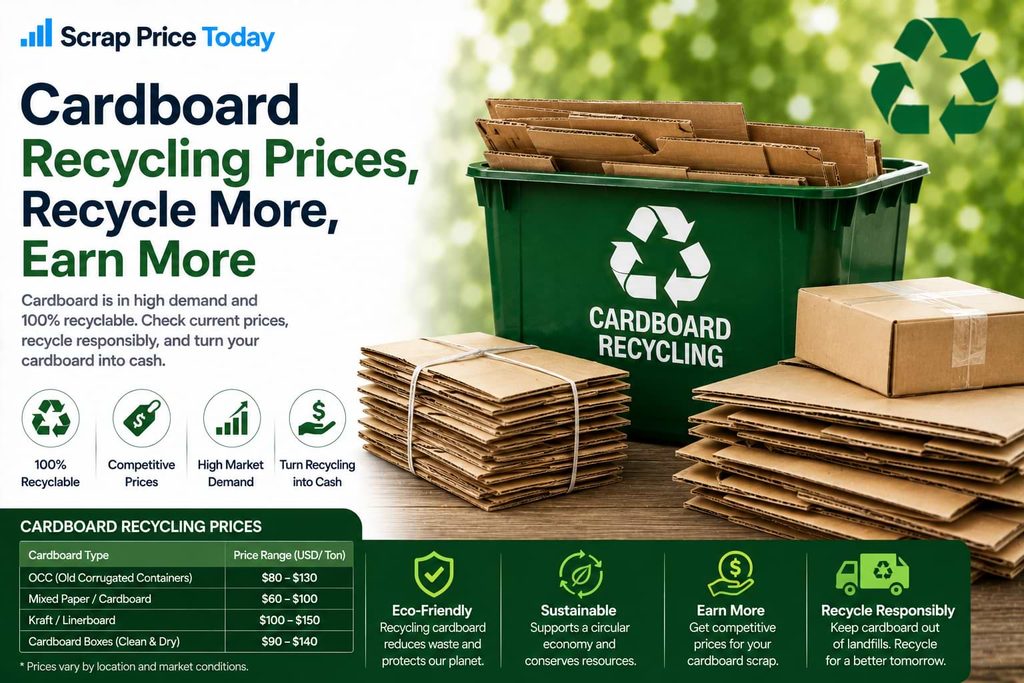
Recovered cardboard currently trades at roughly $56 to $100 a ton in the United States depending on which index you read, up from a low near $44 in December, and still well below the five-year average around $140. That translates to about 3 to 5 cents a pound, which is why a household’s flattened boxes are worth under a dollar while a business producing bales has a real commodity. The price has risen every month this year.
Cardboard is the one paper grade with a genuine, quoted, fought-over market price, and this page treats it the way we treat metal: numbers first, then what they mean at your scale.
The price right now
| National average | Spot index | Export, east coast | Mixed paper | |
|---|---|---|---|---|
| Measurement | Latest published price and its basis | Same | Same | Same |
| Price | $56 a ton in April, rising monthly since | About $100 a ton in July | $132 to $135 a short ton for grade 11 | $28 a ton, the lowest benchmark grade |
| Published by | A market survey of buyers and sellers | A pulp intelligence firm | Port pricing, freight alongside ship | The same market survey |
| Recent move | Up 8 percent in March, 3.7 in April, then $10 in the southeast in June | Roughly $80 at the start of the year to $100 | Steady through August | Up $5 in June |
| Direction | Rising | Rising faster | Firm | Rising slowly |
Two published national numbers, $56 and $100, in the same market. That is not an error, and the gap is the most instructive thing on this page.
Why two published prices disagree
Recovered paper indexes measure different points in the same chain. One firm surveys what mills pay for material delivered to them across regions and averages it. Another tracks spot transactions with its own methodology and panel.
Delivery terms, freight, regional weighting and timing all sit inside those definitions, and a $30 to $40 spread between two honest indexes is normal in this market.
The practical rule is the one we apply to every metal on this site: never compare a price you are quoted against an index without knowing the basis of both. A yard or broker buys at their dock, an index may describe delivered mill, and the freight between those two points belongs to somebody.
What a ton means in pounds
- A ton at the survey average of $56 is 2.8 cents a pound. At the spot index’s $100 it is 5 cents.
- A flattened large delivery box weighs about a pound. A household month of boxes, perhaps 20 pounds, is worth 56 cents to a dollar at index, before anyone handles it.
- A commercial bale of 1,000 to 1,100 pounds carries $28 to $55 at those prices.
- A shop filling a bale a week is holding $1,500 to $2,900 a year at current prices, and double that if the five-year average returns.
The same arithmetic that made cables a collective rather than individual prize applies here, and the conclusion matches: kerbside is the correct household route, and the money begins where a baler does.
Three decades of swings
One west coast city has published its commercial cardboard price history for over thirty years, and the range is startling: annual averages from around $20 a ton in the weakest year to above $160 in the strongest, with $50 to $120 covering most years in between.
Cardboard behaves like the commodity it is. Demand from box mills, export appetite and freight set the price, and household generation barely responds to any of them, which is why the swings are so wide.
The present sits in the lower half of that range. As one analyst put it when the spot index reached $100, this is a recovery story, not a price spike story, since $100 is only about 71 percent of the five-year norm.
What is moving it now
- Box demand never fully recovered. The industry describes a box recession running from a sharp decline four years ago, with each year since expected to be the turnaround and none quite delivering.
- Mills are paying up anyway, because supply is tight: generation follows e-commerce and consumption, and both have been flat.
- The rise is feeding through. One large recycled paperboard producer announced a $70 a ton increase across its finished board grades, citing recovered fibre costs directly.
- Exports are pulling. Total recovered paper exports rose 2.3 percent in the first quarter, with cardboard specifically up 6.1 percent, heading to India, Indonesia, Malaysia, South Korea, Taiwan, Thailand and Vietnam.
- Seasonality still applies. Generation surges after the holidays and prices sag with it, which is why December marked the recent low, the same pattern our seasonality analysis documents for metal.
Selling it, by scale
A household cannot realistically sell cardboard. Buyback sites that pay the public for it are rare, the per-pound value is cents, and kerbside collection is the route that works. Flatten boxes, keep them dry, and remove plastic strapping; tape can stay.
A small business crosses the line at a baler. Loose cardboard in a compactor is a disposal cost, while baled cardboard is a product a collector will pay for or at least haul free. The bale weights above do that arithmetic.
Volume generators deal on index-linked contracts, typically the survey price plus or minus a negotiated spread, which is exactly how scrap yard accounts work on the metal side.
Wet cardboard fails at every scale. Water adds weight a mill will not pay for and fibre damage it will not accept, so storage is the unglamorous half of the value.
The US range in other currencies
Cardboard prices are set market by market, but the US benchmark is the reference point most international traders watch. The table converts the reported range at today’s exchange rate into each market’s customary money and unit.
| Market | Currency | Unit | Equivalent range |
|---|---|---|---|
| United States | USD | per short ton | $56.00 to 100.00 |
| United Kingdom | GBP | per tonne | £46.09 to 82.31 |
| Canada | CAD | per short ton | C$78.67 to 140.48 |
| Australia | AUD | per tonne | A$87.85 to 156.88 |
| Germany | EUR | per tonne | €54.96 to 98.14 |
| India | INR | per tonne | ₹5,839 to 10,427 |
| Bangladesh | BDT | per tonne | ৳7,636 to 13,636 |
| United Arab Emirates | AED | per tonne | AED226.70 to 404.82 |
| Saudi Arabia | SAR | per tonne | SAR231.49 to 413.37 |
| Turkey | TRY | per tonne | ₺3,064 to 5,472 |
| South Africa | ZAR | per tonne | R1,011 to 1,805 |
| China | CNY | per tonne | CN¥412.93 to 737.37 |
Where this fits
Why cardboard recycles so well in the first place, with a recovery rate near 96 percent, is covered in can you recycle pizza boxes. The collective-versus-individual value structure appears again in how to recycle cables and chargers, and the wider stream question sits on the recycling hub.
How we produced this
Prices are drawn from trade press reporting of two commercial price services and a pulp intelligence firm, each attributed by description, with publication months stated relative to the present. The two headline figures measure different bases, which is why both appear rather than an average of them; averaging two different definitions would produce a number matching neither.
The historical range comes from a municipal market report publishing annual commercial averages across three decades. The export figures are census trade data as reported by one of the price services.
Cardboard is not on our live board, which covers exchange-traded metals and published government series. No free, licensed, daily cardboard series exists, and reproducing subscription index values daily would breach their terms. We quote reported levels with attribution instead, and this page is refreshed as reporting moves.
Frequently asked questions
What is the current price of recycled cardboard?
Roughly $56 to $100 a ton in the United States depending on the index, up from a low near $44 in December and rising every month this year. That equals about 3 to 5 cents a pound, against a five-year average around $140 a ton.
Why do published cardboard prices disagree?
Because indexes measure different points in the chain. One surveys what mills pay delivered, another tracks spot transactions with its own panel, and delivery terms, freight and regional weighting sit inside those definitions. A $30 to $40 spread between honest indexes is normal.
How much is my household cardboard worth?
Almost nothing as cash. A flattened large box weighs about a pound, so a month of boxes is worth well under a dollar at index prices, and buyback sites paying the public for cardboard are rare. Kerbside collection is the route that works at household scale.
When does cardboard start being worth money?
At a baler. A commercial bale of 1,000 to 1,100 pounds carries $28 to $55 at current prices, and a shop filling one a week holds $1,500 to $2,900 a year. Loose cardboard is a disposal cost; baled cardboard is a product.
How volatile is the cardboard market?
Very. One city's published thirty-year history shows annual averages from about $20 a ton in the weakest year to above $160 in the strongest. Demand from box mills, exports and freight set the price, and household generation barely responds to any of them.
What is driving prices up this year?
Tight supply against steady mill demand, with exports up 6.1 percent for cardboard in the first quarter to Asian destinations. One large paperboard producer raised its finished board prices by $70 a ton citing recovered fibre costs directly.
Is $100 a ton a high price for cardboard?
No, and that is the honest context. It is only about 71 percent of the five-year average near $140, which is why one analyst called this a recovery story rather than a price spike story.
Does wet cardboard sell?
No, at any scale. Water adds weight a mill will not pay for and fibre damage it will not accept, so wet loads are rejected or heavily discounted. Dry storage is the unglamorous half of the value.
Do I need to remove tape from boxes?
No. Tape and labels are screened out as stickies at the mill. Remove plastic strapping and any foam or film inside, flatten the box, and keep it dry.
Why is cardboard not on your live price board?
Because no free, licensed daily series exists. Our board covers exchange-traded metals and published government data, and reproducing subscription index values daily would breach their terms, so we quote reported levels with attribution and refresh the page as reporting moves.