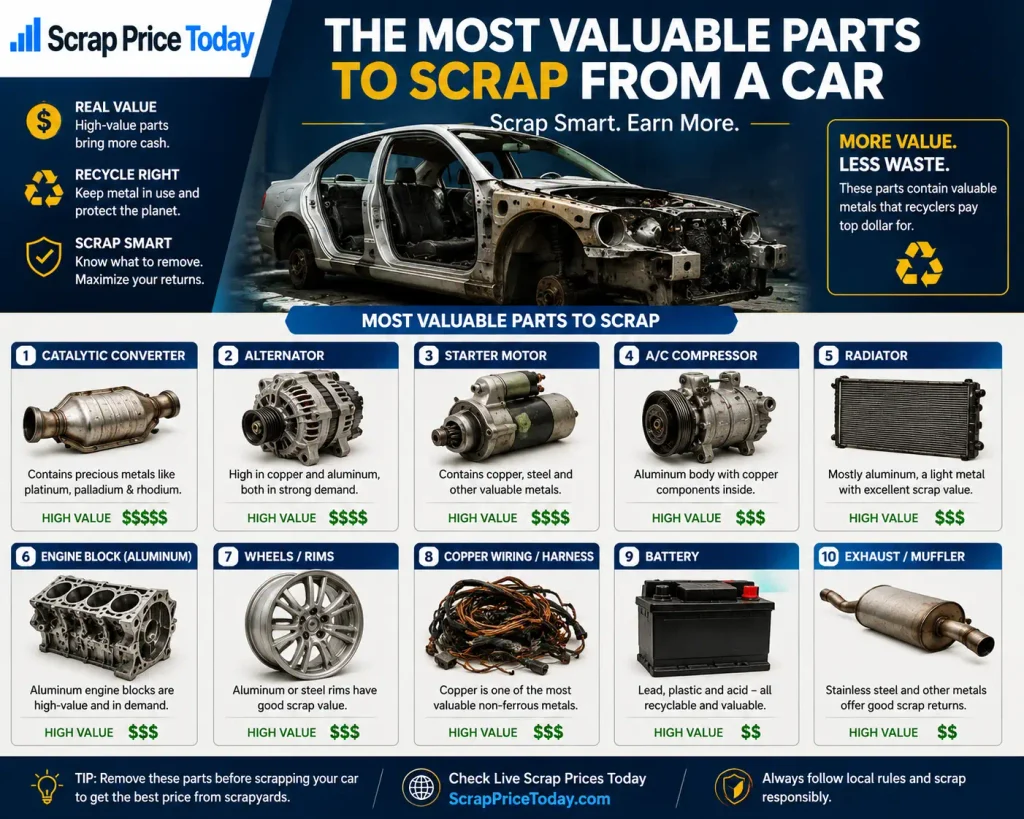
Ask any scrapper which car part pays the most and you’ll hear “the catalytic converter”, which is correct but incomplete. Ask instead what parts are worth money on a car once your own hours are counted, and the answer shifts again. The question that actually decides what you should unbolt first isn’t what pays the most dollars, it’s what pays the most dollars per hour of your labor. Nobody publishes that column. This page does.
The Ranking Nobody Publishes: Dollars Per Hour, Not Dollars
A wiring harness can gross more than an alternator, yet it can take twelve times longer to pull and strip. Rank by raw payout and the harness looks like a win. Rank by $/hour and it drops near the bottom of the list, and the most profitable car parts to scrap turn out to be the quick ones. Every row below shows the typical 2026 payout, an estimated hand-tool removal time, and the hourly rate those two numbers imply, sorted by that last column, because that’s the one your Saturday actually runs on.
| Part | Basis | Removal time | Payout | Implied $ per hour |
|---|---|---|---|---|
| Measurement | Weight and today's rate, or a reference range | Typical, with the car already accessible | What the part returns | Payout divided by removal time |
| Catalytic converter (OEM) | Reference range | 10 min | $75 to $250 | $450 to $1,500 |
| Copper-brass radiator | 12 to 18 lb at $3.19 per lb | 25 min | $38 to $57 | $92 to $138 |
| Car battery | 35 to 45 lb at $0.23 per lb | 5 min | $8.05 to $10 | $97 to $124 |
| Aluminium rims, set of four | 80 to 100 lb at $0.77 per lb | 45 min | $62 to $77 | $82 to $103 |
| Wiring harness, unstripped | Reference range | 105 min | $30 to $80 | $17 to $46 |
| Starter motor, sold whole | 15 to 20 lb at $0.77 per lb | 30 min | $12 to $15 | $23 to $31 |
| Aluminium radiator | Reference range | 25 min | $8.00 to $13 | $19 to $31 |
| Alternator, sold whole | 12 to 15 lb at $0.77 per lb | 25 min | $9.24 to $12 | $22 to $28 |
The payout column is computed at the site’s tracked rates for every row weighed in pounds, so the ranking re-sorts itself as metals move rather than freezing on the day it was written. Three rows are reference ranges instead, because the feed cannot price them honestly: catalytic converters sell by stamped code rather than by weight, and plastic-tank radiators and unstripped harness sell on grades the feed does not track. Those three come from JunkyardInventory and U-Pull-It converter grade tables, Scrapyards.io national estimates and cited yard price boards. Removal times are editorial estimates for hand tools on an accessible vehicle. Every yard quotes differently, so confirm locally before you cut anything.
The Top of the Table: Why the Converter Is Untouchable
Eight to ten minutes with a reciprocating saw or two unbolted flanges, and the catalytic converter returns more than everything else on the car combined in most cases. The platinum, palladium, and rhodium loading inside the honeycomb is what buyers price, which is why an OEM unit from a Honda or a hybrid-heavy Toyota quotes on its serial number, not its weight. Two rules protect that value: never cut the shell open, and keep the serial readable. A gutted or ground unit drops to shell value.
The battery is the sleeper. Nobody brags about a battery worth single digits, but it’s a five-minute pull with one wrench, so on an hourly basis it quietly beats almost everything except the converter. If the car has been sitting, check the trunk and under the seats; plenty of junkers arrive with a second dead battery on board.
Rims earn their rank only when they’re clean. Clean cast aluminium wheels track the aluminium rate, $0.77 per pound as this page loads, but a rim with the tyre still mounted gets a deduction, sometimes half, or gets refused. If a tire shop will dismount for a few dollars a corner, the math still works. Chrome-plated wheels are a different, lower grade; that’s a story for its own page.
The Middle Tier: Worth It If You’re Already Under the Hood
The alternator, starter, and radiator are “while you’re in there” parts. None of them justifies opening a hood on their own, but with the battery already out and thirty free minutes, the alternator adds roughly its weight at the low-grade electronic rate, $0.77 per pound as this page loads. A word before you scrap either electrical unit: rebuilders pay several times scrap for intact cores: case unbroken, shaft turning, pulley attached. Check core value first; scrap is the floor, not the ceiling.
Radiators split into two completely different commodities. Pre-1990s copper-brass units pay the radiator rate, $3.19 per pound as this page loads, and are worth pulling every time you find one. Modern aluminum radiators with plastic end tanks pay a discounted aluminum-breakage style rate until the plastic comes off, and cutting tanks off a $10 radiator is rarely where your hour belongs.
The Bottom of the Table: Where Hours Go to Die
The wiring harness is the most overrated pull in scrapping. Yes, a full harness holds 30 to 50 pounds of insulated copper, and insulated wire carries a strong commodity estimate. Scrapyards.io listed $2.70/lb nationally in late August 2026, with yards typically paying 50 to 80% of estimates. But a harness isn’t clean wire: it’s wire plus connectors, tape, and low-grade thin strands, and it takes 90+ minutes to fight out of a dash and floor pan. Pull it if the interior is already stripped. Don’t open a car for it.
Body panels, hoods and doors ride the shred-steel rate, $0.15 per pound as this page loads. The best tools for scrapping car parts will not rescue this row either, since the constraint is the rate, not the wrench. Removing them individually earns you nothing the crusher wouldn’t pay anyway, with one exception worth its own future page: aluminum panels on modern trucks, which are a different metal at eight times the price.
The Removal Order, If the Car Is Headed to the Crusher
Treat this as your parting out a car checklist, because what to remove before scrapping a car is a question of sequence as much as value. Work the table top-down against the time you have: converter first, battery second, wheels third if tyres can come off cheaply. Those three are the easiest car parts to scrap for cash, and between them they account for most of what a stripped shell will ever return. Then decide: copper-brass radiator yes, aluminum radiator probably not, alternator and starter only as cores or if the wrenches are already out. Whatever remains rides to the yard as a complete car, and “complete” matters: most buyers deduct for a missing engine, transmission, or converter, so parts you did not successfully sell separately should stay bolted in.
Every part, priced individually
The ranking above is a summary. Each part below has its own page with current rates, the grades a yard will actually quote, and the preparation that moves you between them.
Start here
- Junk car prices per ton
- Scrap car price by weight
- Crushed car price per ton
- Car frame: unibody vs body-on-frame
Exhaust and emissions
Engine and drivetrain
Electrical and electronics
- Alternator
- How the core market works
- Starter motor
- ECU and control modules
- ABS module
- Ignition coils
- Window and small motors
- Battery cable and wiring
- How much copper is in a car
Cooling, pumps and body
- Copper-brass radiator
- Aluminium radiator
- Heater core
- Power steering pump
- Body panels
- Steel rims
- Wheel weights
Hybrid and electric
- Prius and hybrid packs
- Hybrid core value by model
- Nissan Leaf packs
- Tesla packs by chemistry
- EV drive units
- Charging cables
- Neodymium magnets
Markets and benchmarks
Before removing anything, the whole versus part-out guide works out which parts beat the drop to shred rate and which cost you money to pull.
The whole or part-out calculator runs this on your own vehicle: tick what you would pull and it works out whether it beats selling complete.
Common Mistakes
- Ranking by payout instead of payout-per-hour, which is the whole reason this table is sorted the way it is.
- Cutting a converter shell open to “check the honeycomb,” destroying the serial-number quote in the process.
- Scrapping rebuildable alternator and starter cores at metal weight when rebuilders pay a multiple of that.
- Stripping the harness on a car that still has an interior, since the labor math only works on an already-gutted shell.
- Selling the car as “incomplete” after pulling parts you never actually sold, because the deduction can exceed what the loose parts bring.
- Trusting one quote, since spreads between buyers on the same converter routinely run 30 to 50%.
How much money can you make parting out a car comes down to that last column rather than the headline figures, and the car parts worth money at scrap yard counters are rarely the ones that take longest to reach. Prices above are reference ranges, not offers. For the full converter-by-brand breakdown, start at our catalytic converter price hub, and for what happens to every other material stream, the recycling hub indexes all of it.
Frequently asked questions
What parts are worth the most money on a scrap car?
By total dollars: the catalytic converter ($75-$250 for most OEM units, $300-$700 for hybrids), clean aluminum rims ($85-$110 a set), and a copper-brass radiator on older cars. By dollars per hour of labor, the converter and the battery lead, because both come off in ten minutes or less.
What should I remove before scrapping a car?
In order: the catalytic converter, the battery, and the wheels if you can get tires dismounted cheaply. Pull the radiator only if it is copper-brass. Leave everything you have not actually sold bolted in, because yards deduct for incomplete cars.
Is it worth parting out a car before junking it?
Selectively, yes. Pulling the converter, battery, and clean rims typically adds more than the yard's incomplete-car deduction costs you. A full part-out, including the harness and small electricals, usually pays less per hour than the whole-car price after you count the labor.
How much is a catalytic converter worth in scrap right now?
Most OEM converters quote between $75 and $250 in 2026 buyer tables, with hybrid units, especially Toyota Prius, reaching $300-$700 and rare units higher. Aftermarket replacements can be worth as little as $15-$50. The serial number sets the quote, so never grind or cut it.
Are aluminum rims worth scrapping with the tires still on?
Usually not at full value. Clean cast wheels paid $1.11-$1.26 per pound at cited yards in August 2026, but a mounted tire triggers a deduction, sometimes around half, or a refusal. If a tire shop dismounts for a few dollars per wheel, the clean rate still wins.
How much copper is in a car wiring harness, and is it worth stripping?
A full harness carries roughly 30-50 pounds of insulated wire, but recovery after connectors, tape, and thin strands is well below that. At yard insulated-wire rates it grosses about $30-$80 and takes 90 minutes or more to pull, so it only makes sense on an already-stripped shell.
Do scrap yards pay less for a car with parts missing?
Yes. Most buyers deduct for a missing engine, transmission, or catalytic converter, and some reprice the whole car as incomplete. Only remove parts you have a real buyer for; an unsold pile of parts plus a deducted car can pay less than the intact vehicle.
Can I legally sell a catalytic converter by itself?
In most US states, yes, but anti-theft laws now commonly require proof of ownership such as the vehicle title or registration, photo ID, and sometimes a holding period. Sell only a converter that came off your own documented vehicle and only to a licensed buyer.
What is a core, and why do some buyers pay more than scrap for alternators?
A core is a used unit a rebuilder can restore, so it is priced for reuse rather than metal weight. An alternator worth $10-$14 as scrap can bring several times that as a core if the case is intact, the shaft spins, and the pulley is attached. Always check core value before scrapping.
How much does a whole junk car pay per ton in 2026?
National 2026 benchmarks put whole-vehicle scrap between roughly $120 and $200 per ton, averaging near $150, which is why most complete cars sell for $100-$600 depending on weight and region. That per-ton floor is what every part you pull is competing against.