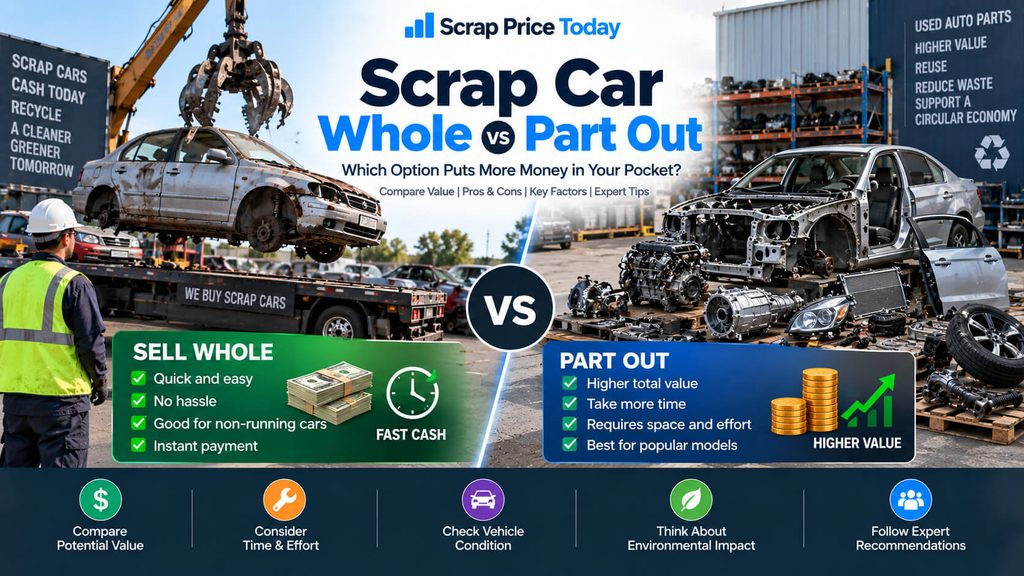
Stripping a car before you scrap it drops the rate you are paid on everything that remains, from around $360 a ton for a complete vehicle to about $300 for the shred floor. On a 3,400 lb car that costs you roughly $87. Pull the converter, the wheels and two cores and you gain $133 to $705. So the answer is not whole or stripped. It is: pull the five things with specialist buyers, and leave everything else attached.
The completeness paradox
Scrap yards do not pay one rate for cars. They pay a complete-vehicle rate and a shred rate, and the gap between them is the whole reason this decision is not obvious.
A complete car with the engine, gearbox and converter still fitted is a known quantity. The buyer can price the assembly. Once you remove those, the vehicle drops to shred grade, because what is left is a body shell that only a shredder wants.
Worked at today’s tracked rates:
| Complete | Stripped | |
|---|---|---|
| Rate per ton | $360 | $300 |
| 3,400 lb car, less 500 lb deduction | 1.45 tons | 1.45 tons |
| Payout | $522 | $435 |
| Cost of stripping | $87 |
That $87 is the toll. Every part you pull has to beat its share of it.
The 500 lb deduction is standard, for tyres and fluids, and it applies whichever route you take. A Honda Civic with a 2,762 lb curb weight is paid on about 2,262 lb; a Chevrolet Tahoe at 5,355 lb is paid on about 4,855 lb. The per-ton page and the calculator work the arithmetic for a specific vehicle.
The five things worth pulling
A part is worth removing when a specialist buyer exists for it. Not when it is valuable in principle, and not when it is easy to reach.
| Part | Value | Why it beats the toll |
|---|---|---|
| Catalytic converter | $50 to $450 | Priced by stamped code by PGM recyclers. Frequently worth more than the rest of the car |
| Alternator, as a core | $18 to $80 | Core buyers pay for the housing; the yard pays $10 to $12 |
| Starter, as a core | $20 to $60 | Same logic; scrap value is $12 to $16 |
| Aluminium wheels | $40 to $100 a set | Only if clean, and only if you are keeping the tyres off |
| Battery | $5 to $15 | Lead has its own market and yards often deduct for it anyway |
| Total | $133 to $705 | Against an $87 completeness toll |
Even at the bottom of that range the maths works. At the top it is not close.
The converter alone usually justifies the exercise. The converter price hub prices by stamped code, and on a hybrid or a high-loading application a single unit can exceed the whole car’s metal value.
What to leave attached
This is the half most part-out advice omits, and it is where people lose money.
The engine and gearbox. Removing them is what triggers the drop to shred rate. Unless you have a buyer already committed for that specific engine, and a way to move it, leave them in. A transmission is worth $11 to $53 as scrap, which does not cover the toll it triggers.
Body panels, doors and glass. Weight without a specialist market. They are paid at the same rate whether attached or not, so removing them is unpaid labour.
The frame and structural steel. Nothing inside worth extracting.
Wiring harness, in most cases. It holds real copper, but stripping a harness is granulation work rather than stripping work, and the wire recovery arithmetic shows fine-strand automotive wire recovers under 50 percent. Unless you already own a granulator, it is not worth the hours.
Small motors individually. Window, seat and mirror motors are pennies each. A 100 lb collected lot is worth about $5 at a general yard and $15 to $20 at a copper-paying recycler, which means volume rather than one car.
When parting out genuinely wins
There is a real version of this, and it is a different activity from scrapping.
Parting out pays when the car has working parts with a resale market, you have buyers or a listing channel, and you have space to store inventory for weeks or months. A functioning ECU is $200 to $1,500 to the reuse market against $3 to $8 as board scrap. A working hybrid pack is two to four times a dead one.
It stops paying when any of those three is missing. Most owners have the car and none of the rest, which is why the five-part approach beats a full strip for almost everyone.
One honest caution: a car that has been picked over is harder to sell whole. Once you start, the complete-vehicle route closes. Decide before you touch anything.
The order of operations
If you are scrapping, do it in this sequence.
1. Check what the car is worth running. If it drives and has a current inspection, a private sale may exceed the scrap value by a wide margin. Scrap is the floor, not the benchmark.
2. Get a whole-car quote first, so you know the number you are comparing against. Two or three yards, because they differ.
3. Pull the five. Converter, alternator, starter, wheels if clean, battery.
4. Sell each to the right buyer, not to the yard. The buyer routing guide covers why the same part is worth $3 at one number and several times that at another.
5. Deliver the car complete otherwise, engine and gearbox in place.
6. Confirm the deduction and the rate on the ticket before you sign. Ask whether the quote is the complete-vehicle rate or the shred rate.
The paperwork that changes the price
Two things can cost more than the parts you pulled.
Title. A car without a title fetches less almost everywhere, and in many jurisdictions cannot be sold for scrap at all without one. Sort it before you call.
The converter’s paper trail. Several states now require seller ID, and unmarked converters are presumed stolen in some. The used converter guide sets out which states and what documentation, and it applies to selling a converter off your own car as much as buying one.
Around the world
The completeness gap exists everywhere, but its size varies with what the local market can process.
Where there is a shredder and a whole-vehicle buyer competing, the gap is meaningful and the calculation above holds. Where the only buyer is a general yard grading by weight, complete and stripped converge, and the case for pulling parts strengthens because the car earns the same either way.
Buyer depth for the removed parts matters more still. A converter is worth $50 to $450 where a code-based recycler operates and considerably less where the only outlet is export. The country pages set out that depth market by market.
If the question is the weight rather than the grade, the scale guide covers what legal-for-trade certification requires and how to check the one you are weighed on.
On whether a given load is worth the drive at all, the hauling guide works the minimum viable load by material from trip cost.
The whole or part-out calculator runs this on your own vehicle: tick what you would pull and it works out whether it beats selling complete.
Questions people actually ask
Does removing the engine lower the car’s scrap price?
Yes. It drops the vehicle from the complete-vehicle rate, around $360 a ton, to the shred rate, around $300. On a 3,400 lb car that is roughly $87, which a transmission worth $11 to $53 as scrap does not recover.
Which parts are worth pulling before scrapping?
Five: the catalytic converter, the alternator and starter as cores, aluminium wheels if clean, and the battery. Together they are worth $133 to $705 against an $87 completeness toll.
Is parting out a car worth the time?
Only with a buyer for each part, a listing channel and space to store inventory. Without all three, most owners recover more by selling complete and pulling the five parts that have specialist buyers.
How much is a junk car worth?
The complete-vehicle rate was near $190 a ton nationally in February 2026, with the site’s tracked rate above bare shred. Less a 500 lb deduction for tyres and fluids, and plus whatever the converter fetches by code.
Why does the yard deduct 500 lb?
For tyres and fluids, which are handled and disposed of separately. It is standard and applies whichever route you take, so a 2,762 lb Civic is paid on about 2,262 lb.
Will a yard take a car with no engine?
Usually, at the shred rate rather than the complete-vehicle rate. Some will not collect a non-rolling shell without a surcharge, so ask before you strip.
Should I strip the wiring harness for copper?
Rarely. Fine-strand automotive wire recovers under 50 percent, which puts it below the stripping break-even, and it is granulation work rather than stripping work. Unless you own a granulator, leave it in.
Do I need the title to scrap a car?
In most jurisdictions yes, and without one the car fetches less or cannot be sold at all. Sort the paperwork before calling yards, because it is the cheapest part of the process to fix.
Is the converter really worth more than the car?
On some vehicles, yes. A high-loading or hybrid converter can exceed the metal value of the whole vehicle, which is why it is the one part worth pulling on almost any car regardless of the rest of the calculation.
Rates are the site’s tracked complete-vehicle and shred figures and move daily with steel. Part values are indicative bands that vary by part number, condition and buyer. Deduction practice, title requirements and converter documentation rules differ by jurisdiction; confirm locally before selling.
Frequently asked questions
Does removing the engine lower the car's scrap price?
Yes. It drops the vehicle from the complete-vehicle rate, around $360 a ton, to the shred rate, around $300. On a 3,400 lb car that is roughly $87, which a transmission worth $11 to $53 as scrap does not recover.
Which parts are worth pulling before scrapping?
Five: the catalytic converter, the alternator and starter as cores, aluminium wheels if clean, and the battery. Together they are worth $133 to $705 against an $87 completeness toll.
Is parting out a car worth the time?
Only with a buyer for each part, a listing channel and space to store inventory. Without all three, most owners recover more by selling complete and pulling the five parts that have specialist buyers.
How much is a junk car worth?
The complete-vehicle rate was near $190 a ton nationally in February 2026, with the site's tracked rate above bare shred. Less a 500 lb deduction for tyres and fluids, and plus whatever the converter fetches by code.
Why does the yard deduct 500 lb?
For tyres and fluids, which are handled and disposed of separately. It is standard and applies whichever route you take, so a 2,762 lb Civic is paid on about 2,262 lb.
Will a yard take a car with no engine?
Usually, at the shred rate rather than the complete-vehicle rate. Some will not collect a non-rolling shell without a surcharge, so ask before you strip.
Should I strip the wiring harness for copper?
Rarely. Fine-strand automotive wire recovers under 50 percent, which puts it below the stripping break-even, and it is granulation work rather than stripping work. Unless you own a granulator, leave it in.
Do I need the title to scrap a car?
In most jurisdictions yes, and without one the car fetches less or cannot be sold at all. Sort the paperwork before calling yards, because it is the cheapest part of the process to fix.
Is the converter really worth more than the car?
On some vehicles, yes. A high-loading or hybrid converter can exceed the metal value of the whole vehicle, which is why it is the one part worth pulling on almost any car regardless of the rest of the calculation.