A 40-mile round trip costs about $7.56 in fuel at 18 mpg, plus an hour of your time. To clear that you need roughly 5 lb of copper, or 138 lb of mixed motors, or 184 lb of steel. That spread is the whole logistics problem: the same trip is trivially worth making for one material and pointless for another.
The minimum viable load
Work it from the trip cost, not from what feels like enough.
Trip cost = fuel + time. At 18 mpg and $3.40 a gallon, a 20-mile round trip is $3.78 of fuel, 40 miles is $7.56, and 80 miles is $15.11. Add an hour of your time at whatever you value it and you have the number to beat.
Against a $27.56 trip cost, being a 40-mile round trip plus an hour at $20:
| Material | Rate | Minimum load to break even |
|---|---|---|
| Bare bright copper | $6.22/lb | 4.4 lb |
| Number 2 copper | $5.48/lb | 5.0 lb |
| Mixed small motors | about $0.20/lb | 138 lb |
| Steel | $300/ton | 184 lb |
Copper travels; steel does not. Five pounds of copper justifies a trip that 180 lb of steel barely covers. That single fact should shape how you accumulate material and when you go.
Adjust for your own numbers. Double the distance and the thresholds double. Value your time at $40 an hour and the steel threshold passes 300 lb.
Batch, do not trickle
The practical consequence: accumulate until the load justifies the trip, and take mixed loads rather than single materials.
A 100 lb lot of small motors is worth about $5 at a general yard at mixed rates, and $15 to $20 at a copper-paying recycler. Neither justifies a dedicated trip. Combined with 40 lb of copper and a set of rims, the same trip pays for itself several times over.
Two habits follow:
Keep sorted piles, not a single heap. Sorted material earns more and a mixed load is paid at the lowest grade present, so batching should not mean mixing. The sorting tools guide covers keeping them separate.
Combine errands. A yard trip attached to something else you were doing costs only the marginal miles.
What you can legally tow
The constraint most people get wrong, because scrap is denser than it looks.
GVWR is the maximum a vehicle is rated to weigh fully loaded, including the vehicle itself. Towing capacity is a separate figure for what you can pull. Both are in the owner’s manual and on the door jamb sticker, and both are legal limits rather than suggestions.
The trap: a small pile of steel weighs more than it appears. A single passenger car steel rim is 20 to 25 lb and a set of four with tyres off is 80 to 100 lb. A stack that looks manageable in a trailer can reach the rating faster than expected.
Work the weight before loading, particularly with dense material: cast iron, steel plate, transformers, batteries and motors. A pickup bed full of copper is fine; a pickup bed full of brake rotors may not be.
Trailer or pickup bed
| Option | Cost | Fits |
|---|---|---|
| Pickup bed alone | none | Small non-ferrous loads, occasional trips |
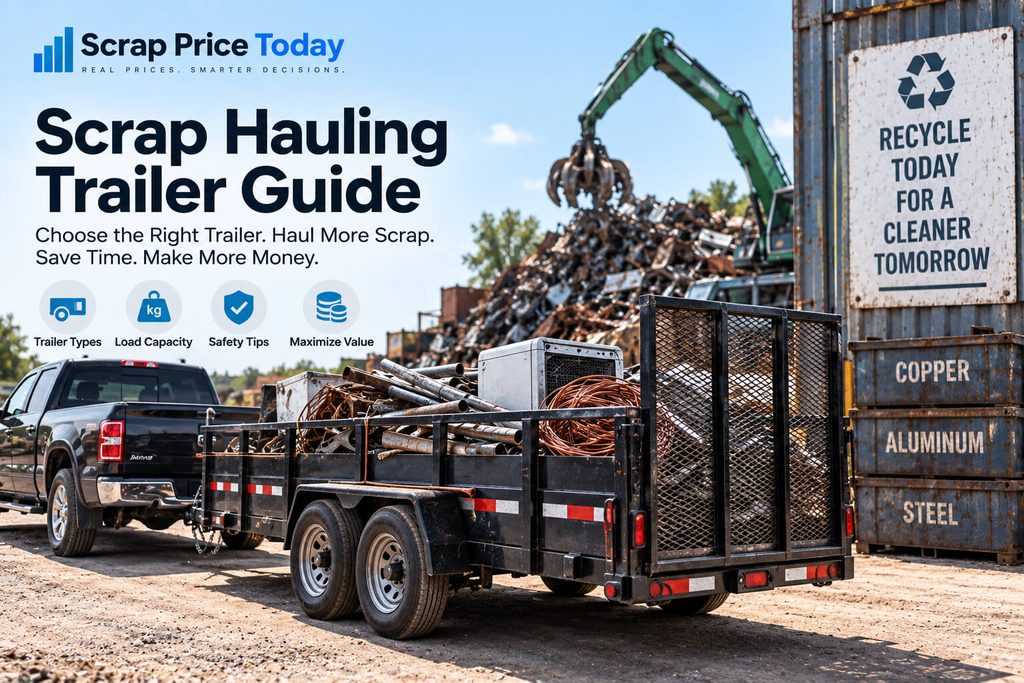
| Utility trailer | $800 to $3,000 used | Regular hauling, appliances, rims, mixed loads |
| Dump trailer | $4,000 upward | Frequent hauling, where unloading time matters |
| Rollback or car trailer | higher | Whole vehicles |
The case for a dump trailer is unloading, not capacity. Hand-unloading is the slowest part of the trip and the part that stops people making them. If you haul weekly, that matters more than the extra payload.
The case against any trailer is that it only pays if you are hauling regularly. For occasional loads, a pickup bed and a tarp cover it, and the money is better spent on grading tools that raise what the load is worth.
The deductions that shrink the payout
Two that catch people out on the weight side.
Vehicles lose about 500 lb for tyres and fluids before the rate applies. A 2,762 lb Honda Civic is paid on about 2,262 lb; a 5,355 lb Chevrolet Tahoe on about 4,855 lb. The per-ton page works this through by model.
Tyres are a cost, not a payment. Disposal fees apply per tyre, and four tyres can cost more than four rims are worth. Take the tyres off before you go, or find out the fee before you load them.
The whole versus part-out guide covers what else to remove before a vehicle goes, and the scale guide covers checking the weight you are paid on.
Before you drive
Five things worth confirming on the phone, because each one can waste the trip.
Do they take this material? Some yards decline steel wheel weights, hybrid packs, tyres, appliances with refrigerant, or converters without documentation.
Is there a minimum weight? Some have one, particularly for non-ferrous.
What are today’s rates by grade? Not one figure for the load.
What identification do they need? Photo ID is standard, and vehicles need a title in most places.
What are the hours, and is there a queue? An hour waiting is an hour of trip cost you did not budget.
Fuel, and the honest limit of optimisation
Worth stating because it bounds the whole exercise.
At the numbers above, fuel on a 40-mile round trip is $7.56. Improving your mileage, driving more efficiently or finding a slightly closer yard moves a figure that is already small.
What actually moves the payout is grade and buyer, not logistics. A load correctly sorted earns more than the same load hauled efficiently, and a specialist buyer can pay several times a general yard for the same item. The buyer routing guide covers that, and it is worth more attention than route planning.
Logistics matters for one decision only: whether to make the trip at all.
Around the world
The arithmetic is universal; the inputs are not.
Fuel price is the largest variable and it changes the thresholds directly. Where fuel is dearer, the minimum viable load rises and batching matters more. Where labour is cheaper relative to metal, the time component shrinks and smaller loads become viable.
Vehicle weight and towing regulations differ substantially, and in many jurisdictions carrying scrap commercially requires specific permits or plates. The scrap business guide covers the licensing side, and the country pages set out what each market pays, which is the other half of every threshold on this page.
To run it on your own numbers, the minimum load calculator gives the threshold for every material at today rates.
Questions people actually ask
How small a load is too small to haul?
Work it from trip cost. A 40-mile round trip at 18 mpg is about $7.56 in fuel plus your time. Against $27.56 all in, that is roughly 5 lb of copper, 138 lb of mixed motors, or 184 lb of steel.
Why is the threshold so different by material?
Because value per pound differs by a factor of thirty between copper and steel. Copper travels well and steel does not, which is why steel is worth accumulating and copper is worth taking when you have it.
What trailer do I need for scrap?
A utility trailer at $800 to $3,000 used covers regular hauling. A dump trailer from around $4,000 makes sense if you haul weekly, because unloading time rather than payload is what limits how many trips you make.
Can I haul scrap in a pickup bed?
For small non-ferrous loads, yes, and it is the sensible starting point. For dense material like cast iron, plate or rotors, check the weight against your GVWR, because scrap is heavier than it looks.
How do I know what I can legally tow?
GVWR and towing capacity are both in the owner’s manual and on the door jamb sticker. GVWR is the loaded weight of the vehicle; towing capacity is what you may pull. Both are legal limits.
Does the yard deduct weight from a car I bring in?
Yes, roughly 500 lb for tyres and fluids before the rate applies. A 2,762 lb Civic is paid on about 2,262 lb, so the payout is smaller than the curb weight suggests.
Should I bring the tyres?
Only if you know the fee. Tyre disposal is charged per tyre, and four tyres can cost more than four rims are worth. Take them off beforehand where you can.
Is a dump trailer worth the money?
If you haul regularly, yes, because hand-unloading is the slowest part of every trip. For occasional loads it is not, and the money is better spent on tools that raise the grade of what you carry.
What should I confirm before driving?
Whether they take your material, any minimum weight, today’s rates by grade, what identification they need, and their hours. Any one of those can waste the trip entirely.
Fuel and time figures used are illustrative, at 18 mpg and $3.40 a gallon with time valued at $20 an hour; substitute your own. Rates are this site’s live figures at the time of writing and move daily. Vehicle weight ratings and towing regulations are legal limits that vary by jurisdiction; check your own vehicle documentation.
Frequently asked questions
How small a load is too small to haul?
Work it from trip cost. A 40-mile round trip at 18 mpg is about $7.56 in fuel plus your time. Against $27.56 all in, that is roughly 5 lb of copper, 138 lb of mixed motors, or 184 lb of steel.
Why is the threshold so different by material?
Because value per pound differs by a factor of thirty between copper and steel. Copper travels well and steel does not, which is why steel is worth accumulating and copper is worth taking when you have it.
What trailer do I need for scrap?
A utility trailer at $800 to $3,000 used covers regular hauling. A dump trailer from around $4,000 makes sense if you haul weekly, because unloading time rather than payload is what limits how many trips you make.
Can I haul scrap in a pickup bed?
For small non-ferrous loads, yes, and it is the sensible starting point. For dense material like cast iron, plate or rotors, check the weight against your GVWR, because scrap is heavier than it looks.
How do I know what I can legally tow?
GVWR and towing capacity are both in the owner's manual and on the door jamb sticker. GVWR is the loaded weight of the vehicle; towing capacity is what you may pull. Both are legal limits.
Does the yard deduct weight from a car I bring in?
Yes, roughly 500 lb for tyres and fluids before the rate applies. A 2,762 lb Civic is paid on about 2,262 lb, so the payout is smaller than the curb weight suggests.
Should I bring the tyres?
Only if you know the fee. Tyre disposal is charged per tyre, and four tyres can cost more than four rims are worth. Take them off beforehand where you can.
Is a dump trailer worth the money?
If you haul regularly, yes, because hand-unloading is the slowest part of every trip. For occasional loads it is not, and the money is better spent on tools that raise the grade of what you carry.
What should I confirm before driving?
Whether they take your material, any minimum weight, today's rates by grade, what identification they need, and their hours. Any one of those can waste the trip entirely.