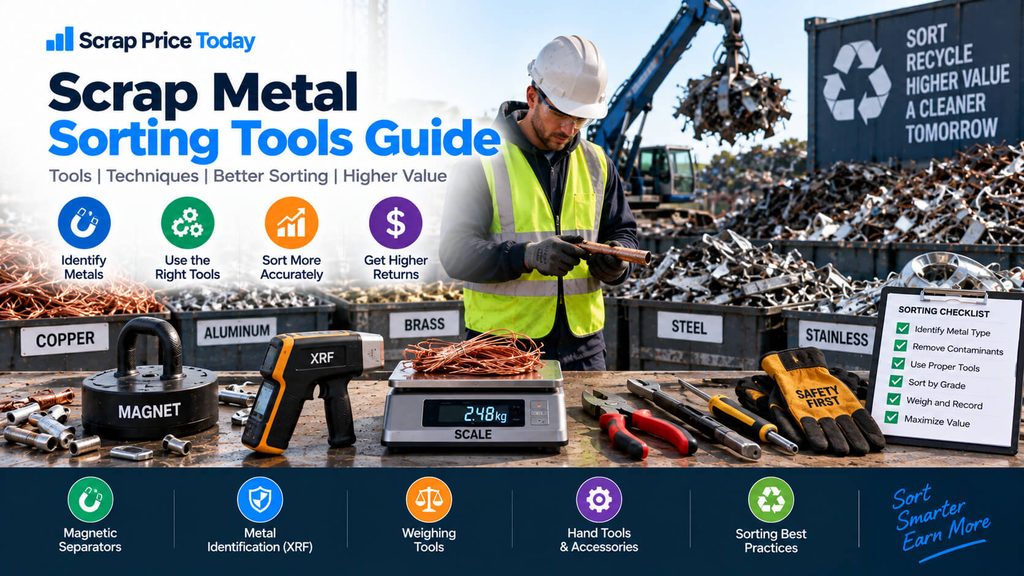
A magnet, a file and a pair of cutters cost about $10 together and settle almost every grading question a scrapper faces. They separate $6.22 copper from copper-clad aluminium paid as aluminium, and $5.95 number 1 from $3.68 irony. This guide covers what each tool proves, and more usefully, what each one cannot.
Why this is a short list
Sorting tools get sold the way exercise equipment gets sold: by promising that the next purchase is the one that changes things.
It is not. Almost every grading decision on household and small-business scrap comes down to four physical questions, and three cheap tools answer them:
- Is it ferrous? Magnet.
- What is under the surface? File or cutters.
- What is the core made of? Cutters.
- Is anything attached that downgrades it? Cutters, again.
The instruments that cost thousands answer a different question, which is what alloy is this to two decimal places. That question matters at yard volume and rarely below it. The XRF guide covers when it starts to.
The magnet
What it costs: $2 to $10 for a decent one. A rare-earth magnet is worth the extra over a fridge magnet because it is decisive rather than ambiguous.
What it proves: the piece contains iron. That single fact splits your pile into ferrous and non-ferrous, which is the first and largest sort you will make.
What it cannot prove, and this is where people go wrong:
It does not identify cast iron. 400-series stainless is magnetic too, so a magnet sticking tells you iron is present and nothing more.
It does not separate 304 from 409 stainless on its own, though it does the opposite job well: a magnet sticks to 409 and not to 304, and those two grades differ several times in price. That is one of the highest-value uses of a $2 tool anywhere in scrap.
It says nothing about copper. Neither copper nor copper-clad aluminium is magnetic, so the magnet cannot separate $6.22 metal from aluminium wearing a copper coat.
The file
What it costs: $3 to $8 for a small flat file.
What it proves: what is under the surface coating.
The specific job: tinned copper looks silver on the outside and is copper underneath. A file scratch reveals the red beneath. Tinned copper cannot reach bare bright however clean it is, so it grades as number 1 or number 2 rather than the top rate. Today that is $5.35 against $6.22, a real gap on a decent load.
The same test catches painted and plated material generally: scratch a small area on an inconspicuous part and look at the colour underneath.
What it cannot do: tell you the alloy. A file proves the surface is not the substance. It does not tell you whether the substance is brass, bronze or something else.
The cutters
What they cost: $8 to $25 for a usable pair of side cutters or small bolt cutters.
They do two jobs, and both are worth more than the tool.
The strand test. Cut a strand of wire and look at the cut end. Copper throughout is copper. Copper outside with silver inside is copper-clad aluminium, which is paid as aluminium rather than copper. Most cheap jumper cables and budget audio wire are CCA. The battery cable page works through the grades that follow from this test.
Removing what downgrades. Solder joints, brass fittings, steel brackets and lead terminal ends all pull a piece down a grade or contaminate the whole pile. Cutting them off takes seconds:
| Cut this off | Grade before | Grade after |
|---|---|---|
| Solder joints from pipe | Number 2, $5.48 | Number 1, $5.95 |
| Steel from copper | Irony, $3.68 | Number 1 or 2 |
| Lead terminals from cable | Contaminated | Copper plus a separate lead ticket |
| Steel clips from wheel weights | Discounted | Clean lead or zinc grade |
Irony copper to number 1 is $3.68 to $5.95. That single cut is worth more per hour than almost any other work in scrap.
Three free tests worth more than a tool
None of these needs anything you have to buy.
The ring test. Drop the piece on concrete. Zinc rings; lead thuds. Wheel weights that look identical are priced differently, and this separates them in one second. The wheel weights page covers why zinc is currently the better-paying of the two.
The colour and weight check. Aluminium is light and dull; zinc is heavier and rings; lead is heavy and dull and marks easily. Held side by side these are obvious, which is why keeping a known sample of each in your sorting area is useful.
The mark check. Steel wheel weights are stamped FE, S or ST, and many yards decline them. Reading the stamp before hauling saves a wasted trip.
What the whole kit costs
| Tool | Cost | Primary job |
|---|---|---|
| Rare-earth magnet | $2 to $10 | Ferrous versus non-ferrous; 304 versus 409 stainless |
| Small flat file | $3 to $8 | Coatings: tinned, painted, plated |
| Side cutters | $8 to $25 | Strand test for CCA; removing downgrades |
| Total | $13 to $43 |
Add a cheap magnet on a stick if you are working through a large pile and do not want to bend, and a pocket scale if you are checking a yard’s weights on small non-ferrous lots.
That is the whole list. Everything beyond it is either volume equipment or a different question.
When you have outgrown this
Three honest signals that the $10 kit is no longer enough.
You are handling alloy grades regularly. Stainless families, nickel alloys, aluminium series. A magnet and a file cannot distinguish 304 from 316, and mis-grading those is expensive at volume.
You are buying rather than selling. Paying a high-grade price for material that assays low is the mistake that ends operations, and it is the case where instrumentation pays for itself.
You are losing loads to mill rejections. One contaminated stainless load returned can exceed a month of XRF rental.
Until one of those is true, the buyer routing guide will make you more money than any instrument, because knowing which buyer to call beats knowing the alloy to a decimal place.
The sorting habit that beats every tool
Worth stating plainly because it costs nothing at all.
A mixed load is paid at the lowest grade present. One soldered joint in a clean pile of number 1 copper can regrade the lot. One steel clip in a bucket of lead weights discounts the bucket.
So the highest-paid work available is separating into piles before you weigh, and the tools above exist to make those piles correct rather than to make them faster. Five minutes of sorting on a mixed load routinely beats a day of waiting for a better market.
Around the world
The tests are physical, so they work identically everywhere. What changes is the grade names and the size of the gaps between them.
The spread between top and bottom copper grades runs 25 to 35 percent in most markets, which means the strand test and the file test are worth similar proportions of a load wherever you are. Local grade terminology differs, and the country pages set out what each market calls these grades and what they pay.
One practical note for markets with limited buyer depth: where a yard grades everything as mixed, careful sorting earns less, because the yard is not paying for the distinction you just made. Ask what grades a buyer actually recognises before spending the afternoon.
If the question is the weight rather than the grade, the scale guide covers what legal-for-trade certification requires and how to check the one you are weighed on.
On where published prices come from and how far to trust them, the price sources guide compares user-reported and benchmark-derived models, including the limitations of the one used here.
On which cuts are worth making, the cutting tools guide prices each grade jump at live rates and covers the four things you should never cut.
If you are unsure what you are holding, the grade finder walks the four physical checks and names the grade with its price today.
The buy or rent calculator asks whether an analyser pays at all before it compares models, using 2026 purchase and rental rates.
For copper specifically, where to find scrap copper ranks the sources by how much they actually yield.
Questions people actually ask
What tools do I need to sort scrap metal?
A rare-earth magnet, a small flat file and a pair of side cutters, which together cost $13 to $43. They answer almost every grading question on household and small-business scrap.
What does a magnet actually prove?
That iron is present, and nothing more. It does not identify cast iron, because 400-series stainless is magnetic too. Its best use is separating 409 stainless, which is magnetic, from 304, which is not.
How do I tell copper from copper-clad aluminium?
Cut a strand and look at the end. Copper throughout is copper; copper outside with silver inside is aluminium with a copper skin, and it is paid as aluminium. Most cheap jumper cables are CCA.
How do I identify tinned copper?
Scratch it with a file. Tinned copper shows silver on the surface and red underneath. It cannot reach bare bright at $6.22 whatever its condition, grading instead at around $5.35.
What is the ring test?
Drop the piece on concrete: zinc rings and lead thuds. It separates wheel weights that look identical, which matters because they are priced differently and zinc currently pays better.
Is cutting fittings off pipe worth the time?
Yes, more than almost anything else you can do. Pipe with solder joints grades as number 2 at $5.48; clean pipe grades number 1 at $5.95. Removing steel from irony copper moves it from $3.68 to $5.95.
Do I need an XRF analyzer?
Not unless you handle alloy grades at volume, buy material rather than sell it, or lose loads to mill rejections. Below that, a magnet, a file and cutters cover the decisions you actually face.
Why does mixing grades matter so much?
Because a mixed load is paid at the lowest grade present. One soldered joint in a clean number 1 pile regrades the lot, which is why sorting into separate piles before weighing is the highest-paid work in the trade.
Will a yard accept steel wheel weights?
Many decline them. They are stamped FE, S or ST, so read the marks before loading rather than after arriving.
Prices quoted are the site’s live copper grade rates at the time of writing and move daily. Grade definitions and the gaps between them vary by market and buyer. Test methods described are standard trade practice and are not a substitute for assay where alloy composition matters.
Frequently asked questions
What tools do I need to sort scrap metal?
A rare-earth magnet, a small flat file and a pair of side cutters, which together cost $13 to $43. They answer almost every grading question on household and small-business scrap.
What does a magnet actually prove?
That iron is present, and nothing more. It does not identify cast iron, because 400-series stainless is magnetic too. Its best use is separating 409 stainless, which is magnetic, from 304, which is not.
How do I tell copper from copper-clad aluminium?
Cut a strand and look at the end. Copper throughout is copper; copper outside with silver inside is aluminium with a copper skin, and it is paid as aluminium. Most cheap jumper cables are CCA.
How do I identify tinned copper?
Scratch it with a file. Tinned copper shows silver on the surface and red underneath. It cannot reach bare bright at $6.22 whatever its condition, grading instead at around $5.35.
What is the ring test?
Drop the piece on concrete: zinc rings and lead thuds. It separates wheel weights that look identical, which matters because they are priced differently and zinc currently pays better.
Is cutting fittings off pipe worth the time?
Yes, more than almost anything else you can do. Pipe with solder joints grades as number 2 at $5.48; clean pipe grades number 1 at $5.95. Removing steel from irony copper moves it from $3.68 to $5.95.
Do I need an XRF analyzer?
Not unless you handle alloy grades at volume, buy material rather than sell it, or lose loads to mill rejections. Below that, a magnet, a file and cutters cover the decisions you actually face.
Why does mixing grades matter so much?
Because a mixed load is paid at the lowest grade present. One soldered joint in a clean number 1 pile regrades the lot, which is why sorting into separate piles before weighing is the highest-paid work in the trade.
Will a yard accept steel wheel weights?
Many decline them. They are stamped FE, S or ST, so read the marks before loading rather than after arriving.