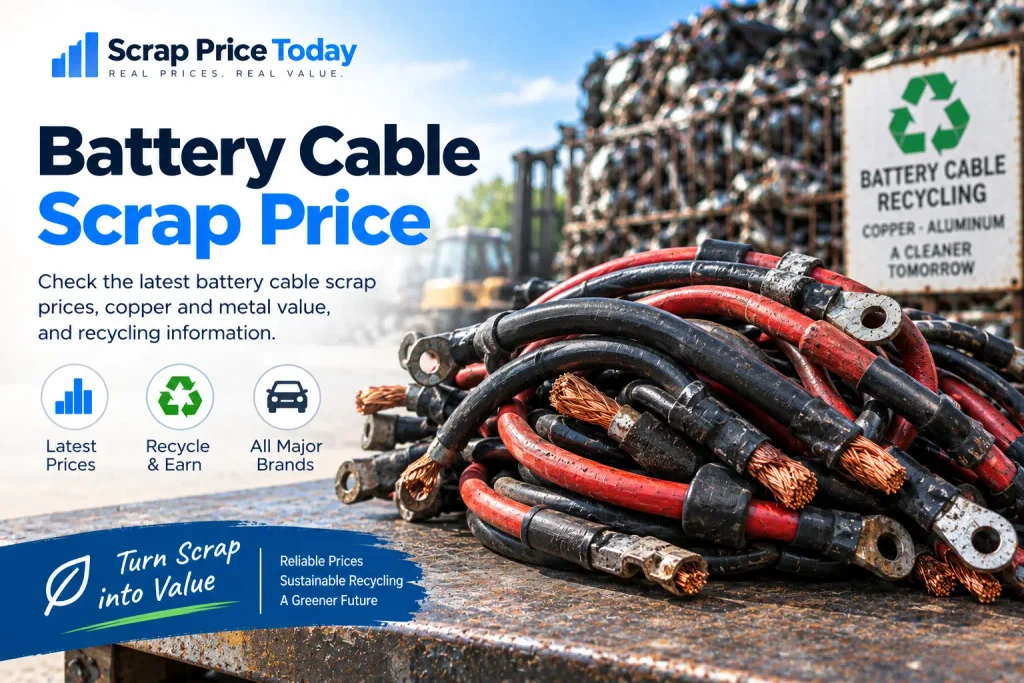
Insulated thick copper cable runs $2.80 to $3.30 per pound as weighed, while stripped bare bright reaches $4.00 to $4.40. Battery cables are heavy gauge and short, which makes them the one automotive wire genuinely worth stripping. The lead terminals must come off separately.
The lugs are the problem
A battery cable is three things bolted together: heavy copper conductor, thick insulation, and lead terminal ends at one or both ends.
The battery cable copper value is excellent. The insulation is a known deduction. The lead is the part that causes trouble, because it is a different metal entirely and it contaminates whatever grade the copper would otherwise earn.
Cutting lugs off cables takes seconds with a pair of cutters, and it should be the first thing you do. Lead battery terminals scrap sells separately, on the same logic the wheel weights page sets out for sorting lead from zinc from steel.
Three cables that look identical and are not
This is the check that matters most, because the three most common battery cable constructions are indistinguishable from the outside and differ by roughly five times in value.
Cut a strand and look at the end of it. One scrapper comparing cables side by side described the tell precisely: on tinned cable the strand is silver outside and copper inside, while copper-clad aluminium is the opposite, copper outside and silver inside.
- Copper all the way through: bare copper. The best case, and the only one that can reach bare bright once stripped.
- Silver outside, copper inside: tinned copper. Genuine copper, but the tin coating caps it at number one or two grade.
- Copper outside, silver inside: copper-clad aluminium. The core is aluminium, and it is paid as aluminium.
Two consequences follow. Most jumper and booster cables are CCA, so a heavy-looking set is worth a fraction of what its weight suggests. And marine cable is tinned by design, since standards such as UL 1426 and BC5W2 require tinned conductors to resist salt corrosion, which is why marine wire looks silver rather than copper.
Copper recovery by wire gauge: how yards actually price it
This is the mechanism, and understanding it changes how you present material.
The insulated copper cable price is set by a recovery percentage: the share of total weight that is actually copper. A yard determines it by stripping a sample, weighing the bare copper, and dividing by the original weight.
Published recovery rates by type:
- 250 to 750 MCM heavy cable: 90 percent
- THHN: 75 percent, at roughly $2.50 to $2.75 per pound
- Romex: 65 percent, around $2.30
- Communication wire: 48 percent, around $1.50
- Computer wire: 30 to 37 percent
- Low grade: anything under 30 percent
The thhn vs battery cable price question resolves in the cable’s favour, because battery cable is heavier gauge with proportionally less insulation.
The two-minute test
You can measure your own recovery before you go, and it settles arguments at the scale.
- Cut a two to three inch piece of the cable.
- Weigh it and write the number down.
- Strip the insulation off completely.
- Weigh the bare copper.
- Divide the copper weight by the original weight.
A recycler’s worked example: five ounces of copper from a ten ounce piece is 50 percent recovery, and that is exactly how they will buy the material.
A cheap kitchen scale is enough. Knowing your number means you can tell whether an offer matches the grade or not.
Today’s rates
Route or component Basis Notes Value today (USD) Measurement What the figure is based on What changes it Computed from the live rate unless marked a reference Bare copper, stripped to bare bright Per lb of copper Uncoated copper only; the top grade $4.00 to $4.40 Bare copper, insulated, heavy gauge Per lb as weighed Sold as is at 75 to 90 percent recovery $2.80 to $3.30 Tinned copper (marine, some automotive) Per lb Number one or two copper; never bare bright $2.50 to $3.90 Industrial and forklift cable, very heavy gauge Per lb as weighed Highest recovery at about 90 percent $1.50 to $1.90 EV high-voltage cable, orange jacket Per lb as weighed Thick copper, often shielded; grade varies $1.50 to $3.00 Copper-clad aluminium (most jumper cables) Per lb Aluminium core; paid as aluminium, not copper $0.77 to $0.77 Aluminium battery cable Per lb Some heavy vehicles and budget cable $0.77 to $0.77 Lead terminal ends, cut off Per lb A separate ticket; contaminates copper if left on $0.59 to $0.59
Is stripping worth it? The arithmetic
Here is the honest answer, worked through with published figures rather than asserted.
Start with 100 pounds of heavy cable at 90 percent recovery.
- Sold as is: roughly $1.50 per pound, which is $150.
- Stripped: you end up with 90 pounds of copper at roughly $1.90 per pound, which is $171.
- Difference: $21 for stripping a hundred pounds of heavy cable.
That is the real number, and whether it is worth your afternoon depends on your afternoon. But there is a structural reason it can still be worth doing.
When you strip wire, you leave the recovery system entirely. There is no insulation weight on the scale, no percentage being applied, no yard formula in play. They assess the copper in front of them and pay for it.
And stripping thick cable is much faster than stripping thin wire, which is exactly why battery cables are the good case and the harness is not.
Fine-strand bonus: why gauge matters, and why not the harness
The distinction matters, and one recycler makes it explicitly.
Granulation is the superior route for thin-gauge material, and automotive harnesses are named as an example alongside communications and network cable. Those wires have a very low recovery rate if stripped individually, which is why the copper in a car page advises leaving the harness alone.
Mechanical stripping stays the more profitable method for thick cable, because it preserves the bare bright classification, which fetches more than granulated chops.
Battery cables sit firmly in the second group. They are short, they are heavy gauge, and there are only two or three of them per vehicle. That combination is what makes them the exception.
Battery cable versus welding cable
Worth separating if you have both, because the construction differs.
Welding cable is fine-stranded for flexibility, with a thick rubber jacket. The fine strands mean excellent copper content but the heavy jacket lowers the recovery percentage as weighed.
Battery cable is typically coarser stranded with thinner insulation, so the welding cable scrap price and the battery cable rate can differ even at similar gauge.
The practical answer is the two-minute test above. Run it on each type rather than assuming they grade alike.
What to do in order
Five steps, none of them long.
Disconnect negative first, always, before touching anything else on a vehicle.
Cut the lead lugs off and put them in a separate container.
Separate battery cable from harness wire. They are different grades and mixing them drags the good material down.
Decide on stripping using the arithmetic above and how much you have.
Keep grades apart at the scale. Bare bright, insulated cable and lead are three tickets, not one.
Lug weight, actually measured, and a note on tinned copper
One thing that quietly lowers your rate.
Some automotive cable uses tin-coated copper for corrosion resistance, and recyclers list tin coating alongside shellac and burning as factors that change the price. Tinned copper cannot earn the bare bright grade even when perfectly stripped, because bare bright must be uncoated.
If your stripped copper looks silver rather than pink, that is tinning, and it grades as number one or number two rather than bare bright.
Which grade is your cable? A name-to-grade map
People search for battery cable scrap under dozens of names. Almost none of them are separate grades. A yard has no price for RV cable or golf cart cable specifically; it has prices for metals and recovery rates. Here is where the common names actually land.
Bare copper, insulated or stripped. Car battery cable, automotive battery cable, truck battery cable, heavy duty battery cable, positive and negative battery cable, ground cable, starter cable, battery wire, copper battery wire, SAE SGT and SGX cable. These are the ordinary case and the rates above apply directly.
Tinned copper. Marine battery cable, boat battery cable, and any cable printed UL 1426, BC5W2 or ABYC. Also some underhood automotive cable. Real copper, capped below bare bright by the tin.
Copper-clad aluminium. Most jumper and booster cables, and budget car audio cable. Check the strand end before assuming otherwise, because this is where sellers lose the most money.
Very heavy gauge, high recovery. Forklift battery cable, industrial battery cable, heavy equipment cable, UPS and inverter cable, solar battery cable. Thick conductor, proportionally little insulation, and usually the best recovery percentage you will see.
EV and hybrid high-voltage cable. Orange jacketed, thick, often shielded, and it must be treated as live until the pack is isolated. Grade varies with the shielding, so ask rather than assume.
Small and light. Motorcycle, golf cart and RV battery cable are ordinary copper in short, thin runs. The grade is the same as a car cable; there is simply less of it.
Battery cable prices around the world
Copper settles in US dollars, so the metal in a cable is worth the same everywhere. Currency and local buyer depth are what change.
Market Equivalent range Local market note United States $0.59 to 4.40 Deepest buyer pool. Even within the US, state to state runs $50 to $60 per ton apart. United Kingdom £0.42 to 3.15 Strong processing capacity. Battery and PGM material reported 20 to 40 percent above thin markets. Canada C$0.80 to 6.00 Similar structure to the US; thinner in the prairies and the north. Australia A$0.80 to 5.95 Good coastal capacity, long hauls inland. Distance is the main discount. Germany €0.54 to 4.00 Dense processing and strict documentation. Good grades pay well; paperwork matters. India ₹51.35 to 382.92 Large volume, but black mass export restrictions have compressed local payables. Bangladesh ৳64.23 to 478.99 Ferrous depth is good. Specialist converter, PGM and battery buyers are scarce. United Arab Emirates AED2.06 to 15.35 Re-export hub with real processing depth. Among the better-paying markets outside the West. Saudi Arabia SAR2.06 to 15.35 Growing capacity; specialist PGM and battery buyers still limited. Turkey ₺30.46 to 227.17 Major ferrous importer, so steel grades hold up better than non-ferrous here. South Africa R8.21 to 61.24 Reported below UAE and UK on battery material; processing infrastructure is the constraint. China CN¥3.87 to 28.84 Aggressive bidder on imported battery material; 2026 recycling rules moved payables down.
Treat these as a metal-value anchor rather than a local quote. Recovery percentages and grade names vary between yards, which is why measuring your own is worth the two minutes.
Questions people actually ask
“What is the car battery cable scrap value?”
As insulated thick copper, $2.80 to $3.30 per pound as weighed. Stripped to bare bright, $4.00 to $4.40 per pound of copper. Cables are short, so the totals are modest either way.
“Do I have to cut the lead terminals off?”
You should. Lead is a different metal, it contaminates the copper grade, and it sells separately. The cut takes seconds.
“Is stripping worth the time?”
On heavy cable, published figures show about $21 gained per 100 pounds. On thin harness wire, generally no, which is why granulation exists for that material.
Common mistakes
- Weighing cable with the lead lugs still attached, which contaminates the copper grade.
- Mixing battery cable with harness wire, which drags heavy-gauge material down to a thin-wire recovery rate.
- Stripping thin automotive wire by hand, where the recovery is low and the time is long.
- Assuming stripped copper is automatically bare bright. Tin-coated copper cannot reach that grade.
- Accepting a recovery percentage without checking it, when a two-minute test and a kitchen scale settle it.
- Presenting bare bright, insulated cable and lead as one load rather than three.
- Disconnecting the positive terminal first when removing cables from a vehicle.
Figures on this page are indicative buyer references rather than futures-linked rates for the wire grades; the lead row is computed from the site’s tracked benchmark. Recovery percentages and prices vary by yard, gauge and coating, so measure and confirm locally.
Frequently asked questions
What is the battery cable scrap price today?
Insulated thick copper cable of 14 gauge or heavier runs roughly $2.80 to $3.30 per pound as weighed. Stripped to bare bright it reaches $4.00 to $4.40 per pound of copper. Battery cables are short, so totals are modest even at good rates.
Should I cut the lead terminals off battery cables?
Yes, and it takes seconds. Lead is a different metal that contaminates the copper grade if left attached, and it has its own value when sold separately. Put the lugs in their own container before anything goes on the scale.
How do scrap yards price insulated copper cable?
On a recovery percentage, meaning the share of total weight that is actually copper. They strip a sample, weigh the bare copper and divide by the original weight. Published rates run 90 percent for heavy cable, 75 for THHN, 65 for Romex and 48 for communication wire.
How can I work out my own copper recovery rate?
Cut a two to three inch piece, weigh it, strip the insulation off completely, weigh the bare copper and divide. A recycler's example: five ounces of copper from a ten ounce piece is 50 percent recovery, which is exactly how they will buy it.
Is it worth stripping battery cable?
Often yes, though the gain is modest. Published figures show 100 pounds of heavy cable at 90 percent recovery selling for about $150 as is, against roughly $171 stripped, a difference of $21. Thick cable also strips far faster than thin wire.
Why strip battery cable but not the wiring harness?
Because recovery differs enormously. Automotive harnesses are named by recyclers as material better suited to granulation, since thin wires have very low recovery if stripped individually. Mechanical stripping stays profitable on thick cable because it preserves the bare bright grade.
What is the difference between battery cable and welding cable?
Construction. Welding cable is fine-stranded for flexibility with a thick rubber jacket, giving excellent copper content but a lower recovery percentage as weighed. Battery cable is usually coarser stranded with thinner insulation, so the two can grade differently at similar gauge.
Why is my stripped copper silver instead of pink?
It is tin-coated, which some automotive cable uses for corrosion resistance. Recyclers list tin coating alongside shellac and burning as factors that change price. Tinned copper cannot earn bare bright, since that grade must be uncoated, so it grades as number one or two.
What is the 1 gauge cable scrap price?
Heavy gauge cable falls into the high-recovery insulated categories, so it earns nearer the top of the insulated range as weighed, and reaches bare bright rates once stripped. The exact figure depends on your measured recovery percentage and any coating.
Should battery cable and harness wire go in the same load?
No. They are different grades with very different recovery rates, and mixing them means the heavy cable is paid at something closer to the thin-wire rate. Keep bare bright, insulated cable and lead as three separate tickets.