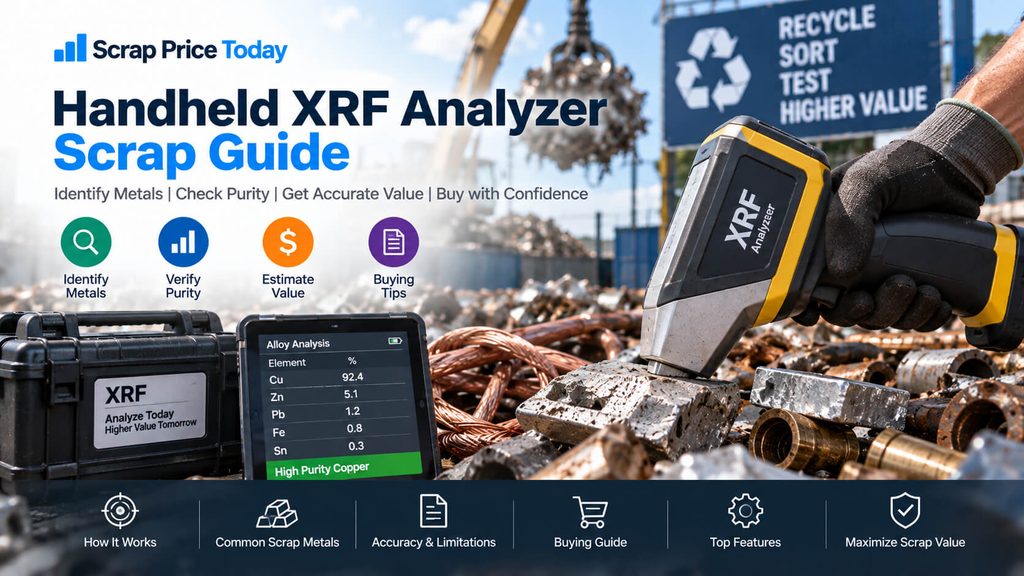
A handheld XRF analyzer costs $10,000 to $40,000 depending on detector, with entry Si-PIN units at $10,000 to $15,000 and SDD units from $15,000. Rental is available weekly or monthly. The question that decides it is not features but mis-grade cost: if you are losing loads to wrong calls, the instrument pays back. If you are sorting copper and steel by eye and getting it right, it does not.
Ask the cost question, not the feature question
Every XRF guide is written by someone selling XRF, which is why they all lead with detectors and count rates. Those matter, but they are the second question.
The first is: what does getting it wrong currently cost you?
An XRF pays back through avoided mistakes, and there are only three that count:
Mis-graded loads. Sending 304 stainless as 409, or a nickel alloy as stainless, means being paid the lower rate on the whole load. On a mixed skip that is real money every month.
Rejected shipments. A contaminated load returned by a mill carries the freight both ways plus the penalty, and a single event can exceed a month of rental.
Buying wrong. Paying a high-grade price for material that assays low is the mistake that closes yards.
If none of those describe you, the honest answer is that a magnet, a file and a grinder cover your sorting, and the sorting tools guide approach costs about $10.
What it actually costs
Prices are 2026 ranges from suppliers and comparison sites in this category.
| Tier | Price | Detector | What it does well |
|---|---|---|---|
| Entry | $10,000 to $15,000 | Si-PIN | Stainless grades, heavy metals, brass, copper alloys, gold karat. Slower on light elements |
| Mid-range | $15,000 to $25,000 | Standard SDD | 1 to 2 second readings, much better aluminium and light-element performance |
| Premium | $25,000 to $40,000+ | Large-area SDD | Fastest analysis, best detection limits, legacy Western brands |
| Used | below new, varies | either | Worth considering; check tube hours and calibration status |
| Rental | weekly or monthly | either | Short projects, seasonal peaks, or validating before purchase |
Total cost of ownership is not the sticker. Budget for X-ray tube replacement every 3 to 5 years, annual calibration, and software or library updates. Those recur whether the instrument is used daily or monthly, which is why an under-used analyzer is expensive in a way the purchase price hides.
Si-PIN or SDD: the one specification that sets the price
The detector is the biggest single differentiator in both performance and cost.
Si-PIN (silicon PIN diode) is the older technology. Reliable, rugged, affordable, and entirely adequate for standard gold karats and common alloys: stainless, copper, brass, heavy metals. Its weakness is speed and light elements.
SDD (silicon drift detector) offers significantly higher count rates. In practice that means 1 to 2 second readings instead of longer ones, and materially better performance on light elements.
The decision rule is simple: if aluminium alloy sorting matters to you, buy SDD. Aluminium is the light-element case, and Si-PIN struggles with it. If your material is stainless, brass, copper and heavy metals, Si-PIN does the job at two-thirds the price.
XRF or LIBS: not the same instrument
This distinction is missing from most buying guides and it changes purchases.
XRF has been the scrap industry standard for decades. It offers the highest accuracy for heavy metals, is the preferred method for stainless steel, nickel and precious metals where elemental precision directly affects trading value, and covers the broadest material range in a single device: ferrous, aluminium, copper, stainless, nickel and gold karats.
LIBS (laser-induced breakdown spectroscopy) uses a short-pulse laser to ablate a small area of the surface. It gives 3 to 5 second analysis of aluminium, titanium and magnesium, and it has no radiation concerns, which changes the licensing and training picture.
So LIBS is not a cheaper XRF. It is the better tool for light-alloy sorting, and the weaker tool for heavy metals and precious metals. Yards handling both aluminium and stainless in volume frequently end up with one of each rather than one instrument that compromises.
Buy, rent, or skip
Three routes, and the honest boundaries between them.
Skip it if your sorting is copper, steel and aluminium at household or small-business volume. A magnet, a file and a strand cut settle almost every call you need to make, and the copper grade pages tell you what each grade is worth once identified.
Rent if you have a defined project, a seasonal peak, or you want to validate before committing. Rental is also the honest answer when you suspect you are losing money to mis-grading but cannot yet quantify it: a month of rental measures the problem.
Buy when the instrument is in daily use and the avoided-mistake value clearly exceeds the annual cost of ownership including tube replacement and calibration.
The trap in the middle is buying an instrument that gets used weekly. At that frequency the recurring costs are the same and the payback is not, which is where rental or a used unit makes more sense.
Specifications that matter in a yard
Beyond the detector, four things separate an instrument that gets used from one that sits in the office.
Weight. Advanced handhelds run around 1.6 kg. That sounds trivial until a sorter holds it for a shift.
Battery life. Look for 8 to 10 hours continuous to cover a full shift, and hot-swappable batteries so a flat battery does not mean powering down and waiting for the software to restart.
Calibration libraries. Instruments can be configured with calibrations optimised for particular material families: broad alloy ranges, mining samples, restricted materials. The right library matters more than raw specification for your specific material.
Trial on your own samples. Suppliers who will run a trial on your alloys, surfaces and geometries, rather than clean demo coupons, are the ones worth talking to. Real scrap is dirty, curved and coated, and that is where instruments differ.
The obligations that come with it
XRF uses ionising radiation, and that carries duties most buying guides mention only in passing.
Expect radiation-protection obligations, operator training at delivery, and registration or licensing requirements that vary by jurisdiction. A supplier who does not raise these unprompted is not the supplier you want.
This is also the practical advantage of LIBS for light-alloy work: laser ablation carries no radiation concerns, which removes that whole layer.
Working out your own payback
Do this with your own numbers rather than a vendor’s ROI slide.
Count your mis-grades. Over one month, log every load where the grade you sent differed from the grade you were paid for. Multiply the difference by the weight.
Add your rejections. Any load returned or penalised, at full cost including freight both ways.
Add your buying errors. Material bought at a grade it did not assay to.
Compare against annual cost. Purchase amortised over the instrument life, plus tube replacement every 3 to 5 years, plus annual calibration. Rental cost is simpler: it is just the rental.
If the avoided cost clears the annual cost with margin, buy. If it clears the rental cost but not the ownership cost, rent. If it clears neither, the money belongs somewhere else in the operation.
Around the world
The instruments are global; the surrounding costs are not.
Radiation licensing, calibration service availability and support response times vary substantially by market, and they matter more than the purchase price over five years. A cheaper instrument with no local service is a false economy in a yard that cannot afford downtime.
The value of accurate grading, though, is universal. Published trade figures put accurate identification at 15 to 30 percent better returns than sellers who guess or accept first offers, and that gap exists in every market on the country pages regardless of local rates.
Below instrument volume, the sorting tools guide covers what a magnet, a file and a pair of cutters actually prove, and what each one cannot.
The buy or rent calculator asks whether an analyser pays at all before it compares models, using 2026 purchase and rental rates.
Questions people actually ask
How much does a handheld XRF analyzer cost?
Roughly $10,000 to $40,000 new. Entry Si-PIN units run $10,000 to $15,000, mid-range SDD $15,000 to $25,000, and premium large-area SDD $25,000 to $40,000 or more. Used and rental options sit below those.
Can I rent an XRF instead of buying?
Yes, weekly or monthly from several suppliers. Rental suits short projects, seasonal peaks and validating an instrument on your own material before committing. It is also the cheapest way to measure whether mis-grading is costing you anything.
Si-PIN or SDD, which do I need?
Si-PIN if your material is stainless, brass, copper and heavy metals; it is reliable and roughly two-thirds the price. SDD if aluminium alloy sorting matters, because light elements are exactly where Si-PIN struggles and SDD gives 1 to 2 second readings.
Is LIBS better than XRF for scrap?
Not better, different. LIBS gives 3 to 5 second analysis of aluminium, titanium and magnesium with no radiation concerns. XRF remains the standard for stainless, nickel and precious metals and covers a broader material range. Yards handling both often run one of each.
Does an XRF pay back for a small operation?
Only if you are losing money to mis-grading. One contaminated stainless load rejected by a mill can exceed a month of rental, but if your sorting is currently accurate the instrument saves nothing.
What are the ongoing costs?
X-ray tube replacement every 3 to 5 years, annual calibration, and software or library updates. These recur regardless of usage, which is why a lightly used analyzer costs more per test than the purchase price suggests.
What battery life should I look for?
8 to 10 hours of continuous operation to cover a shift, with hot-swappable batteries so a change does not require powering down and restarting the software.
Do I need a licence to operate one?
Usually some form of registration or licensing, plus operator training and radiation-protection obligations, and the requirements vary by jurisdiction. A supplier should raise this before you buy rather than after.
Can I check a supplier’s claims before buying?
Insist on a trial with your own samples: your alloys, your surface condition, your geometries. Demo coupons are clean and flat; real scrap is neither, and that is where instruments separate.
Price bands are 2026 ranges published by suppliers and comparison sites and vary by configuration, brand and region. Detector and technology descriptions follow manufacturer and industry documentation. Radiation licensing requirements differ by jurisdiction; confirm locally before purchase. Nothing here is a recommendation of a specific brand.
Frequently asked questions
How much does a handheld XRF analyzer cost?
Roughly $10,000 to $40,000 new. Entry Si-PIN units run $10,000 to $15,000, mid-range SDD $15,000 to $25,000, and premium large-area SDD $25,000 to $40,000 or more. Used and rental options sit below those.
Can I rent an XRF instead of buying?
Yes, weekly or monthly from several suppliers. Rental suits short projects, seasonal peaks and validating an instrument on your own material before committing. It is also the cheapest way to measure whether mis-grading is costing you anything.
Si-PIN or SDD, which do I need?
Si-PIN if your material is stainless, brass, copper and heavy metals; it is reliable and roughly two-thirds the price. SDD if aluminium alloy sorting matters, because light elements are exactly where Si-PIN struggles and SDD gives 1 to 2 second readings.
Is LIBS better than XRF for scrap?
Not better, different. LIBS gives 3 to 5 second analysis of aluminium, titanium and magnesium with no radiation concerns. XRF remains the standard for stainless, nickel and precious metals and covers a broader material range. Yards handling both often run one of each.
Does an XRF pay back for a small operation?
Only if you are losing money to mis-grading. One contaminated stainless load rejected by a mill can exceed a month of rental, but if your sorting is currently accurate the instrument saves nothing.
What are the ongoing costs?
X-ray tube replacement every 3 to 5 years, annual calibration, and software or library updates. These recur regardless of usage, which is why a lightly used analyzer costs more per test than the purchase price suggests.
What battery life should I look for?
8 to 10 hours of continuous operation to cover a shift, with hot-swappable batteries so a change does not require powering down and restarting the software.
Do I need a licence to operate one?
Usually some form of registration or licensing, plus operator training and radiation-protection obligations, and the requirements vary by jurisdiction. A supplier should raise this before you buy rather than after.
Can I check a supplier's claims before buying?
Insist on a trial with your own samples: your alloys, your surface condition, your geometries. Demo coupons are clean and flat; real scrap is neither, and that is where instruments separate.