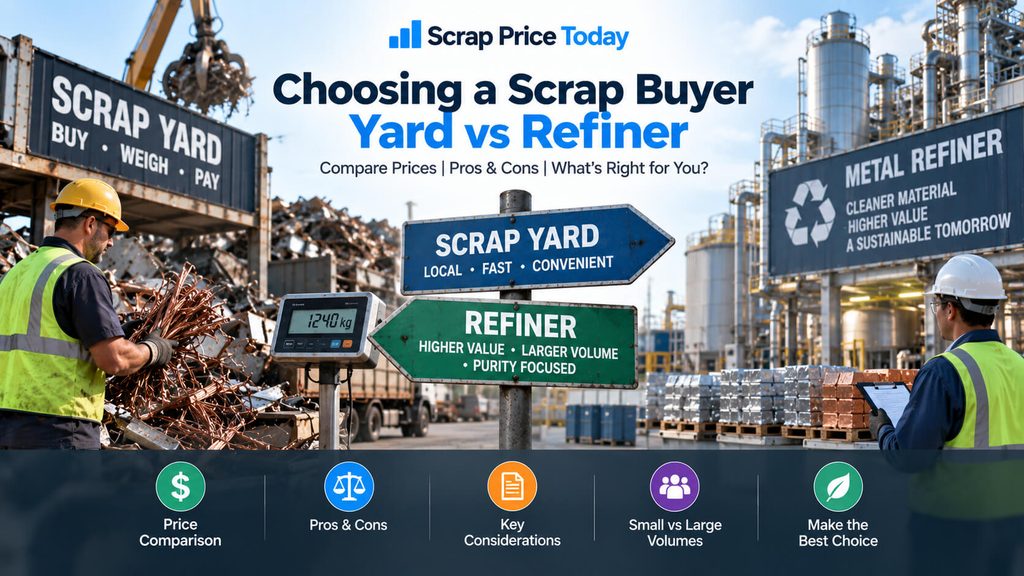
The same object is worth $3 or $700 depending on which phone number you call. A DPF assayed by a precious metals recycler brings $10 to $700; the same filter graded as a steel canister at a general yard brings $0.50 to $3.00. A 100 lb lot of electric motors is $5 at one buyer and $15 to $20 at another. This guide is the routing decision, part by part.
Why the buyer matters more than the metal
Most scrap advice is about preparation: sort it, clean it, strip it. All useful, and all secondary to a decision most sellers never consciously make.
Different buyers are buying different things from the same object.
A general scrap yard buys weight and grade. It has a scale, a magnet and a set of commodity rates. What it does not have is an assay furnace, a part-number database, or a bench to test whether your alternator spins.
A specialist buys what is inside, or what the item can do. A PGM refiner buys the platinum in your converter. A rebuilder buys a core that will come back as a working unit. A board refiner buys assayed gold content.
So when a yard offers $3 for a DPF, it is not lowballing. It is correctly pricing a steel canister, because a steel canister is all it can sell. The $700 exists somewhere else entirely.
The routing table
Every figure below is sourced on this site, on the page linked in the first column.
| What you have | General scrap yard | Specialist buyer | Ratio |
|---|---|---|---|
| DPF or DOC | $0.50 to $3.00 as steel | $10 to $700 by part number | up to 230x |
| Catalytic converter | rarely accepted loose | $50 to $450 by stamped code, hybrids higher | large |
| Electric motors, 100 lb lot | about $5 at mixed rate | $15 to $20 at a copper-paying recycler | 3 to 4x |
| Alternator | $10 to $12 whole as scrap | $18 to $80 as a rebuildable core | 2 to 7x |
| Starter motor | $12 to $16 whole | core market pays more | 2 to 3x |
| Transmission | $11 to $53 as scrap | core market on common applications | several times |
| Turbocharger | $3 to $12 as mixed metal | good core pays far more | large |
| Car ECU | $3 to $8 per lb as board | working module sells to the reuse market | 20 to 100x+ |
| Hybrid battery pack | often refused outright | working pack 2 to 4x a dead one; Prius modules $25 to $40 each | large |
| Neodymium magnets | pennies in mixed | N50 to N52 grades 20 to 30 percent above N35 | modest |
| Insulated copper wire | insulated rate | bare bright after stripping | see recovery percentage |
The ratio column is the point. On most of these the difference is not a few percent. It is a multiple, and on the DPF it is two orders of magnitude.
The four buyer types
Knowing which one you are talking to explains the number they quote.
General scrap yards buy by weight against commodity grades. They are the right buyer for structural steel, mixed non-ferrous, aluminium, whole cars and anything where weight is the value. They are the wrong buyer for anything whose value is inside it.
Specialist recyclers assay or price by part number. PGM recyclers for converters and diesel filters, battery recyclers for packs and black mass, board refiners for electronics. They pay a payable percentage of contained metal value after processing cost, which is the pricing model set out on the black mass page.
Rebuilders and core buyers buy function, not material. They want the housing intact, the shaft turning and the part number matched, and they pay a core value that has nothing to do with the metal. The alternator core page documents two Denso units with core charges of $68 and $39: same brand, different part number, nearly half the value.
The used parts market buys working items. This is the highest tier for anything that still functions, and it is the tier most sellers skip because it takes longer than a trip to the yard.
The test that routes almost everything
Before you decide where to sell, ask one question: is the value in the weight, or in something else?
If the value is weight, the yard is correct and the only optimisation is sorting and calling around.
If the value is something else, name it:
- Precious metal inside goes to a refiner or assay-based recycler. Converters, DPFs, DOCs, boards, black mass.
- Function goes to a rebuilder or the used parts market. Alternators, starters, transmissions, ECUs, hybrid packs, window regulators.
- A specific grade the yard does not distinguish goes to a specialist. Neodymium by N-grade, copper by ReMA grade, stainless by alloy.
That single question routes almost every part on a vehicle, and it is the reason the parts ranking sorts by value rather than by weight.
When the yard is genuinely right
This guide could easily overstate its case, so here is the other side.
Freight can eat the gap. A specialist paying three times more is no help if shipping costs more than the difference. On heavy, low-value items like motors, that is common: the motor page sets the practical threshold at around 100 lb before a trip is worth making.
Volume gates some buyers. Assay-based settlement needs enough material for an assay to be worth running. A single board or one filter is priced from a table, not assayed, and that is reasonable.
Some things really are just weight. Steel rims, body panels, frame rails, cast iron. No specialist route exists because there is nothing inside worth extracting.
Documentation matters more with specialists. Converters and batteries carry ID, VIN and record-keeping requirements in many jurisdictions, covered on the used converter guide. A specialist will ask; that is a sign of a compliant buyer, not an obstacle.
The mistake that destroys value fastest
Opening things.
An ECU is worth $200 to $1,500 as a working module to the reuse market, and $3 to $8 per pound as a bare board. Breaking the tamper seal or opening the case converts the first number into the second, instantly and irreversibly.
The same pattern repeats: a hybrid pack opened into modules becomes a different product with a different buyer, a converter cut open becomes loose substrate that many buyers will not touch, and a motor stripped for copper loses the used-part route entirely.
Test before you dismantle. Every time.
How to find a specialist buyer
Search by the part and the metal, not by “scrap yard”.
- Converters and diesel filters: PGM recyclers, converter recyclers, assay-based refiners
- Batteries and packs: battery recyclers, hybrid rebuilders, black mass processors
- Boards and electronics: e-scrap refiners, board processors
- Cores: remanufacturers, core buyers, and parts stores for matched exchanges
- Working parts: dismantlers, online parts marketplaces, specialist forums
Two practical filters. Ask how they price: by part number, by assay, or by weight tells you immediately which tier you are in. And ask what they need from you: documentation, minimum quantity, collection or drop-off.
Around the world
Buyer depth is the variable that changes most between markets, and it changes more than the metal price does.
Dense processing regions have specialists within reach, so the gap between the yard and the specialist is narrower in practice because the yard has competition. Markets that export rather than process have fewer assay-based buyers, which means more material ends up priced as weight regardless of what is inside it.
That is the largest structural value loss in the whole trade, and it is a buyer problem rather than a metal problem. The country pages set out buyer depth and identification rules market by market, and the pattern is consistent: the same object earns more where more buyers can reach you.
The same routing question applies to electronics: the circuit board guide sets out board grades, why refining consumes most of the contained gold value, and the volume where an assay-based buyer beats a yard.
Below instrument volume, the sorting tools guide covers what a magnet, a file and a pair of cutters actually prove, and what each one cannot.
On where published prices come from and how far to trust them, the price sources guide compares user-reported and benchmark-derived models, including the limitations of the one used here.
On whether a given load is worth the drive at all, the hauling guide works the minimum viable load by material from trip cost.
To run it on your own numbers, the minimum load calculator gives the threshold for every material at today rates.
Questions people actually ask
Why would a yard pay $3 for something a refiner pays $700 for?
Because they are buying different things. The yard grades it as a steel canister, which is all it can sell. The refiner assays the platinum and palladium inside. Neither is wrong; they are pricing different products from the same object.
How do I find a specialist buyer?
Search by the part and the metal rather than by scrap yard. PGM recyclers, battery recyclers, board refiners and remanufacturers all operate separately from general yards, and they price by part number or assay rather than by weight.
Is it worth shipping to a specialist?
For high-value, low-weight items like DPFs, converters and cores, usually yes. For heavy, low-value items like electric motors, freight often exceeds the gain, which is why the motor threshold sits around 100 lb before a trip is worth making.
Will a yard tell me a part is worth more elsewhere?
Rarely, and it is not their job to. Knowing that a DPF, a converter or a working core has a market beyond the scale is the seller’s responsibility, which is what this site exists to document.
What is a payable percentage?
The share of contained metal value a refiner pays after processing cost and margin. It is how black mass, boards and PGM-bearing parts are priced, and it is why those buyers quote a percentage rather than a rate per pound.
Should I open an ECU or a battery pack to check what is inside?
No. A working ECU is worth $200 to $1,500 and a bare board $3 to $8 per pound; opening the case moves it permanently to the lower number. Test function first and dismantle only when the reuse route is closed.
Do specialists need more paperwork?
Usually, and that is a good sign. Converters and batteries carry ID, VIN and record-keeping rules in many jurisdictions. A buyer who skips those checks is the riskier buyer, not the easier one.
What if there is no specialist near me?
Then compare the specialist price minus freight against the yard price. On light, high-value items the specialist usually still wins by post. On heavy items, accumulate until a collection is worth arranging, or accept the yard rate knowingly rather than by default.
Is the difference always this large?
No. On steel, aluminium, mixed non-ferrous and whole vehicles the yard is the correct buyer and the gap is small. The multiples appear only where value sits inside the object rather than in its weight.
Figures on this page are drawn from the linked pages on this site, each sourced separately. Ranges are indicative and vary by part number, condition, region and buyer. Freight, minimum quantities and documentation requirements differ by buyer and jurisdiction.
Frequently asked questions
Why would a yard pay $3 for something a refiner pays $700 for?
Because they are buying different things. The yard grades it as a steel canister, which is all it can sell. The refiner assays the platinum and palladium inside. Neither is wrong; they are pricing different products from the same object.
How do I find a specialist buyer?
Search by the part and the metal rather than by scrap yard. PGM recyclers, battery recyclers, board refiners and remanufacturers all operate separately from general yards, and they price by part number or assay rather than by weight.
Is it worth shipping to a specialist?
For high-value, low-weight items like DPFs, converters and cores, usually yes. For heavy, low-value items like electric motors, freight often exceeds the gain, which is why the motor threshold sits around 100 lb before a trip is worth making.
Will a yard tell me a part is worth more elsewhere?
Rarely, and it is not their job to. Knowing that a DPF, a converter or a working core has a market beyond the scale is the seller's responsibility, which is what this site exists to document.
What is a payable percentage?
The share of contained metal value a refiner pays after processing cost and margin. It is how black mass, boards and PGM-bearing parts are priced, and it is why those buyers quote a percentage rather than a rate per pound.
Should I open an ECU or a battery pack to check what is inside?
No. A working ECU is worth $200 to $1,500 and a bare board $3 to $8 per pound; opening the case moves it permanently to the lower number. Test function first and dismantle only when the reuse route is closed.
Do specialists need more paperwork?
Usually, and that is a good sign. Converters and batteries carry ID, VIN and record-keeping rules in many jurisdictions. A buyer who skips those checks is the riskier buyer, not the easier one.
What if there is no specialist near me?
Then compare the specialist price minus freight against the yard price. On light, high-value items the specialist usually still wins by post. On heavy items, accumulate until a collection is worth arranging, or accept the yard rate knowingly rather than by default.
Is the difference always this large?
No. On steel, aluminium, mixed non-ferrous and whole vehicles the yard is the correct buyer and the gap is small. The multiples appear only where value sits inside the object rather than in its weight.