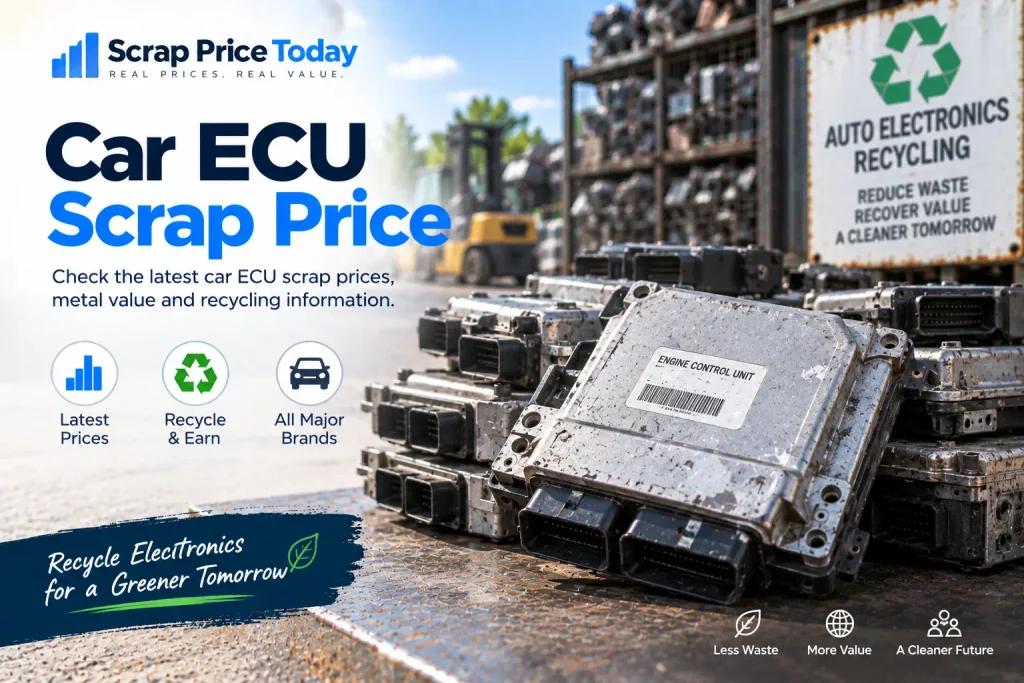
A bare ECU board grades at roughly $3 to $8 per pound, so a typical unit is worth single figures as scrap. The same module working can bring $200 to $1,500 on petrol vehicles and $300 to $2,500 on diesels. The gap is roughly a hundredfold, and it turns on security programming rather than on metal.
Two piles: working and board-grade
Every ECU that comes off a car belongs in one of two piles, and they are not close in value.
Board grade. The unit is dead, water damaged, opened, or from a vehicle nobody wants. It becomes electronic scrap priced by weight, and the pcm scrap value is the same story under a different acronym.
Reuse grade. The unit works, the case is sealed, and the application has demand. It becomes a part.
The difficulty is that a great many ECUs get thrown into the first pile when they belonged in the second, usually because someone opened the case to look inside.
Today’s board-grade rate
Route or component Basis Notes Value today (USD) Measurement What the figure is based on What changes it Computed from the live rate unless marked a reference Diesel ECM, working, common application Per unit Reuse market; scarcity drives the premium $300 to $2,500 Petrol ECM, working, 2010 onward Per unit Reuse market; functional units command most $200 to $1,500 Working module, typical salvage sale Per unit What salvage yards commonly realise $100 to $800 Bare board, e-scrap grade 0.5 to 1 lb Graded at $3 to $8 per lb; gold is not visible $1.50 to $8.00 Opened or tamper seal broken Per unit Reuse value gone; board grade only $1.50 to $8.00 Aluminium or steel case 0.5 to 1.5 lb The housing, once the board is out $0.39 to $1.16
As electronic scrap, ECU boards are graded at around $3 to $8 per pound, which sits toward the upper end of circuit board scrap prices per pound and remains trivial next to the reuse figures above it.
The metal content per pound of bare board is unusually well documented:
- Gold: 0.11 grams per pound of board
- Silver: 0.45 grams per pound
- Palladium: 0.05 grams per pound
- Copper: around 20 percent of board mass
For comparison within the same family, ABS, transmission and body control modules also run $3 to $8 per pound, airbag control modules $2 to $6, and instrument clusters and head units $3 to $12. A bcm scrap value is therefore in the same band as an ECU, which is why they tend to be sold together.
Gold recovery: the honest yield
The car computer gold recovery question deserves a plain answer rather than an encouraging one.
Gold in electronics per pound is well documented for this item: at 0.11 grams per pound of board, an ECU weighing under a pound holds well under a tenth of a gram. That is real, and it is not a payday.
More usefully, you cannot see it. A scrapper who posted photographs of an actual car ECU board to a metals forum was told there was no visible gold and the boards would grade mid grade rather than high. The reply that matters: the majority of gold in electronics sits where you cannot see it, inside integrated circuit packages rather than on visible plating.
So do not judge an ECU by looking for gold-coloured edges. The mid grade board price is what most car ECUs earn, and the visible-gold test tells you nothing.
One wrinkle specific to these boards: many carry a waxy conformal coating for waterproofing, which buyers factor into grading. Mention it when quoting rather than being surprised by it.
The reuse premium, quantified
Here is where the money actually is.
- Petrol engine control modules: $200 to $1,500 depending on vehicle and condition.
- Diesel engine control modules: $300 to $2,500, commanding a premium because they are scarcer.
- Typical salvage yard realisation: $100 to $800 per module.
- One published figure puts the average used ECU market price near €1,265, roughly $1,300.
Demand concentrates on functional units from 2010 onward, because those vehicles are still on the road in numbers and the modules are expensive new.
Against a board-grade value of a few dollars, that is not a premium. It is a different business.
The catch: VIN locking
None of those figures are achievable if the buyer cannot make the module work, and modern modules resist being moved between cars.
A VIN-locked module has a vehicle identification number permanently stored inside it, and the factory tool will not reprogram a part already claimed by another vehicle. That is why a salvage PCM, cluster, radio or key module so often shows a theft-lock screen or a security error the moment it is fitted.
Specialists describe four routes out, and which applies depends on the module and the vehicle:
- Unlock, stripping the security lock so the module accepts programming.
- Virginize, resetting it to factory-new so it can marry a new car.
- Clone, copying the original module’s identity onto the donor unit.
- Stock reprogram, writing the correct manufacturer calibration and VIN back.
The standards that govern automotive diagnostics draw a deliberate line between fitting a virgin part and re-homing a used one, and factory tools enforce it.
Two practical consequences follow, and they are the most valuable things on this page.
Keep the matched set together. The immobiliser is not just the ECU. It typically involves the keys, the engine controller and the instrument cluster or a separate immobiliser module, and on some newer models the transmission as well. On later Honda applications even the under-dash fuse box forms part of the combination. One owner’s simplest fix was pulling the ECU, ignition switch with key, and immobiliser from a single donor and fitting them together.
Do not open the case. Sellers state it plainly in their listings: computers with the tamper seal broken are not warranted. Opening a working module converts it to board grade in one motion.
Modules rebuilders actively hunt, and where the lock does not apply
One genuinely useful exception. Immobilisers are not universal and are not ancient.
Most Volkswagen and Audi models before model year 2000 in North America did not have an immobiliser at all. Older vehicles across other makes are similarly free of the problem, which means their modules can often be swapped with far less ceremony.
So the age rule runs opposite to what you might expect. Newer modules are worth more and are harder to reuse. Older ones are worth less and move freely.
Reading ECU part numbers
The part number is the whole identity of the unit, in the same way a stamped code identifies a catalytic converter.
Used ECM buyers state the requirement bluntly: the part number must match, and the programming and anti-theft security must be adapted for every unit. A listing for a genuine Volkswagen module at $155 carries exactly that warning.
So when you pull one, photograph the label before anything else. A module with a legible part number is a saleable part; the same module with a scratched label is a board.
For how the ECU ranks against everything else on a vehicle by return per hour, see the most valuable parts ranking. The alternator page covers the same core-versus-scrap decision on a mechanical part.
ECU prices around the world
The metals in a board settle in US dollars, so board-grade content is worth the same everywhere. Currency and local buyer depth are what change.
Market Equivalent range Local market note United States $0.39 to 2,500 Deepest buyer pool. Even within the US, state to state runs $50 to $60 per ton apart. United Kingdom £0.28 to 1,792 Strong processing capacity. Battery and PGM material reported 20 to 40 percent above thin markets. Canada C$0.53 to 3,407 Similar structure to the US; thinner in the prairies and the north. Australia A$0.53 to 3,380 Good coastal capacity, long hauls inland. Distance is the main discount. Germany €0.35 to 2,270 Dense processing and strict documentation. Good grades pay well; paperwork matters. India ₹33.94 to 217,566 Large volume, but black mass export restrictions have compressed local payables. Bangladesh ৳42.46 to 272,154 Ferrous depth is good. Specialist converter, PGM and battery buyers are scarce. United Arab Emirates AED1.36 to 8,722 Re-export hub with real processing depth. Among the better-paying markets outside the West. Saudi Arabia SAR1.36 to 8,719 Growing capacity; specialist PGM and battery buyers still limited. Turkey ₺20.14 to 129,071 Major ferrous importer, so steel grades hold up better than non-ferrous here. South Africa R5.43 to 34,797 Reported below UAE and UK on battery material; processing infrastructure is the constraint. China CN¥2.56 to 16,389 Aggressive bidder on imported battery material; 2026 recycling rules moved payables down.
Treat these as an anchor rather than a local quote. The reuse market is strongly regional, since it depends on which vehicles are common and which programming tools local shops own.
Questions people actually ask
“Is there enough gold in an ECU to bother recovering?”
No. At 0.11 grams per pound of board, a single unit holds a fraction of a gram, and recovery requires chemistry and volume. Sell the board, or better, sell the working module.
“The yard offered me five dollars for a computer that costs hundreds new.”
That is the board-grade price and it is correct for scrap. The difference is that a yard buys metal while a parts buyer buys function. Ask a used module buyer instead.
“Can a used ECU actually be made to work in another car?”
Often yes, through unlocking, virginizing, cloning or stock reprogramming, but it needs the right tool and sometimes the matched immobiliser components. That is why buyers pay more when you supply the set.
For boards in general rather than ECUs specifically, the circuit board guide covers grades, refiner economics and the volume that justifies an assay-based buyer.
The board value calculator prices your own lot by grade, shows what a general yard would pay for the same material, and what mixing costs.
Common mistakes
- Opening the case to look for gold, which converts a several-hundred-dollar part into a few dollars of board.
- Judging value by visible gold, when most of it sits inside chip packages and car ECUs typically grade mid grade.
- Splitting the immobiliser set, when the ECU, keys, ignition switch and cluster are worth more together.
- Scrapping the label or letting it corrode, since the part number is what makes the unit saleable.
- Assuming every module is locked. Many pre-2000 vehicles have no immobiliser at all.
- Selling a working diesel module as board scrap, when diesel units carry the highest reuse premium of the category.
Figures on this page are indicative buyer references rather than futures-linked rates, drawn from published e-scrap grade data and salvage market guides current in 2026. Reuse values depend heavily on application and on whether the module can be programmed to the receiving vehicle.
Frequently asked questions
What is the car ECU scrap price today?
As electronic scrap, ECU boards grade at roughly $3 to $8 per pound, so a typical unit is worth single figures. The same module sold working brings far more: $200 to $1,500 for petrol engine control modules and $300 to $2,500 for diesel ones.
How much gold is in a car ECU?
Published figures put it at 0.11 grams per pound of bare board, alongside 0.45 grams of silver, 0.05 grams of palladium and copper at around 20 percent of board mass. An ECU board weighing under a pound therefore holds well under a tenth of a gram of gold.
Is car computer gold recovery worth doing?
Not at household scale. The quantity is a fraction of a gram per unit and recovery requires refining chemistry and volume. More importantly, opening the case destroys the reuse value, which is typically a hundred times the board value.
What is the engine control module value if it still works?
Substantial. Salvage yards commonly realise $100 to $800, petrol modules run $200 to $1,500 and diesel modules $300 to $2,500, with one published figure putting the average used ECU market price near €1,265. Demand concentrates on functional units from 2010 onward.
What does VIN locked mean on a used ECU?
The module has a vehicle identification number permanently stored inside it, and the factory tool will not reprogram a part already claimed by another vehicle. That is why a salvage module often shows a theft-lock screen or security error when fitted to a different car.
Can a VIN-locked module be reused at all?
Usually yes, by one of four routes: unlocking to strip the security lock, virginizing to reset it to factory-new, cloning your original module's identity onto the donor, or stock reprogramming to write the correct calibration and VIN. Each needs the right tool and expertise.
Should I sell the ECU with the keys and immobiliser?
Yes, when you can. The immobiliser typically involves the keys, the engine controller and the instrument cluster or a separate module, and on some vehicles the transmission or under-dash fuse box too. A matched set from one donor is far easier for a buyer to fit.
Which vehicles have no immobiliser to worry about?
Older ones. Most Volkswagen and Audi models before model year 2000 in North America had no immobiliser at all, and older vehicles across other makes are similarly free of the problem. Those modules swap with far less difficulty, though they are worth less as parts.
What is the ecu board scrap price compared to other modules?
Similar. ECU boards run $3 to $8 per pound, as do ABS, transmission and body control modules. Airbag control modules run $2 to $6 and instrument clusters and head units $3 to $12, so a bcm scrap value sits in the same band as an ECU.
Why did the yard grade my ECU board as mid grade?
Because most of the gold in electronics sits inside integrated circuit packages rather than on visible plating, so car ECU boards typically grade mid rather than high. Many also carry a waxy conformal coating for waterproofing, which buyers factor into the grade.