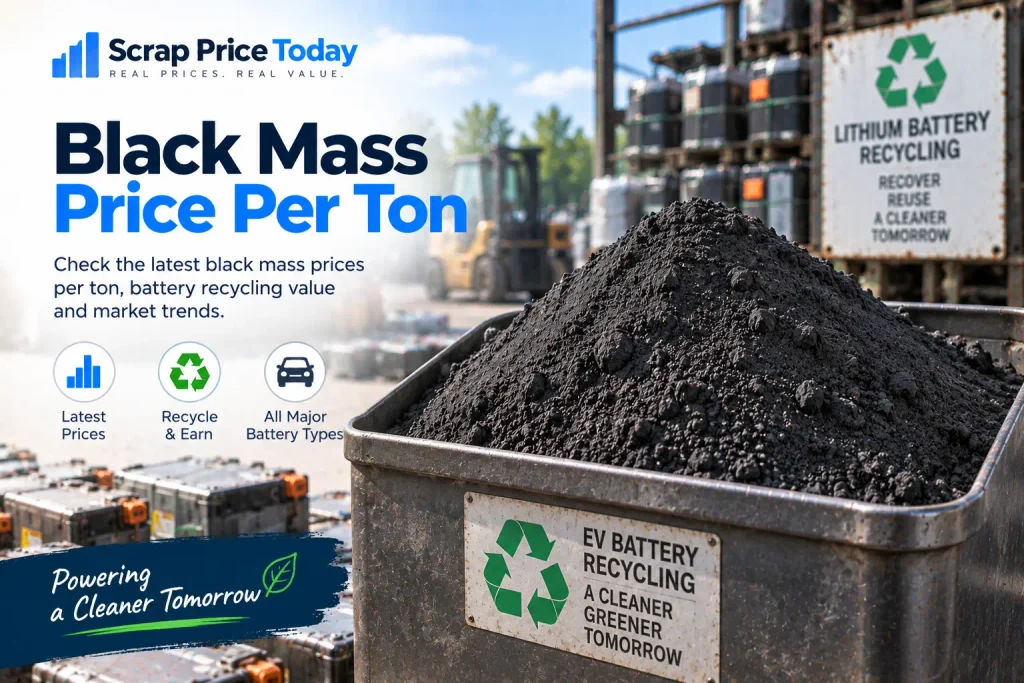
Black mass traded at $3,954 to $4,737 per tonne in recent audited figures. That price is derived rather than quoted: buyers pay a percentage of what the contained nickel, cobalt and lithium would cost new, and those payables ran 74 to 75 percent in China and peaked at 87.5 percent into South Korea.
What black mass actually is
When a lithium battery is discharged, dismantled and shredded, the result separates into casing, foils and a dark powder. That powder is black mass, and it holds the cathode and anode material where the valuable metals sit.
It makes up roughly 40 to 50 percent of an EV battery’s total weight, so a pack is not mostly black mass, but the black mass value is where the money is.
That is why the shredded battery material price and the pack price are different conversations. The pack is a container; the powder is the product.
The payables model, explained
Here is the mechanism, and it is the most useful thing on this page because it explains every battery quote elsewhere on this site.
Black mass is priced as a payable percentage of prevailing virgin battery-grade mineral spot prices. A payable is agreed for each contained metal, and those payables derive the price.
A pricing agency put the logic plainly: the balance between the payable and the virgin market has to account for processing costs and recyclers’ margins.
That single sentence answers the question that makes sellers angriest across the whole battery trade. When a Prius pack holding $120 to $180 of nickel pays $15 to $50, the gap is not a swindle. It is the payable, plus the fact that a whole pack is several steps upstream of black mass.
Three payables, not one
Each metal gets its own percentage, and they move independently.
Recent published assessments for NCM black mass:
- China domestic, June 2026: payables of 74 to 75 percent for nickel, cobalt and lithium.
- China domestic, late 2025: 73 to 74 percent for nickel and cobalt, 72 to 73 percent for lithium.
- Cobalt across regions: rose from around 70 percent in early 2025 to over 80 percent by year end.
- CIF South Korea, November 2025: a record 85 percent, driven by Indian export restrictions tightening supply.
- CIF South Korea, 7 January 2026: an all-time high of 87.5 percent for cobalt and nickel.
The lithium payable rate typically sits a point or two below nickel and cobalt, which is why lithium is quoted separately rather than lumped in.
One assessment has even exceeded 100 percent, for production scrap meeting strict impurity and metal content thresholds. A payable above 100 sounds impossible until you remember it is measured against virgin material that still needs refining.
Chemistry decides everything: today’s contained-metal backdrop
The payable is a percentage. What it is a percentage of depends entirely on chemistry, which is why one battery black mass price tells you nothing without knowing the cells it came from.
Route or component Basis Notes Value today (USD) Measurement What the figure is based on What changes it Computed from the live rate unless marked a reference LCO cells, contained metal value Per tonne of cells Lithium 11 percent by weight, 42 percent by value $11,130 to $11,130 NCM cells, contained metal value Per tonne of cells Lithium 14 percent by weight, 55 percent by value $8,700 to $8,700 Black mass, traded price Per tonne Audited figures, March 2024 and March 2025 $3,954 to $4,737 LFP cells, contained metal value Per tonne of cells No nickel or cobalt; the least valuable black mass $3,170 to $3,170 NCM payable, China domestic Percent of virgin price Nickel, cobalt and lithium, June 2026 $74 to $75 NCM payable, CIF South Korea peak Percent of virgin price Record highs Nov 2025 and Jan 2026 $85 to $88
Per tonne of cells, at the prices those assessments were made:
- LCO holds about $11,130 of contained value, with lithium at 11 percent by weight and 42 percent by value.
- NCM holds about $8,700, with lithium at 14 percent by weight but 55 percent by value.
- LFP holds about $3,170, contains neither nickel nor cobalt, and is the least valuable black mass there is.
That LFP figure is why the EV battery pages treat chemistry as the first question rather than a detail. Two packs of identical weight can differ by more than three times in what the powder inside is worth.
There is a processing consequence too. Pyrometallurgical refining heats black mass to 1,400 degrees Celsius, at which point lithium is lost to the slag. That makes pyro unviable for LFP, where lithium is essentially the only value. The hydromet vs pyromet recycling choice is therefore driven by chemistry rather than by preference.
Why two quotes differ so much
Four variables, and they compound.
Chemistry, as above, sets the ceiling.
Origin. A two-tier market has emerged. Production scrap from manufacturing meets strict purity thresholds and commands steep premiums, while end-of-life material, particularly from Europe, faces weaker demand under hazardous waste export restrictions.
Destination. Payables differ between China domestic, CIF South Korea and European markets, sometimes by ten points or more.
Policy. Black mass export rules move this market faster than demand does. India’s export restrictions pushed South Korean payables to a record. China’s April recycling framework prompted informal operators to liquidate stock, pushing more recycled cobalt into the market and weakening payables. Congolese cobalt export quotas pushed them back up.
So a quote six months old tells you very little.
Who trades this, and at what scale
This is a bulk commodity traded in tonnes, shipped internationally and assessed weekly by price reporting agencies.
Black mass buyers usa and elsewhere are refiners and specialist processors, not scrap yards. The material moves by container, and the assessments quoted above are for DDP China and CIF South Korea delivery terms, which tells you the unit of trade.
For anyone holding a single pack, the practical route is the one the hybrid battery page sets out: a rebuilder or a recycler who aggregates. You are selling into the top of a chain that ends in black mass several steps later, and each step takes a margin.
What this means if you are not a refiner
Three takeaways worth carrying.
Your pack price is a derived number. It reflects a payable, minus dismantling, minus transport, minus each intermediary. Understanding that stops the offer feeling arbitrary.
Chemistry matters more than weight. An LFP pack and an NCM pack of the same mass are not comparable. Ask which you have.
Timing is policy-driven. Payables moved from 70 to over 80 percent on cobalt within a year on export policy alone. If you are holding volume, the direction of travel is worth watching.
Black mass prices around the world
Black mass is unusual on this site in being genuinely internationally traded, with published regional assessments rather than a single benchmark.
Market Equivalent range Local market note United States $74.00 to 11,130 Deepest buyer pool. Even within the US, state to state runs $50 to $60 per ton apart. United Kingdom £53.04 to 7,978 Strong processing capacity. Battery and PGM material reported 20 to 40 percent above thin markets. Canada C$100.84 to 15,166 Similar structure to the US; thinner in the prairies and the north. Australia A$100.05 to 15,048 Good coastal capacity, long hauls inland. Distance is the main discount. Germany €67.20 to 10,107 Dense processing and strict documentation. Good grades pay well; paperwork matters. India ₹6,440 to 968,603 Large volume, but black mass export restrictions have compressed local payables. Bangladesh ৳8,056 to 1,211,629 Ferrous depth is good. Specialist converter, PGM and battery buyers are scarce. United Arab Emirates AED258.18 to 38,831 Re-export hub with real processing depth. Among the better-paying markets outside the West. Saudi Arabia SAR258.08 to 38,816 Growing capacity; specialist PGM and battery buyers still limited. Turkey ₺3,821 to 574,624 Major ferrous importer, so steel grades hold up better than non-ferrous here. South Africa R1,030 to 154,915 Reported below UAE and UK on battery material; processing infrastructure is the constraint. China CN¥485.11 to 72,963 Aggressive bidder on imported battery material; 2026 recycling rules moved payables down.
Treat these as an anchor. Regional payables differ substantially, and export restrictions rather than metal prices are often the reason.
Questions people actually ask
“What is black mass worth per ton?”
Audited figures put traded black mass at $3,954 to $4,737 per tonne. But the number is derived from payables against virgin metal prices, so it moves with both the metals and the payable percentage.
“Why is my battery worth so much less than the metal inside it?”
Because the payable accounts for processing costs and recyclers’ margins, and because a whole pack sits several steps upstream of black mass. Each step between them takes a share.
“Is LFP black mass worth anything?”
Less, and it is a genuinely different business. LFP contains no nickel or cobalt, holds roughly a third the contained value of NCM, and cannot be processed pyrometallurgically without losing the lithium.
Common mistakes
- Treating black mass as a weight-priced commodity, when it is priced as a percentage of contained metal value.
- Comparing an LFP pack with an NCM pack on mass, when contained value differs by more than three times.
- Using a payable figure more than a few months old, in a market where export policy moves percentages by ten points.
- Assuming production scrap and end-of-life material trade alike. They are now a two-tier market.
- Expecting a scrap yard to quote black mass. It is a refiner’s commodity traded by container.
- Reading a payable above 100 percent as an error. It happens on high-purity production scrap.
Figures on this page are published market assessments and audited company filings from 2025 and 2026. Payable percentages are assessed weekly by price reporting agencies and move with both metal prices and trade policy. Contained-value figures reflect the metal prices prevailing when those assessments were made.
Frequently asked questions
What is the black mass price per ton today?
Audited figures put traded black mass at $3,954 to $4,737 per tonne across recent reporting years. The price is derived rather than quoted directly, because buyers pay a percentage of what the contained nickel, cobalt and lithium would cost as virgin material.
What is a black mass payable percentage?
The share of the prevailing virgin battery-grade mineral price that a buyer pays for the same metal contained in black mass. A payable is agreed for each metal separately, and together they derive the price. The gap below 100 percent covers processing costs and recyclers' margins.
What are current black mass payables?
NCM black mass traded at payables of 74 to 75 percent DDP China for nickel, cobalt and lithium in June 2026. CIF South Korea reached a record 85 percent in November 2025 and an all-time high of 87.5 percent for cobalt and nickel on 7 January 2026.
What is black mass made of?
It is the metal-rich powder recovered when spent lithium batteries are discharged, dismantled and shredded, containing the cathode and anode material. It constitutes roughly 40 to 50 percent of an EV battery's total weight.
Why is LFP black mass worth less?
Because it contains neither nickel nor cobalt. LFP cells hold about $3,170 of contained metal value per tonne against roughly $8,700 for NCM and $11,130 for LCO. It also cannot be processed pyrometallurgically, since heating to 1,400 degrees loses the lithium to slag.
What is the lithium payable rate in black mass?
Typically a point or two below the nickel and cobalt payables, which is why it is assessed separately. In late 2025 China domestic lithium payables ran 72 to 73 percent against 73 to 74 percent for nickel and cobalt, converging to 74 to 75 percent for all three by mid 2026.
Can a payable exceed 100 percent?
Yes, and it has. Production scrap meeting strict impurity and metal content thresholds has been assessed above 100 percent, because it is measured against virgin material that still requires refining while the scrap is already close to specification.
How do black mass export rules affect price?
Substantially, and faster than demand does. India's export restrictions pushed South Korean payables to a record in November 2025, China's April recycling framework prompted informal operators to liquidate stock and weakened payables, and Congolese cobalt quotas pushed them back up.
What is the hydromet vs pyromet recycling difference?
Pyrometallurgy heats material to around 1,400 degrees Celsius, at which point lithium is lost to the slag. That makes it unviable for LFP black mass where lithium is essentially the only value. Hydrometallurgy uses chemical leaching and recovers lithium, so chemistry drives the choice.
Who are black mass buyers?
Refiners and specialist processors rather than scrap yards. The material trades by container on DDP and CIF terms into China, South Korea and Southeast Asia, with weekly assessments published by price reporting agencies. Individual sellers reach that chain through aggregators.