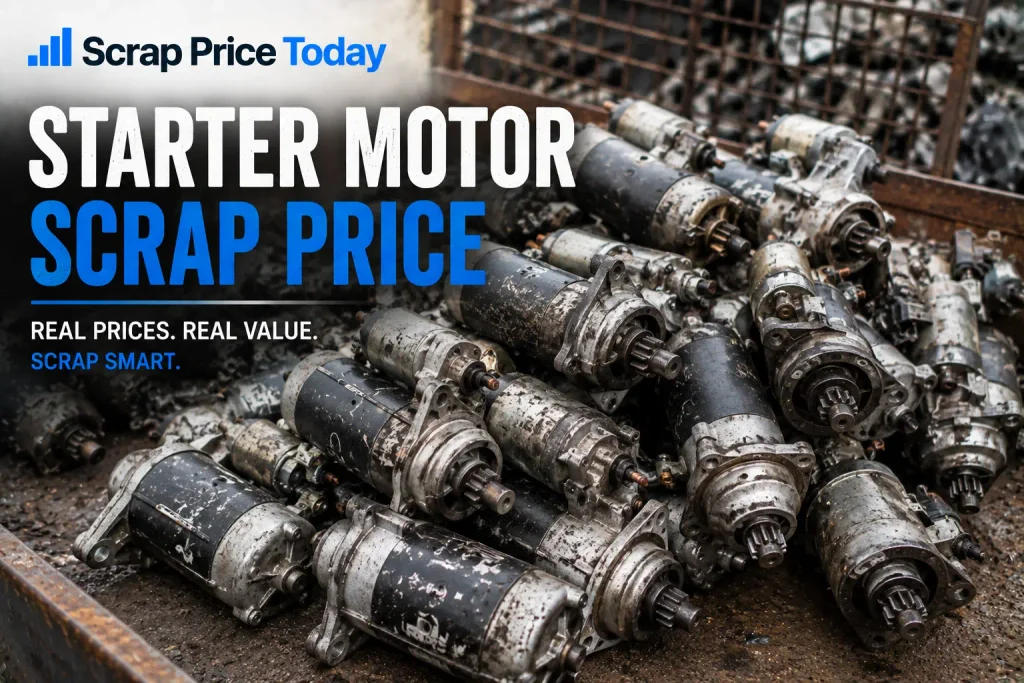
A car starter holds roughly 1.5 to 4 pounds of recoverable copper, and the design decides where in that range you land. Direct-drive units carry field-coil windings and can weigh twice as much as a gear-reduction unit doing the same job. Many gear-reduction starters replaced those windings with permanent magnets, which are worth nothing at a yard.
Not all starters are equal inside
Pick up two starters from different decades and the difference is immediate. One is heavy and barrel-shaped. The other is noticeably smaller and lighter, sometimes half the weight for the same engine.
That is not just packaging. The industry moved from direct-drive to gear-reduction designs, and the change went deeper than size.
For scrap purposes the important part is what replaced the missing weight. In many gear-reduction starters, the copper field windings were swapped for permanent magnets. Magnets crank the engine perfectly well. They pay nothing.
Today’s starter scrap rate
Route or component Basis Notes Value today (USD) Measurement What the figure is based on What changes it Computed from the live rate unless marked a reference Whole unit, sold as-is Per unit, 15 to 20 lb Mixed-grade $12 to $15 Direct-drive copper 3 to 4 lb recovered copper Heavier armature, older design $17 to $22 Gear-reduction copper 1.5 to 2.5 lb recovered copper Smaller motor, most cars since the 1990s $8.34 to $14 Rebuildable core, discontinued application Per unit Scarcity lifts core demand when new units stop $25 to $60 Rebuildable core, common application Per unit Core market, not a metal rate $12 to $35 Core with no rebuild demand Per unit Falls back to the mixed-grade row above $0.00 to $0.00
The spread between those two copper rows is the whole point of this page. Same job, same car, and a materially different amount of metal inside. Starter scrap value therefore depends less on the badge or the vehicle than on which of two designs you are holding.
Teardown one: the direct-drive design
The older layout, and the copper-heavy one.
The motor armature and the Bendix drive sit directly connected and in line with each other. Inside, the motor uses series-wound field coils, which are heavy copper windings wrapped around pole shoes.
Three things follow from that:
- Direct-drive units draw up to 50 percent more electrical power to turn the same engine, which is why they need the copper.
- A direct-drive starter can weigh as much as twice a comparable gear-reduction unit.
- The starter armature copper sits in a thick, tightly wound bundle that is slow but straightforward to recover, so how much copper is in a starter of this type is at the top of the range rather than the bottom.
If your unit is long, cylindrical, heavy in one hand, and the nose lines up with the body, this is what you have.
Teardown two: the gear-reduction design
The modern layout, in two variants, and the reason copper yield varies so much.
Gear-reduction starters use a smaller, faster motor plus a 4:1 reduction to produce the same torque. Smaller motor means less winding.
The two variants look different from outside:
- Offset gear reduction: the motor body and the Bendix drive are not in line. The nose sits offset from the barrel.
- Planetary gear reduction: motor and drive are in line, but the body is visibly shorter and slimmer than a direct-drive unit.
The critical scrap question inside either variant is whether the motor uses field coils or permanent magnets. A permanent-magnet motor spins far faster than a series-wound one, which is precisely why gear reduction was needed in the first place. Where magnets replaced coils, that copper is simply gone.
Spotting the difference from outside
Gear reduction starter identification takes about ten seconds once you know what to look at.
- Weight in the hand. The single best signal, and the reason starter motor weight is worth noting before anything else. Direct drive feels dense and heavy; gear reduction feels light for its size.
- Alignment. Nose offset from the body means offset gear reduction. In line could be either, so use size next.
- Overall length. Direct-drive bodies are long barrels. Gear-reduction bodies are stubby.
- Age of the donor vehicle. Pre-1990s and older heavy-duty applications skew direct drive; most modern cars are gear reduction.
None of this tells you coil versus magnet with certainty from outside. If you are sorting a large batch, open one representative unit per design and weigh what comes out, then apply that yield to the rest.
Do not forget the solenoid
The cylinder bolted to the top of the starter is a separate copper source, and it is routinely thrown away with the housing.
Inside sit two windings, the pull-in and hold-in coils, plus a copper contact disc and two heavy copper terminal studs. The disc and studs are among the cleanest copper on the whole unit.
Starter solenoid copper will not make anyone rich, but on a batch it adds up, and it is the fastest copper on the part to reach. Alternators have no equivalent component.
Strip or sell whole: the verdict
The honest answer differs from the alternator case, and here is why.
On a direct-drive unit with field coils, the copper fraction is high enough that stripping can be worth it if you have volume and the yard does not pay a premium for intact units.
On a gear-reduction unit, especially a permanent-magnet one, you may open it and find far less copper than the size suggested. That is the scrapping starters worth it question answered by design rather than by hope.
The safe sequence for a mixed batch:
- Sort by weight into heavy and light piles.
- Check every unit for core value first. Starter motor core value beats metal value on any unit a rebuilder can resell, and opening it ends that option permanently.
- Open one unit from each pile, weigh the copper, and decide for the pile rather than the piece.
For the same three-door logic applied to the part most people pair with this one, see the alternator page. The most valuable parts ranking puts both in context against the rest of the car.
Starter prices around the world
Copper settles in US dollars, so the metal inside a starter is worth the same everywhere. Currency and local buyer depth are what change.
Market Equivalent range Local market note United States $8.34 to 22.24 Deepest buyer pool. Even within the US, state to state runs $50 to $60 per ton apart. United Kingdom £5.98 to 15.94 Strong processing capacity. Battery and PGM material reported 20 to 40 percent above thin markets. Canada C$11.36 to 30.31 Similar structure to the US; thinner in the prairies and the north. Australia A$11.28 to 30.07 Good coastal capacity, long hauls inland. Distance is the main discount. Germany €7.57 to 20.20 Dense processing and strict documentation. Good grades pay well; paperwork matters. India ₹725.80 to 1,935 Large volume, but black mass export restrictions have compressed local payables. Bangladesh ৳907.91 to 2,421 Ferrous depth is good. Specialist converter, PGM and battery buyers are scarce. United Arab Emirates AED29.10 to 77.59 Re-export hub with real processing depth. Among the better-paying markets outside the West. Saudi Arabia SAR29.09 to 77.56 Growing capacity; specialist PGM and battery buyers still limited. Turkey ₺430.58 to 1,148 Major ferrous importer, so steel grades hold up better than non-ferrous here. South Africa R116.08 to 309.55 Reported below UAE and UK on battery material; processing infrastructure is the constraint. China CN¥54.67 to 145.80 Aggressive bidder on imported battery material; 2026 recycling rules moved payables down.
Treat these as the metal-value anchor rather than a local quote. Core markets are regional, so ask locally whether rebuilders buy starters in your market at all.
Questions people actually ask
“Why is my old truck starter twice the size of the one from my hatchback?”
Because it is a direct-drive unit and the hatchback has gear reduction. The old one needs more copper and more current to do the same work. It is heavier, and for scrap that is in your favour.
“I opened one and there was hardly any copper, did I get a bad one?”
Probably not. You likely opened a permanent-magnet gear-reduction starter, where magnets do the job the field coils used to. The copper is genuinely not there.
“Is the armature the valuable bit?”
It is the largest single piece of copper on most units, yes, but the field coils on a direct-drive starter can rival it. On a magnet unit the armature is essentially all of it.
Common mistakes
- Judging copper by external size, when a modern starter can be half the weight and hold a fraction of the copper.
- Opening a rebuildable unit before checking core value, which closes the highest-paying route permanently.
- Binning the solenoid with the housing, throwing away the cleanest and fastest copper on the part.
- Stripping a whole batch after opening one unit, when the batch may contain both designs.
- Assuming starters and alternators grade identically. Many yards lump them together, but starter copper yield is usually lower.
- Applying one copper yield electric motors figure across a mixed batch, when wound and permanent-magnet units recover very differently.
- Leaving the heavy copper terminal studs attached to a steel housing, which downgrades them to steel weight.
Figures on this page are indicative buyer ranges, not offers to buy. Metal rows are computed from the site’s tracked daily benchmarks; core values are market references and are not futures-linked. Weights vary by application, so weigh a representative unit before applying a yield to a batch.
Frequently asked questions
How much copper is in a car starter?
Roughly 1.5 to 4 pounds of recoverable copper, with the design deciding where in that range you land. Direct-drive units with field-coil windings sit at the top, while gear-reduction units, especially permanent-magnet ones, sit at the bottom because magnets replaced much of the winding.
What is a starter motor worth in scrap?
A whole unit is usually graded at the yard's electric motor rate by weight, which puts a typical 15 to 20 pound starter in the low tens of dollars. Stripped copper is worth more per pound, but how much you recover depends entirely on whether the motor uses field coils or permanent magnets.
Which starters have the most copper?
Direct-drive units with series-wound field coils. They draw up to 50 percent more electrical power than gear-reduction starters to turn the same engine, and can weigh as much as twice a comparable gear-reduction unit, with the extra weight largely in copper and iron.
How do I identify a gear-reduction starter from outside?
Weight is the best single signal, since gear-reduction units feel light for their size. On offset designs the nose is visibly not in line with the motor body. Planetary designs are in line but noticeably shorter and slimmer than a direct-drive barrel.
Is the starter armature copper the valuable part?
It is usually the largest single piece of copper, but on a direct-drive unit the field coils can rival it. On a permanent-magnet starter the armature is effectively all of the copper, which is why those units yield so much less than their size suggests.
Is there copper in the starter solenoid?
Yes, and it is the fastest copper on the part to reach. The solenoid holds pull-in and hold-in windings plus a copper contact disc and two heavy copper terminal studs. The disc and studs are among the cleanest copper on the whole unit.
Do starters have core value like alternators?
Yes, rebuilders buy starter cores, though demand varies more by application than it does for alternators. Check core value before opening any unit, because once it has been taken apart the core option is gone permanently.
How much does a starter motor weigh?
Commonly 15 to 20 pounds for a car unit, but the range is wide because a direct-drive starter can weigh as much as twice a comparable gear-reduction one. That weight difference is the most useful sorting signal you have.
Is scrapping starters worth it compared to alternators?
Generally alternators yield more copper for the same effort, since starter copper varies so much by design. A direct-drive starter can be worth stripping at volume, while a permanent-magnet gear-reduction unit rarely is.
What copper yield should I expect from electric motors generally?
It varies by construction rather than by size, which is the same lesson starters teach. Wound motors hold copper in both the armature and the field, while permanent-magnet motors hold it only in the armature. Open one representative unit and weigh the recovery before applying a yield to a batch.