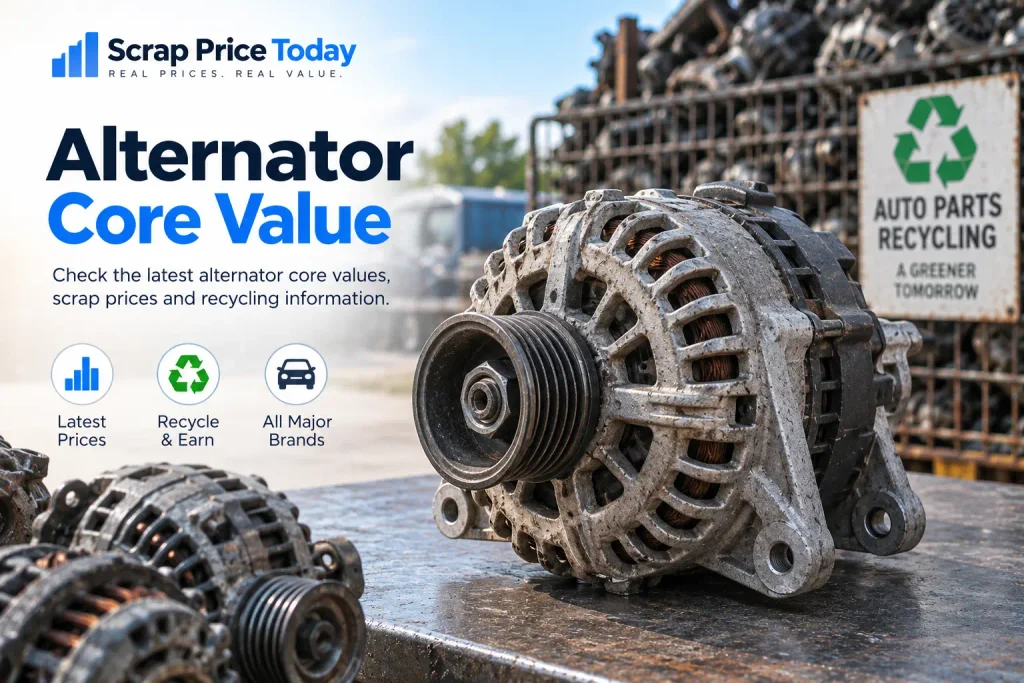
A rebuildable alternator core is worth roughly $18 to $45 against $10 to $12 as scrap. The bigger point is that the core system is closed: a retail core charge is a refundable deposit tied to a matching purchase, not an open offer to buy your old part. Bulk core buyers are a separate channel.
Why some buyers pay several times the scale
A scrap yard buys metal. A rebuilder buys a housing.
That is the entire difference. A remanufacturer strips a worn unit down, replaces the internals and resells it, so what they are paying for is the casting, the shaft and the machined surfaces. Those are expensive to produce from raw metal, which is why recovering them keeps remanufacturing costs down across the whole trade.
A tax authority’s definition puts it more precisely than most industry pages do: the core charge is a means used by the rebuilder to ensure a supply of rebuildable parts, and the returned part is treated as part of the consideration paid for the rebuilt one. It is not a fee and not a penalty. It is part of the price.
Core charges at parts stores, decoded
The core charge explained in one line: it is a deposit, not a charge. The mechanism follows from that.
Buy a remanufactured alternator at $150 with a $75 core charge and you pay $225 at the counter. Return your old unit and the $75 comes back. If you bring the old part with you, most retailers waive the charge on the spot and you only pay for the replacement.
The charge follows the part all the way down the chain, from rebuilder to distributor to wholesaler to retailer to you. Everyone in that chain is holding a deposit on a housing they expect to get back.
Typical return windows run 30 days at some retailers and 30 to 90 days at others, and refunds usually process within five to ten business days of the supplier receiving the part. Core charges are all or nothing: there is no partial refund for a late return, and some retailers add a restocking fee on top.
The limitation nobody mentions
Here is the part that catches out anyone trying to sell cores they collected themselves.
A parts store generally cannot buy your alternator. They take cores against rebuilt parts you bought from them. Their point of sale systems are built to link the core money they pay out to the sale of the corresponding part, so there is no transaction to attach a walk-in core to.
One person who tried reported being told plainly at the counter that the store took only batteries and used oil. Staff at large chains report that customers arriving with junkyard-sourced cores are among the most common problems at the returns desk, for exactly this reason.
So returning cores to AutoZone, O’Reilly, NAPA or any other chain works when you are replacing a part. It does not work as a way to sell cores you collected.
Where cores actually get sold
The channel that does buy from collectors is separate and less visible.
Bulk core buyers exist specifically to feed rebuilders, and they operate at volume. Searching for bulk core buyers usa finds businesses that do nothing else. As one scrapper described it, these businesses send people to self-service yards to pull starters and alternators by the crate.
That is the market to look for if you are accumulating units. Terms differ from a retail counter in three ways worth knowing: they buy by part number rather than by category, they expect volume rather than single pieces, and they publish or quote a core buyer price list rather than a fixed charge.
For what an individual alternator is worth through each route, the alternator page compares selling whole, stripping for copper and selling as a core side by side.
The acceptance checklist
This is the most useful thing on this page, because rejection is where core value disappears.
Cores are commonly refused for:
- Cracked or broken housings. Reported as the single most common disqualifier. A split alternator case, a caliper with a broken mounting ear, or a cracked block cannot be salvaged.
- Stripped or cannibalised units. Windings, rotors, regulators, solenoids and pistons removed. Rebuilders need complete assemblies.
- Wrong part returned. An alternator purchase requires an alternator core, not a different component.
- Fire, flood or impact damage. A unit from a collision, or one that has been run over, is finished.
- Severe freeze or corrosion damage. Cores frozen solid and cracked, or showing deep rust penetration.
- Evidence of tampering or failed repair. Send it back assembled. A unit taken apart and reassembled badly gets refused.
- Air conditioning compressors still holding refrigerant. This one is not store policy but an environmental regulation: refrigerant must be properly recovered first.
The theme running through all of that is completeness. Do not remove brackets, sensors, wiring or electronics unless you have been told to, and return the unit in the box the replacement came in.
Today’s core versus scrap spread
Route or component Basis Notes Value today (USD) Measurement What the figure is based on What changes it Computed from the live rate unless marked a reference Transmission Core vs scrap Scrap value roughly $11 to $53 on a car unit $60 to $400 Turbocharger, good core Core vs scrap Scrap value roughly $3 to $12 as mixed metal $80 to $400 ABS module, working Core vs scrap Board grade is single figures $100 to $300 Alternator, rebuildable Core vs scrap Scrap value roughly $10 to $12 whole $18 to $45 Starter, rebuildable Core vs scrap Scrap value roughly $12 to $16 whole $12 to $35 Denso alternator 210-4144 Observed core charge From a live reman listing $68 to $68 Denso alternator 210-0506 Observed core charge Same brand, different part number, nearly half $39 to $39 Discontinued OEM application (e.g. Hitachi) Reman plus core Scarcity lifts core demand when new units stop $220 to $235 Application with no core demand New unit, no core charge Some new Bosch and ACDelco units carry none $0.00 to $0.00 Typical retail core charge Deposit, not a sale Refunded against a matching purchase only $20 to $150
The pattern holds across the whole drivetrain. The transmission shows the widest absolute gap, the turbocharger the widest multiple, and the ABS module sits between them.
The starter motor is worth checking against its own page too, since starter core value depends heavily on which of two designs you are holding.
Part numbers that command premiums
Core value tracks demand for that exact unit, not the badge on it.
A rebuilder pays for what they can resell, so the alternator core price on a common application still in service beats a rare unit from the same manufacturer. High-output and specialty units, including those from hybrid and electric vehicles, are reported to fetch premiums over standard car alternators.
The practical rule: photograph the label before the unit goes in a crate. A core with a legible part number is a transaction; the same core with a corroded label is a guess, and buyers price guesses low.
Does the brand matter? Part number matters more
People search for core value by brand, so it is worth being precise about what the brand actually does.
The major original equipment names are Bosch, Denso, ACDelco, Valeo, Remy, Mitsubishi, Hitachi, Motorcraft and Delphi. Rebuilders know all of them, and none of them commands a premium by name alone.
Two live listings make the point better than any argument. A Denso alternator, part number 210-4144, carries a core charge of $68. Another Denso alternator, part number 210-0506, carries a core charge of $39. Same manufacturer, nearly double the difference, because they fit different vehicles with different rebuild demand.
At the other end, some new Bosch and ACDelco units are sold with no core charge at all, which tells you the rebuilders do not want that housing back.
What does lift core value is scarcity. One owner searching for a Hitachi unit found that no new ones were available at all, leaving remanufactured units at $220 to $235 plus a core charge. When a manufacturer stops making an application, every remaining housing becomes feedstock, and the core price follows.
So the practical rule is the one this page keeps returning to: photograph the label. A part number tells a buyer what they are getting. A brand name tells them almost nothing.
Where rejected cores end up
Nothing is wasted, but the value drops sharply.
A rejected core becomes scrap, priced by weight and grade like any other lump of metal. That is the fallback described on each of the part pages on this site, and it is typically a fifth to a tenth of what the core would have brought.
Which is the whole argument for handling units carefully during removal. The difference between a core and a scrap item is often a single cracked mounting ear.
Core prices around the world
Core markets are regional rather than commodity-priced, so these figures do not convert the way metal does.
Market Equivalent range Local market note United States $12.00 to 400.00 Deepest buyer pool. Even within the US, state to state runs $50 to $60 per ton apart. United Kingdom £8.60 to 286.72 Strong processing capacity. Battery and PGM material reported 20 to 40 percent above thin markets. Canada C$16.35 to 545.07 Similar structure to the US; thinner in the prairies and the north. Australia A$16.22 to 540.82 Good coastal capacity, long hauls inland. Distance is the main discount. Germany €10.90 to 363.24 Dense processing and strict documentation. Good grades pay well; paperwork matters. India ₹1,044 to 34,811 Large volume, but black mass export restrictions have compressed local payables. Bangladesh ৳1,306 to 43,545 Ferrous depth is good. Specialist converter, PGM and battery buyers are scarce. United Arab Emirates AED41.87 to 1,396 Re-export hub with real processing depth. Among the better-paying markets outside the West. Saudi Arabia SAR41.85 to 1,395 Growing capacity; specialist PGM and battery buyers still limited. Turkey ₺619.54 to 20,651 Major ferrous importer, so steel grades hold up better than non-ferrous here. South Africa R167.02 to 5,567 Reported below UAE and UK on battery material; processing infrastructure is the constraint. China CN¥78.67 to 2,622 Aggressive bidder on imported battery material; 2026 recycling rules moved payables down.
Treat these as an anchor for scale rather than a local quote. Whether a core market exists near you depends on whether rebuilders operate in your market at all, which varies enormously between countries.
If you are buying a replacement rather than selling the old one, the alternator buying guide prices reman, new and core exchange side by side.
Questions people actually ask
“Can I take an alternator I pulled at a junkyard to a parts store for the core charge?”
No. Their systems tie core refunds to a matching purchase, so there is nothing to refund against. Look for a bulk core buyer instead.
“I lost the box. Does that matter?”
Often yes. Retailers generally want the core returned in the packaging the replacement came in, and some will refuse without it.
“I took the pulley off my old alternator. Is it still a core?”
Probably not. Missing components are a standard rejection reason. Return the unit as it came off the car.
Common mistakes
- Expecting a parts store to buy a core you did not replace through them.
- Stripping brackets, pulleys, regulators or sensors off a unit before returning it.
- Missing the return window, when core refunds are all or nothing with no partial credit.
- Returning an air conditioning compressor with refrigerant still in it, which is a regulatory problem rather than a policy one.
- Handling a unit roughly during removal, since a cracked housing is the most common disqualifier of all.
- Selling by category rather than part number, when rebuilders price by exact application.
- Assuming a rejected core is worthless. It is scrap, which is a real if much smaller number.
Figures on this page are indicative buyer references rather than futures-linked rates. Core values vary by application, by rebuilder demand and by region. Retailer return windows, acceptance criteria and refund timescales differ between chains, so confirm the policy where you bought the part.
Frequently asked questions
What is alternator core value today?
A rebuildable alternator core is commonly worth $18 to $45 against roughly $10 to $12 for the same unit sold as scrap. The exact figure depends on the part number and on rebuilder demand for that specific application rather than on the brand.
What is a core charge and is it a fee?
It is a refundable deposit, not a fee. A tax authority defines it as a means for rebuilders to ensure a supply of rebuildable parts, with the returned unit treated as part of the consideration paid for the rebuilt one. Buy a $150 remanufactured alternator with a $75 core charge and you pay $225, getting the $75 back on return.
Can I sell an alternator core at a parts store?
Generally no. Parts stores take cores against rebuilt parts bought from them, and their point of sale systems link core refunds to the matching sale. Staff at large chains report that customers arriving with junkyard-sourced cores are a common problem for exactly this reason.
Who buys alternator cores from collectors?
Bulk core buyers, which operate as a separate channel feeding rebuilders. They send people to self-service yards to pull alternators and starters at volume. They buy by part number, expect quantity rather than single pieces, and quote from a core price list.
What are the core acceptance criteria?
Completeness and structural integrity. Common rejections are cracked or broken housings, which is the most frequent disqualifier, stripped or cannibalised units missing windings or regulators, the wrong part type, fire, flood or impact damage, severe freeze or corrosion, and evidence of failed repair.
How long do I have to return a core?
Typically 30 days at some retailers and 30 to 90 days at others, with refunds usually processing within five to ten business days of the supplier receiving the part. Core charges are all or nothing, so a late return earns no partial credit.
Does a rebuildable alternator value depend on the brand?
Less than people expect. Value tracks demand for that exact part number, so a common application still on the road is worth more than a rare unit from the same manufacturer. High-output and specialty units, including hybrid and electric vehicle alternators, are reported to fetch premiums.
Why was my core rejected for missing parts?
Because rebuilders need complete assemblies. Removing a pulley, voltage regulator, solenoid, bracket or connector leaves the unit incomplete and it will usually be refused. Return the part exactly as it came off the vehicle, assembled.
Is there a special rule for air conditioning compressor cores?
Yes, and it is regulatory rather than commercial. Refrigerant must be properly recovered before the compressor is returned. This is an environmental requirement, not merely a store policy, so no retailer will waive it.
What is starter core value compared to an alternator?
Generally a little lower, at roughly $12 to $35 for a rebuildable unit. Starter core value varies more than alternator value because two quite different motor designs are in circulation, which affects both rebuild demand and the metal fallback if the core is rejected.