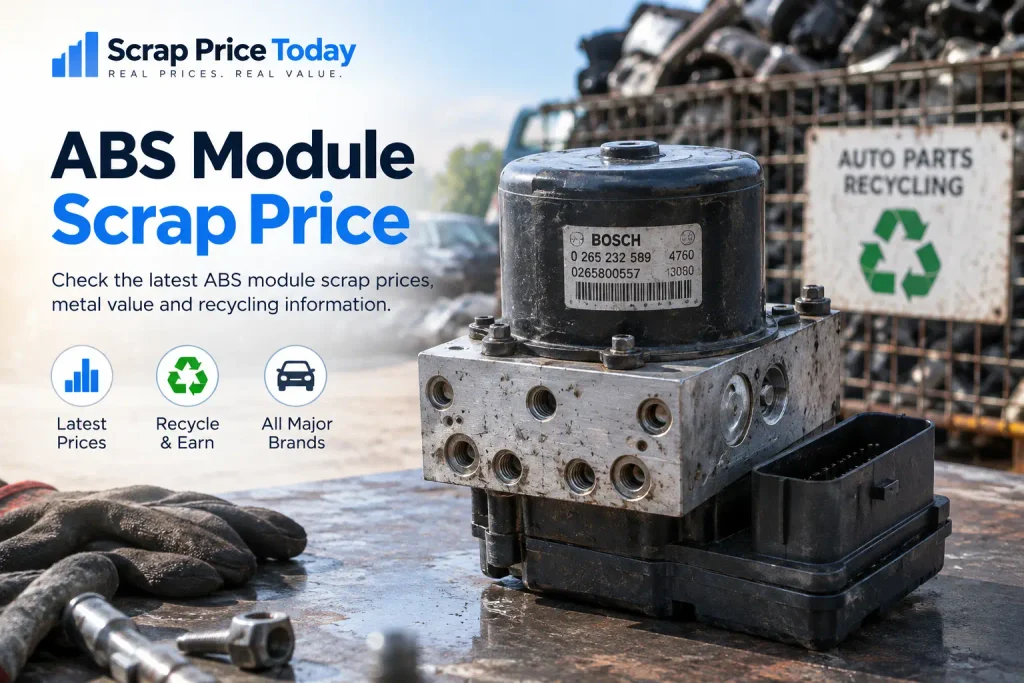
A complete working ABS assembly sells used for $100 to $300 against $250 to $1,200 for a new one. Broken down for metal it is worth far less: the control board grades at $3 to $8 per pound, the hydraulic block yields 1.5 to 3 pounds of aluminium, and the pump motor holds 40 to 120 grams of copper.
One unit, three products
Most people call the whole assembly the ABS module. Technicians do not, and the distinction is what this page turns on.
- The hydraulic unit, sometimes called the modulator. A cast aluminium block full of valves, with modern designs running three to four valves per wheel and brake lines branching off it.
- The pump motor, which builds pressure and is wound with copper.
- The control module, the black electronic unit bolted to the bottom of the assembly.
Repair specialists diagnose failures by narrowing them to one of those three. That is a useful clue for a seller too, because each one has a separate value and a separate buyer.
Today’s rates by component
Route or component Basis Notes Value today (USD) Measurement What the figure is based on What changes it Computed from the live rate unless marked a reference BMW motorcycle ABS2 rebuild Repair and return The dearest common rebuild $390 to $390 ATE MK60, BMW 325 330 M3 Z3 Z4 and VW Golf Jetta Repair and return 2001 to 2006 applications $350 to $350 Bosch 5.7 or 8.0 (Audi, BMW, Porsche, Ford, Toyota) Repair and return The two most widely fitted premium families $300 to $300 Nissin, Honda Civic and Accord 2009 to 2017 Repair and return ATE MK60E BMW also $250 $250 to $250 Bosch 5.3 (Audi, Cadillac, Ford, Hyundai, Saab, VW) Repair and return Some part numbers need recoding after fitting $160 to $160 Kelsey-Hayes or Delco Delphi (GM, Ford, Dodge) Repair and return Series 30, 125, 325 and 430 $150 to $150 ATE MK20 (Audi, Chrysler, Jeep, Toyota, Volvo) Repair and return The cheapest common rebuild $120 to $120 Refurbished exchange unit Rebuild price plus Added to the figures above; no core to send $100 to $100 Complete working assembly, used part Per unit Against $250 to $1,200 for a new one $100 to $300 Pump motor alone, working Per unit Sold separately from the module on many applications $90 to $200 Control module, e-scrap grade 1 to 2 lb Graded at $3 to $8 per lb like any module board $3.00 to $16 Aluminium hydraulic block 1.5 to 3 lb Cast aluminium once fully separated and drained $1.16 to $2.31 Copper from the pump motor 40 to 120 g recovered Only worth it once the unit is being broken anyway $0.50 to $1.45
The published metal content for this family of modules is specific:
- Gold: 0.010 to 0.030 grams per module
- Silver: 0.2 to 1.5 grams, mostly in relay contacts on body control modules
- Copper: 40 to 120 grams in the ABS pump motor
- Aluminium: 1.5 to 3 pounds in the hydraulic block
Board grade for ABS, transmission and body control modules runs $3 to $8 per pound, the same band as an engine ECU and below the high grade boards scrap price paid for telecom and server material. So the abs module gold recovery question has the same answer as it does there: the gold is real, it is a fraction of a gram, and chasing it costs you the part.
The working-module exception
Here is why the scrap figures above are usually the wrong target.
A new abs control unit price runs $250 to $1,200, and dealer pricing on some applications is worse. One owner found the cheapest online listing for a Lincoln Navigator module at just under $1,000, with the local dealer asking $1,250.
A used module sells for $100 to $300 depending on make and model, and a used pump alone for $90 to $200.
Against a board worth single figures and an aluminium block worth a few dollars, the abs module resale value is not close. A scrapper on a metals forum put the range plainly: these sell like converters, from a few dollars to several hundred depending on year and part number.
One correction from that same discussion is worth repeating, because the vocabulary matters when you sell. A core normally means a non-working part that can be refurbished, or one with significant scrap value. So a brake module core value only applies when the unit is actually faulty. A module pulled from a car that was scrapped for other reasons is not a core at all. It is a good used resaleable part, and it should be described that way.
Coding: the difference between two markets
This is the detail that explains why two quite different businesses exist around this part.
Used module fitted to another car: generally needs coding to the receiving vehicle. One owner’s shop fitted a used module, the fault persisted, and the diagnosis pointed to the coding step not completing. They put the original back.
Your own module rebuilt and returned: needs no coding at all, because it is still the original module married to your car. Repair services state this explicitly as the advantage of a repair-and-return model.
That second route also explains the pricing gap. One rebuild service was described by owners as costing roughly a quarter of a new unit, which is why rebuilding beats replacing on expensive applications.
For a seller, the practical consequence is simple: a used module is worth more when the buyer can code it, so note the part number and the donor vehicle rather than just the make.
Splitting the unit: when and how
If the assembly genuinely has no resale value, and only then, the separation is straightforward.
- Drain the brake fluid completely. It is corrosive, it damages paint, and yards will not take a wet hydraulic unit. Dispose of it properly rather than down a drain.
- Unbolt the control module from the block. It usually comes away with a few screws and a connector.
- Separate the pump motor if it is a distinct unit, which it is on many applications.
- Grade each piece. Board to e-scrap, hydraulic block to cast aluminium, motor to copper-bearing electric motor.
Separating electronics from castings is what turns this from one mixed item into three graded ones. Left assembled, a yard will price the whole thing as mixed material, which is close to the worst outcome available.
One warning on the block. It is cast aluminium with steel fittings and valve internals, so it grades as irony aluminium unless properly cleaned, exactly as the engine block page describes.
Which module do you have? Families, brands and rebuild prices
Four suppliers built most of the ABS modules on the road, and the family name printed on the unit is what a rebuilder prices from. It is not the badge on the car.
- Bosch, in generations 2, 2E, 2U, 5.0, 5.3, 5.3ASG, 5.3S, 5.7, 5.7ASG, 8.0, 8.1, 9.0 and SBC3. Bosch also absorbed the Bendix ABS business.
- ATE, properly Continental Teves, with the Mark 4, MK20, MK60 and MK60E families. Fitted to BMW, Chrysler, Ford, GM, Honda, Saab and Volkswagen.
- Kelsey-Hayes, best known for rear-wheel anti-lock on Ford, GMC and Dodge trucks, plus the 4WAL and EBC systems.
- Delco Delphi, Nissin, Denso, Sumitomo and TRW, covering most of the remainder.
Published rebuild prices show how wide the spread is between families. An ATE MK20 rebuild is listed at $120 and covers Audi, Chrysler, Dodge, Ford, Jaguar, Jeep, Toyota, Nissan and Volvo. A Bosch 5.3 is $160, a Bosch 5.7 or 8.0 is $300, and an ATE MK60 for BMW 325, 330, M3, Z3 and Z4 or VW Golf and Jetta is $350. A BMW motorcycle ABS2 unit reaches $390.
Refurbished exchange units are sold at the rebuild price plus $100, which is the premium for not waiting on your own unit.
One coding detail worth checking before you buy a used module. On Bosch 5.3 units, a supplier notes that if the part number ends in 135, 285, 358, 573 or 451, the replacement may need recoding by a dealer or with VAG-COM after fitting. That is the difference between a plug-in job and a workshop visit, and it turns on the last three digits.
Which boards grade highest, and the gold-plated pins
Worth knowing rather than acting on.
Some modules carry gold-plated pins in the connector, which is visible gold rather than the hidden kind inside chip packages. It is a small quantity and it is the one place where looking actually tells you something.
It does not change the decision. A connector’s worth of plating is pennies against a hundred-dollar used part.
Where each half sells, and how to store one
A practical tip from the repair trade that applies while a unit sits in your garage.
Cover the exposed face of the hydraulic control unit, foil works, to keep water and dirt out of the ports. A contaminated hydraulic unit is much harder to sell as a working part, and corrosion in the valve bores is not recoverable.
ABS module prices around the world
The metals settle in US dollars, so board and casting content is worth the same everywhere. Currency and local buyer depth are what change.
Market Equivalent range Local market note United States $0.50 to 390.00 Deepest buyer pool. Even within the US, state to state runs $50 to $60 per ton apart. United Kingdom £0.36 to 279.55 Strong processing capacity. Battery and PGM material reported 20 to 40 percent above thin markets. Canada C$0.68 to 531.44 Similar structure to the US; thinner in the prairies and the north. Australia A$0.68 to 527.30 Good coastal capacity, long hauls inland. Distance is the main discount. Germany €0.45 to 354.16 Dense processing and strict documentation. Good grades pay well; paperwork matters. India ₹43.51 to 33,940 Large volume, but black mass export restrictions have compressed local payables. Bangladesh ৳54.43 to 42,456 Ferrous depth is good. Specialist converter, PGM and battery buyers are scarce. United Arab Emirates AED1.74 to 1,361 Re-export hub with real processing depth. Among the better-paying markets outside the West. Saudi Arabia SAR1.74 to 1,360 Growing capacity; specialist PGM and battery buyers still limited. Turkey ₺25.81 to 20,135 Major ferrous importer, so steel grades hold up better than non-ferrous here. South Africa R6.96 to 5,428 Reported below UAE and UK on battery material; processing infrastructure is the constraint. China CN¥3.28 to 2,557 Aggressive bidder on imported battery material; 2026 recycling rules moved payables down.
Treat these as an anchor rather than a local quote. The used module market is strongly regional, because it depends on which vehicles are common and which shops can code them.
Questions people actually ask
“Is the gold in an ABS module worth recovering?”
No. At 0.010 to 0.030 grams per module, a single unit holds a tiny fraction of a gram. Opening it to reach that destroys a part worth a hundred dollars or more.
“The yard offered me a few dollars for the whole assembly.”
That is a mixed-material price and it is what an assembled, undrained unit earns. Either separate it properly or, better, check whether it sells as a used part first.
“Where do used abs module buyers actually look?”
Specialist recycled-parts sellers pull modules from scrapyard vehicles and refurbish them, and core buyers handle the rest. Both price by year and part number, so photograph the label.
Common mistakes
- Scrapping a working assembly, when used modules sell for $100 to $300 against a few dollars of metal.
- Selling the unit assembled and undrained, which gets it graded as mixed material.
- Opening the control module for gold, which is a fraction of a gram and ends the resale.
- Calling a good used part a core, which invites core pricing rather than parts pricing.
- Leaving brake fluid in, which yards refuse and which corrodes the valve bores.
- Sending the hydraulic block in with steel fittings attached, which drops it to irony aluminium.
- Quoting the make rather than the part number, when buyers price by year and number.
Figures on this page are indicative buyer references rather than futures-linked rates. Metal rows for aluminium and copper are computed from the site’s tracked benchmarks; module and pump values are published market references. Brake fluid must be handled and disposed of properly.
Frequently asked questions
What is the ABS module scrap price today?
As metal it is modest. The control board grades at $3 to $8 per pound like any module board, the cast aluminium hydraulic block yields 1.5 to 3 pounds, and the pump motor holds 40 to 120 grams of copper. A working assembly sold as a part is worth far more.
What is the abs module resale value if it works?
Used complete assemblies sell for $100 to $300 depending on make and model, and used pumps alone for $90 to $200. That compares with $250 to $1,200 for a new module, with some dealer applications above $1,200.
Is abs module gold recovery worth doing?
No. Published content is 0.010 to 0.030 grams of gold per module, a tiny fraction of a gram. Opening the unit to reach it destroys resale value that is typically a hundred dollars or more, which makes it a clear loss.
What is inside an ABS unit?
Three separate things bolted together: a cast aluminium hydraulic unit or modulator containing valves, with three to four valves per wheel on modern designs; a copper-wound pump motor; and the electronic control module mounted to the bottom of the assembly.
Does a used ABS module need coding to the car?
Usually yes. One owner's shop fitted a used module and the fault persisted, with the diagnosis pointing to incomplete coding to the PCM. By contrast, a repair-and-return service that rebuilds your own module needs no coding, because it remains the original part married to your vehicle.
Is rebuilding an ABS module cheaper than replacing it?
Considerably, on expensive applications. Owners describe rebuild services costing roughly a quarter of a new unit, which is why the repair market exists alongside the used-parts market for this component.
What is the hydraulic block aluminum scrap worth?
The block yields 1.5 to 3 pounds of cast aluminium, so a few dollars at current rates. It grades as irony aluminium rather than clean unless the steel fittings and valve internals are removed, which is rarely worth the labour on its own.
What is the abs pump scrap value separately?
As metal, the pump motor holds 40 to 120 grams of copper, which is worth under a dollar. As a working used part it sells for $90 to $200, so testing it before scrapping is worth the time.
Do ABS modules have gold-plated pins?
Some do, in the connector. That is visible plating rather than the hidden gold inside chip packages, and it is the one place where looking tells you something. The quantity is still pennies against the value of a working part.
How should I store an ABS unit I am not selling yet?
Cover the exposed face of the hydraulic control unit, foil is sufficient, to keep water and dirt out of the ports. Corrosion in the valve bores is not recoverable and makes the unit much harder to sell as a working part.