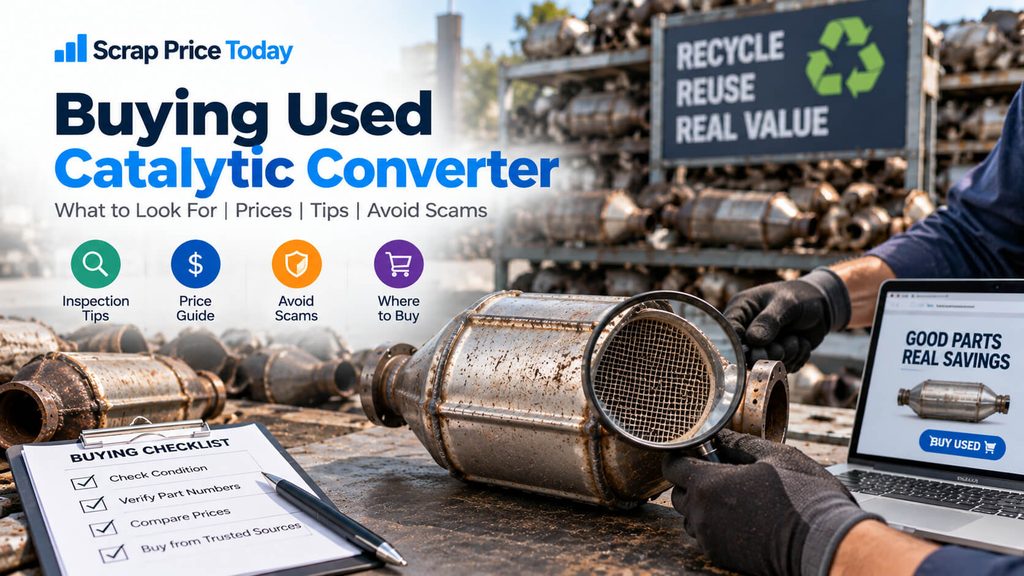
Buying a used catalytic converter is lawful under federal law, but only if it is EPA-certified for your exact year, make, model and engine, and only if the seller can prove it came from a vehicle they owned. New York bans installing used converters outright. Seven states require seller ID, the donor VIN and record-keeping. In California and Texas an unmarked converter is presumed stolen. The paperwork test comes before the price test.
The legal position, stated accurately
Most guides get this wrong in one of two directions. Some say used converters are illegal, which is not true federally. Others treat them as an ordinary used part, which is worse.
There is no single federal law prohibiting the sale of a used OEM catalytic converter. What federal rule does require, under 40 CFR 85.1701 to 1716, is that any converter sold for installation be EPA-certified for the specific vehicle, or CARB-certified in California and the other CARB states.
A used converter can satisfy that only if it came from a same-make, same-model, same-year vehicle and still meets the certification. That is a narrow gate, and most marketplace listings do not pass through it.
So the accurate framing is not prohibited, and not ordinary. It is conditionally lawful and difficult to satisfy, which is why shops that decline used converters are making a commercial judgement rather than being awkward.
Two related points, because people conflate them:
Converter replacement pipes are flatly illegal. Under the 1990 Clean Air Act Amendments, removing a converter and fitting a straight pipe violates section 203(a)(3)(A) and (B), and the prohibition extends to private individuals working on their own vehicles. There is no grey area there.
CARB states allow one-for-one replacement only. Adding converters or consolidating two into one is forbidden, whatever the parts catalogue suggests.
What it costs to get it wrong
The penalties are federal, per-violation, and they attach to more people than most sellers realise.
| Who | Penalty | Basis |
|---|---|---|
| Individual, repair shop or fleet operator | up to $2,500 per violation | Each improper installation counts as a separate violation |
| New-car dealer | up to $25,000 per violation | Same rules, higher exposure |
| Anyone who causes a violation | same penalty as the technician | You do not have to hold the tools to be liable |
| New York, first violation | minimum $500 | State Environmental Conservation Law |
| New York, each subsequent violation | up to $26,000 | Escalates sharply |
Note the third row. A vehicle owner who supplies a used converter and asks a shop to fit it can be subject to the same penalty as the technician who fits it. That is the specific reason independents who otherwise accept customer-supplied parts refuse this one.
Failure to keep complete records is itself a violation. California and New York require the paperwork to be retained for at least four years.
State rules: where used converters stand in 2026
The federal position is the floor. States have built substantially on top of it, and the direction of travel is one way.
| State | Position on used converters | What it requires |
|---|---|---|
| New York | Installation banned outright | Plus S4154 (2024): VIN engraving on every converter sold or installed, dealer records kept two years |
| California | Lawful only with full documentation | AB 1740 (2022): seller must record buyer ID, vehicle VIN and converter origin. Sales without VIN or proof of ownership are illegal |
| Texas | Trading in stolen converters heavily penalised | Unmarked converters treated as suspect; seller ID and origin records required |
| Minnesota, Illinois, Oregon, Washington | Lawful with documentation | Seller ID, VIN of origin and record-keeping required as of 2026 |
| Virginia | Disconnected converters restricted | Under § 18.2-146.1, sale or purchase of a disconnected converter is prohibited except by a compliant scrap purchaser. New, never-installed units are explicitly exempt |
| Most other states | No specific used-converter statute | Federal certification rule still applies, as does theft law |
Two things carry across almost all of them.
Possession of an unmarked or stolen converter is a felony in most of these states. Not a fine, a felony.
Unmarked converters are presumed stolen in California, Texas and several others. The absence of markings is not a neutral fact; it shifts the burden onto you.
The federal picture is about to change
The Preventing Auto Theft and Recycling Act, introduced in 2025 as S.2238 in the Senate and H.R.5221 in the House during the 119th Congress, is bipartisan and would do two things that matter here.
It would require traceable identification numbers etched or stamped onto catalytic converters at the factory, which removes the anonymity that makes stolen units saleable. And it would establish federal criminal penalties for trafficking stolen converters, which currently sits mostly with the states.
If it passes, the used market changes shape: a converter without a traceable number becomes obviously suspect everywhere rather than in seven states. Anyone buying used should assume that direction rather than bet against it.
The five checks, in order
Run these before you discuss price. Any one failing is a walk-away.
1. Does the seller have documentation of the donor vehicle? A bill of sale, a title, or a salvage yard receipt showing the VIN it came from. In seven states the seller is legally required to have this. If they cannot produce it, the transaction is unlawful in those states and unwise everywhere.
2. Does the VIN match a real vehicle of your exact year, make, model and engine? Federal certification is application-specific. A converter from a different application does not satisfy 40 CFR 85.1701, however well it bolts up.
3. Is the converter marked? Look for stamped certification numbers on the housing and cross-reference them against the EPA certified-converter database, or the CARB Executive Order listing in CARB states. An unmarked unit is presumed stolen in several states. Treat it as suspect and do not buy.
4. Does your state permit installation at all? In New York it does not, regardless of paperwork.
5. Will a shop actually fit it? Ask before you buy. Many refuse because the liability lands on them, and a converter you cannot get installed is a paperweight.
Why the cheap listing is cheap
A legitimate used OEM converter has a floor under its price, and that floor is its core value. A specialist recycler will pay $50 to $450 for a standard OEM unit and considerably more for hybrid units, priced from the stamped code.
So a seller listing a genuine OEM converter for $150 is choosing to accept less than a recycler would pay them, which is unusual behaviour with an honest explanation only occasionally.
The common explanations for a very cheap listing are, in rough order of likelihood: it is aftermarket rather than OEM and therefore worth under $30 as a core; it is the wrong application; the substrate is damaged or hollowed; or it has no paperwork because it cannot have paperwork.
That last case is the one that makes this a legal question rather than a bargain-hunting one. The replacement cost guide works through the full bill, and the converter price hub prices cores by stamped code, and comparing a listing against that figure is the fastest lie detector available.
When a used converter genuinely makes sense
There are real cases, and it is worth naming them rather than pretending there are none.
A documented salvage-yard unit from an identical vehicle, with the donor VIN recorded and the certification markings intact, in a state that permits installation. This is the mainstream lawful case, and reputable dismantlers handle it routinely.
An older vehicle in a non-CARB state where an OEM replacement is no longer manufactured and the aftermarket options are poor.
A vehicle being parted out where you own both cars and can document the transfer yourself.
In each case the unit is not cheap, because a lawful used converter competes with its own core value. If the price looks like a bargain, that is the signal to slow down.
Outside the United States
The certification framework is US-specific, but the underlying problem is not.
In the United Kingdom, converter theft drove the trade toward documented sourcing, and licensed Authorised Treatment Facilities handle end-of-life units under ATF rules. A used converter from an unlicensed source carries the same evidential problem it does in the US, without the EPA certification layer.
In the European Union, replacement converters must meet type-approval requirements rather than an EO scheme. Euro 7 enforcement from late 2026 changes what is fitted to new vehicles rather than what may be fitted to older ones.
In markets without an equivalent regime, the test shifts entirely to provenance: who owned the donor vehicle, and can they show it. The country pages set out identification and record-keeping rules market by market, and the pattern is consistent everywhere that scrap theft is a problem.
If you are setting up to buy rather than sell, the scrap business guide covers licence costs by state and the record-keeping obligations that come with dealing.
Questions people actually ask
Is it legal to buy a used catalytic converter?
Under federal law yes, with conditions. The unit must be EPA-certified for your exact year, make, model and engine, and the seller must be able to prove it came from a vehicle they owned. Seven states add ID and record-keeping requirements, and New York bans installation outright.
How do I know a used converter is not stolen?
Ask for the donor vehicle’s VIN and a bill of sale, and check the housing for stamped certification markings. In California, Texas and several other states an unmarked converter is presumed stolen, so the absence of markings is itself the answer.
Can a shop install a used converter I supply?
Many will refuse. Anyone who causes a violation is subject to the same penalty as the technician, up to $2,500 per installation, so the shop is accepting your risk as well as its own. Ask before you buy rather than after.
Why did my state ban used converters?
New York banned installation as a theft-suppression measure: removing the lawful outlet removes the cover story for stolen units. The penalty structure follows the same logic, starting at $500 and reaching $26,000 for repeat violations.
What is the PART Act?
A bipartisan federal bill introduced in 2025 as S.2238 and H.R.5221. It would require traceable identification numbers stamped on converters at the factory and create federal criminal penalties for trafficking stolen units. It is not law yet, but it signals where the market is heading.
Is a $300 used converter a good deal?
Usually not, because a genuine OEM unit is worth $50 to $450 as a core to a recycler. A seller accepting less than the scrap value is telling you something: the unit is aftermarket, the wrong application, damaged, or undocumented.
Can I fit a converter replacement pipe instead?
No. Under the 1990 Clean Air Act Amendments this violates section 203(a)(3)(A) and (B), and the prohibition applies to private individuals working on their own vehicles. It is the clearest rule in this area.
How long do I need to keep the paperwork?
At least four years in California and New York. Two years for dealer records under New York’s 2024 VIN engraving law. Failure to maintain complete records is itself a violation, separate from the installation.
Does a used converter need to match my exact model year?
Yes. Federal certification is application-specific, so a used unit satisfies the rule only if it came from a same-make, same-model, same-year vehicle and still meets that certification. Close enough is not a category the regulation recognises.
Regulatory figures on this page are from 40 CFR 85.1701 to 1716, EPA exhaust system repair guidance, and state statutes including California AB 1740 (2022), New York S4154 (2024) and Virginia § 18.2-146.1, current to 2026. The PART Act (S.2238 / H.R.5221) was introduced in the 119th Congress and is not law. State rules change frequently; verify with your state before buying or installing. This is general information, not legal advice.
Frequently asked questions
Is it legal to buy a used catalytic converter?
Under federal law yes, with conditions. The unit must be EPA-certified for your exact year, make, model and engine, and the seller must be able to prove it came from a vehicle they owned. Seven states add ID and record-keeping requirements, and New York bans installation outright.
How do I know a used converter is not stolen?
Ask for the donor vehicle's VIN and a bill of sale, and check the housing for stamped certification markings. In California, Texas and several other states an unmarked converter is presumed stolen, so the absence of markings is itself the answer.
Can a shop install a used converter I supply?
Many will refuse. Anyone who causes a violation is subject to the same penalty as the technician, up to $2,500 per installation, so the shop is accepting your risk as well as its own. Ask before you buy rather than after.
Why did my state ban used converters?
New York banned installation as a theft-suppression measure: removing the lawful outlet removes the cover story for stolen units. The penalty structure follows the same logic, starting at $500 and reaching $26,000 for repeat violations.
What is the PART Act?
A bipartisan federal bill introduced in 2025 as S.2238 and H.R.5221. It would require traceable identification numbers stamped on converters at the factory and create federal criminal penalties for trafficking stolen units. It is not law yet, but it signals where the market is heading.
Is a $300 used converter a good deal?
Usually not, because a genuine OEM unit is worth $50 to $450 as a core to a recycler. A seller accepting less than the scrap value is telling you something: the unit is aftermarket, the wrong application, damaged, or undocumented.
Can I fit a converter replacement pipe instead?
No. Under the 1990 Clean Air Act Amendments this violates section 203(a)(3)(A) and (B), and the prohibition applies to private individuals working on their own vehicles. It is the clearest rule in this area.
How long do I need to keep the paperwork?
At least four years in California and New York. Two years for dealer records under New York's 2024 VIN engraving law. Failure to maintain complete records is itself a violation, separate from the installation.
Does a used converter need to match my exact model year?
Yes. Federal certification is application-specific, so a used unit satisfies the rule only if it came from a same-make, same-model, same-year vehicle and still meets that certification. Close enough is not a category the regulation recognises.