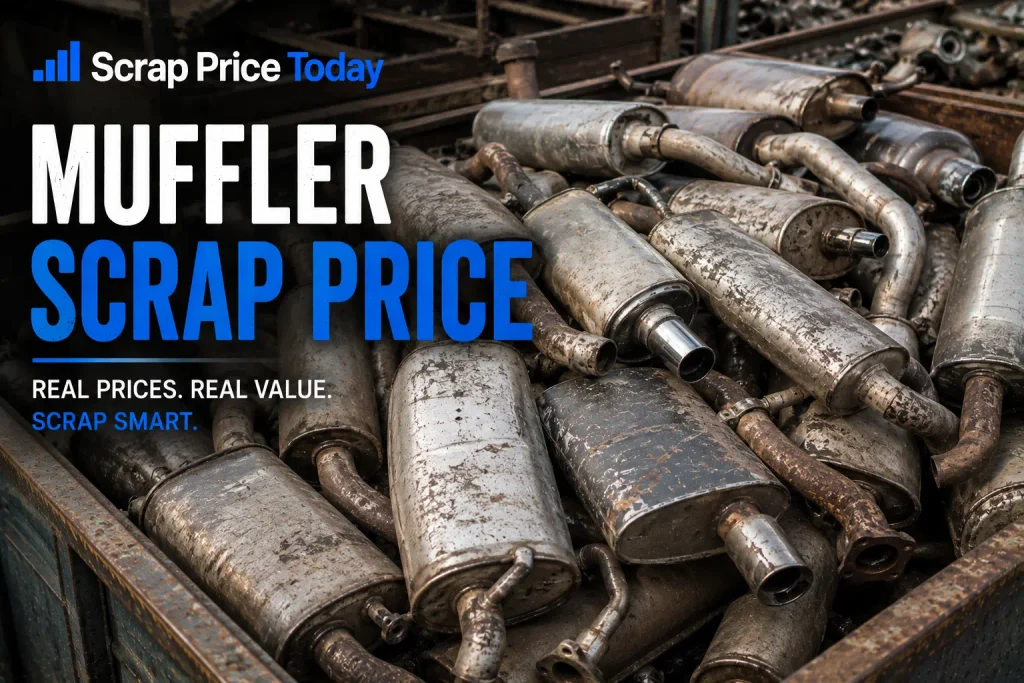
A steel muffler is worth its weight as shred steel, which puts a typical 15 to 25 pound unit in the low tens of dollars. A catalytic converter from the same exhaust can be worth $90 to $550, and sometimes over $1,000. If the number you were expecting is much larger than the number below, you are probably thinking of the converter.
First: which part are you holding?
The question sounds basic, but it is the one that decides everything. A great many people searching for a muffler scrap price are describing a converter, and a smaller group have a resonator and do not know the word for it.
All three are metal cylinders bolted into the same pipe under the same car. They look similar from three feet away. They are not remotely similar in value.
Identifying exhaust parts correctly is the whole job here, and the muffler vs catalytic converter mix-up is the one that costs real money.
Here is the order they sit in, from the engine backward: exhaust manifold, then the catalytic converter, then the resonator, then the muffler, then the tailpipe. Work from the front of the car and the first substantial component you meet is the valuable one.
Converter, resonator and muffler, told apart
Four checks, in the order that settles it fastest.
- Position. The converter sits closest to the engine, usually within a metre of the manifold. The muffler is at the back, near the tailpipe. The resonator, when fitted, sits between them.
- Heat shielding. A working converter runs at roughly 1,200 to 1,600 degrees Fahrenheit, so it is wrapped in a stainless heat shield. Mufflers are not.
- Stamped codes. Converters carry serial numbers and part codes on the housing. Mufflers and resonators rarely carry anything but a brand name.
- Size and shape. The resonator is usually smaller than the muffler and often a plain straight-through cylinder. Not every car has one, though most do.
The resonator vs catalytic converter question trips up more sellers than the muffler one, because both can sit mid-pipe on a long exhaust. Position and the stamped code settle it: only the converter carries a code.
One more that costs nothing: shake it. A converter holds a ceramic honeycomb and feels dense. A muffler is chambers and baffles, and sounds hollow.
If you are still unsure what does a catalytic converter look like in practice, the answer is a compact oval or round canister, noticeably heavier than it appears, wrapped in bright stainless shielding and stamped with a code that no other exhaust component carries.
Today’s muffler rate, and the honest low number
The table below is why the confusion matters. These are indicative buyer ranges, not offers.
Route or component Basis Notes Value today (USD) Measurement What the figure is based on What changes it Computed from the live rate unless marked a reference Catalytic converter, for comparison Per unit Priced by stamped code, not weight $50 to $450 304 stainless muffler (aftermarket, performance) 15 to 25 lb Nickel-bearing; magnet will not stick $8.55 to $14 409 or 439 stainless muffler (OEM stainless) 15 to 25 lb Ferritic, little or no nickel; magnet sticks $4.00 to $9.00 Aluminized steel muffler (most factory systems) 15 to 25 lb Carbon steel with a thin aluminium coat; shred grade $2.25 to $3.75 Mild steel muffler 15 to 25 lb Shred grade $2.25 to $3.75 Resonator 8 to 15 lb Same materials, smaller; not a converter $1.20 to $2.25 Titanium muffler (rare, performance only) 6 to 12 lb Own grade; call before assuming a yard buys it $30 to $90
So, is a muffler worth scrapping on its own? If it is already off the car, yes, take it with the rest of your steel. If it is still bolted on and the vehicle is heading to a crusher, no, because that weight is paid for either way.
The short version of the exhaust scrap value question: everything behind the converter is priced as ordinary steel by weight, and the converter is priced by its stamped code.
A few figures worth carrying:
- Most used catalytic converters sell for $90 to $550 in 2026, with aftermarket units as low as $15 and some hybrid units above $1,000.
- Scrap buyers sort converters into more than 40 classifications, which is why a code beats a description every time.
- Aftermarket converters contain 50 to 90 percent less platinum, palladium and rhodium than the factory part they replaced.
- Diesel converters hold roughly 2 to 3 grams of precious metal against 10 to 15 grams in a petrol unit.
Stainless exhaust: the one genuine upgrade
If your muffler is stainless rather than mild steel, separate it. Stainless sells as its own grade and pays several times the shred rate, so the sorting is worth the two minutes.
Testing it is simple. Most stainless exhaust alloys are weakly magnetic or non-magnetic, while mild steel grabs a magnet firmly. Stainless also stays bright where mild steel goes orange with rust.
This is the honest answer to the stainless muffler scrap price question: better than mild steel, still nowhere near converter money.
Four exhaust metals, and the magnet test that separates them
Saying a muffler is stainless or not is too coarse, because four materials are in common use and they span a wide range of value.
- Aluminized steel. Carbon steel hot-dipped in an aluminium alloy, with no chromium or nickel. Most factory exhausts use it because it keeps the build cost low. It grades as ordinary shred steel.
- 409 stainless. Ferritic, with chromium but almost no nickel. A common OEM stainless, more durable than aluminized but the cheaper stainless grade at the scale.
- 439 stainless. Sits between the two, with roughly 18 percent chromium matching 304 but only about 0.5 percent nickel, matching 409.
- 304 stainless. Austenitic, with 18 to 20 percent chromium and 8 to 10 percent nickel. Common on aftermarket and performance systems, and the best-paying exhaust metal short of titanium.
The magnet works here, but only for one job. A magnet sticks to 409 because of its higher iron content, and does not stick to 304. So a magnet separates the two stainless grades from each other. It does not tell you stainless from aluminized steel, because it sticks to both.
For aluminized versus stainless, look at how it has failed. Aluminized steel rusts from the inside out and eventually rots through, so a rusted-through muffler is almost certainly aluminized or mild steel. Stainless discolours to a golden brown under heat without scaling away.
One practical shortcut on origin: factory systems are usually aluminized or 409, and 304 usually means someone fitted an aftermarket system. That is a tendency rather than a rule, so test rather than assume from the badge on the car.
If yours is actually a converter
Good news, and a different page. Converter values turn on the stamped code, the vehicle it came from and whether the honeycomb is intact, none of which apply to a muffler.
Start at the catalytic converter price page, which covers types, codes and selling rules, and carries a page for each of 48 brands. If you know the make, go straight to it: Honda, Toyota and Ford are the three most searched.
For how the rest of the car ranks by return per hour of work, the most valuable parts to scrap ranking puts the exhaust in context.
Muffler prices around the world
Steel settles in US dollars, so the metal in a muffler is worth the same everywhere. What changes is the currency and how deep the local buyer market is.
| Market | Equivalent range | Local market note |
|---|---|---|
| United States | $1.20 to 14.25 | Deepest buyer pool. Even within the US, state to state runs $50 to $60 per ton apart. |
| United Kingdom | £0.86 to 10.21 | Strong processing capacity. Battery and PGM material reported 20 to 40 percent above thin markets. |
| Canada | C$1.64 to 19.42 | Similar structure to the US; thinner in the prairies and the north. |
| Australia | A$1.62 to 19.27 | Good coastal capacity, long hauls inland. Distance is the main discount. |
| Germany | €1.09 to 12.94 | Dense processing and strict documentation. Good grades pay well; paperwork matters. |
| India | ₹104.43 to 1,240 | Large volume, but black mass export restrictions have compressed local payables. |
| Bangladesh | ৳130.63 to 1,551 | Ferrous depth is good. Specialist converter, PGM and battery buyers are scarce. |
| United Arab Emirates | AED4.19 to 49.72 | Re-export hub with real processing depth. Among the better-paying markets outside the West. |
| Saudi Arabia | SAR4.19 to 49.70 | Growing capacity; specialist PGM and battery buyers still limited. |
| Turkey | ₺61.95 to 735.71 | Major ferrous importer, so steel grades hold up better than non-ferrous here. |
| South Africa | R16.70 to 198.34 | Reported below UAE and UK on battery material; processing infrastructure is the constraint. |
| China | CN¥7.87 to 93.42 | Aggressive bidder on imported battery material; 2026 recycling rules moved payables down. |
Treat these as the metal-value anchor rather than a local quote. In markets where scrap steel is collected by weight at the kerb, a single muffler is rarely worth a separate trip, which is the same conclusion the US column reaches.
Questions people actually ask
“I cut off the round thing near the back, is that the expensive one?”
Almost certainly not. The valuable unit sits near the engine, not near the bumper. Look forward along the pipe for a component with a heat shield and a stamped code.
“My exhaust came off in one piece, what is the full exhaust system scrap value?”
Sell it in two parts. Cut the converter free and quote it by its code, then weigh the remaining pipe, resonator and muffler as steel. Selling the assembly whole means the buyer prices the converter and keeps the difference.
“What is the exhaust pipe scrap price on its own?”
Pipe is mild steel by weight, so it moves with the shred rate and nothing else. A full length of pipe rarely reaches double figures, which is why it is worth removing only when the car is already stripped.
“Is it worth taking the exhaust off before scrapping the car?”
For the muffler and pipe alone, no. The crusher pays for that steel anyway, so you gain nothing but an hour under the car. For the converter, yes, every time.
Common mistakes
- Selling a whole exhaust as one lot, so the converter goes out at pipe-steel rates.
- Cutting a converter open to look at the honeycomb, which destroys the code-based quote.
- Assuming the biggest component is the valuable one. The muffler is usually the largest and the cheapest.
- Scrapping stainless with mild steel, which loses the one premium the exhaust genuinely offers.
- Grinding off a serial number, which reputable buyers treat as a theft indicator and will refuse.
- Taking one quote on a converter, when spreads between buyers on the same unit routinely run 30 to 50 percent.
Figures on this page are indicative buyer ranges for the material described, not offers to buy. Steel rates are computed from the site’s tracked daily benchmark; converter figures are published market references. Confirm locally before cutting anything.
Frequently asked questions
Is a muffler the same as a catalytic converter?
No. The converter sits near the engine, carries a heat shield and a stamped serial code, and cleans exhaust gases using platinum, palladium and rhodium. The muffler sits at the back of the car, reduces noise using internal chambers, and contains no precious metal at all.
How much is a muffler worth in scrap?
A mild steel muffler is priced as shred steel by weight, so a typical 15 to 25 pound unit lands in the low tens of dollars. A stainless muffler of the same size pays several times more because stainless sells as its own grade.
How do I know if I have a catalytic converter or a resonator?
Check position and markings. The converter sits closest to the engine, usually within a metre of the manifold, and carries a heat shield plus a stamped part code. The resonator sits further back between the converter and the muffler, is usually smaller, and carries no code.
Are stainless steel exhausts worth more as scrap?
Yes. Stainless sells as a separate grade well above mild steel shred rate, so it is worth separating. Test it with a magnet: most stainless exhaust alloys are weakly magnetic or non-magnetic, while mild steel grabs firmly and rusts orange.
Where is the catalytic converter located on a car?
Between the exhaust manifold and the resonator, usually within about a metre of the engine. Follow the exhaust pipe forward from the tailpipe and it is the first substantial component you reach, identifiable by its stainless heat shield.
How much is a catalytic converter worth compared to a muffler?
Most used converters sell for $90 to $550 in 2026, with aftermarket units as low as $15 and some hybrid units above $1,000. A muffler from the same vehicle is worth its weight in steel, which is a fraction of that.
Should I sell my whole exhaust system as one piece?
No. Separate the converter and quote it by its stamped code, then weigh the pipe, resonator and muffler as steel. Sold as one lot, the buyer prices the converter and keeps the difference between that and the scrap-steel rate you were paid.
Is an exhaust pipe worth scrapping on its own?
Only as steel by weight, which rarely justifies removing it. If the car is going to a crusher, the pipe is paid for in the vehicle weight anyway, so the labour returns nothing extra.
Why do converters vary so much in price?
Because buyers sort them into more than 40 classifications based on the stamped code, the vehicle and the precious metal loading. Aftermarket units contain 50 to 90 percent less platinum group metal than the factory part, and diesel units hold 2 to 3 grams against 10 to 15 grams in a petrol converter.
Does every car have a resonator?
Most do, but not all. When fitted it sits between the converter and the muffler, and its job is smoothing specific frequencies rather than reducing overall volume. As scrap it prices the same as the muffler, by weight and grade.