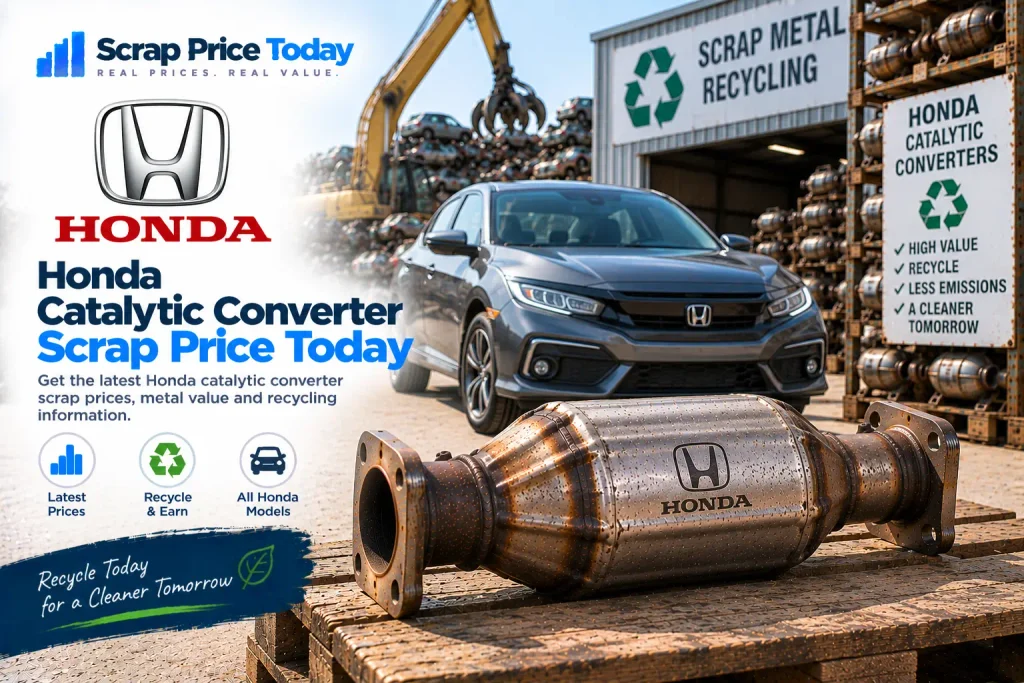
Most original Honda catalytic converters sell for $50 to $250 as scrap in 2026. Fit and Jazz units start near $30, Accord and CR-V units run $60 to $230, and Odyssey and Pilot units reach about $250. Buyers price the code stamped on the shell, not the car, and the ranges below are compiled from published core-buyer lists and catalyst exchange data.
Honda sits near the top of almost every core buyer’s list, and not out of badge loyalty. The 1998 to 2017 fleet was built in the heart of the palladium era, the units are compact enough to ship cheaply in bulk, and the number of Accords, Civics and CR-Vs reaching end of life keeps a steady stream of known part numbers moving through the trade. When supply is that predictable, buyers publish firm numbers for it — which is exactly what makes a Honda easy to sell well, and just as easy to sell badly.
What a buyer checks first on a Honda
Watch a buyer handle a Honda unit and the routine barely varies. First, the code. Honda stamps short mixed letter and number combinations on the shell body or the flange collar, sometimes hidden under a spot-welded heat shield. That code is the price; the car it came off is almost irrelevant.
Second, the shake and the look. A gentle shake should return silence — rattling means broken honeycomb and a steep markdown. A glance through each end should show the honeycomb face intact and unmelted. Third, the seams. A factory Honda unit has clean pressed seams and real weight in the hand. A thin shell, a plain welded tag or no code at all reads as an aftermarket replacement, and it gets the flat $5 to $50 price whatever car it came off.
Pass all three checks and the conversation moves to the buyer’s list price for that code. Fail any one, and the quote drops before you have said a word.
Honda catalytic converter scrap prices by model
Model Years Notes Indicative range (USD) Measurement Model years covered What sets the unit apart Buyer quotes for one complete unit, honeycomb intact Accord 1994 to 2017 V6 and 1990s 3.0 units lead; four-cylinder units sit lower $60 to $230 CR-V 1997 to 2017 Priced close to the Accord on most lists $60 to $230 Odyssey 1999 to 2017 V6 van, usually two units; the range is for one $75 to $250 Pilot 2003 to 2017 V6 with a larger substrate, shares codes with Odyssey $75 to $250 Element 2003 to 2011 Shares a unit with Accord and Civic of the same era $60 to $215 Civic 1996 to 2018 The benchmark small Honda unit; some 1.5 codes go higher $50 to $200 Insight hybrid 2000 to 2014 Hybrid loading, but well below Prius levels $75 to $250 Prelude 1992 to 2001 Worth real money only if the original survives $40 to $150 Fit and Jazz 2007 to 2018 Small unit, modest loading $30 to $150 Manifold pre-cat, any model Various Small unit cast into the exhaust manifold $20 to $100 Aftermarket replacement, any model All years Universal unit, trace metal $5 to $50
Ranges are compiled from published core-buyer code lists and catalyst exchange transaction data, cross-checked against current scrap guides; they are not a live per-code feed. Figures are for one complete unit. Four-cylinder Accords and Civics from the 2000s often carry a second small manifold unit worth checking, and every Odyssey and Pilot V6 carries a unit per cylinder bank, so a whole vehicle can total well above the single-unit figure.
Honda prices around the world
Precious metals settle in US dollars, so a Honda code carries the same metal value in Dhaka as in Detroit. What changes is the currency, the freight and how many buyers are competing for it. The table converts the going range for one original Honda unit into each market’s money at today’s exchange rate.
Market Currency Unit Equivalent range United States USD per unit $50.00 to 250.00 United Kingdom GBP per unit £37.33 to 186.67 Canada CAD per unit C$70.24 to 351.20 Australia AUD per unit A$71.16 to 355.80 Germany EUR per unit €44.51 to 222.57 India INR per unit ₹4,730 to 23,648 Bangladesh BDT per unit ৳6,185 to 30,927 United Arab Emirates AED per unit AED183.63 to 918.13 Saudi Arabia SAR per unit SAR187.50 to 937.50 Turkey TRY per unit ₺2,482 to 12,411 South Africa ZAR per unit R818.74 to 4,094 China CNY per unit CN¥334.47 to 1,672
Treat the conversions as the metal-value anchor rather than a local quote. Deep markets such as the United States and the United Kingdom pay close to the anchor; markets where units are exported for refining, including Bangladesh and India, settle below it once freight and the exporter’s margin come out.
Accord, Civic, CR-V and Odyssey: the big four
| Model | Units on the vehicle | Where the code hides | What moves the quote |
|---|---|---|---|
| Measurement | Separate converters fitted | Typical stamp location | The detail buyers reprice on |
| Accord | One main; 4-cylinder years add a manifold unit | Shell body, under the heat shield | V6 units and clean originals sit at the top |
| Civic | One main, small pre-cat on some years | Flange collar | Aftermarket swaps are common, so originals stand out |
| CR-V | One main unit | Shell body near the front flange | AWD years run larger substrates |
| Odyssey | Two, one per bank | Each unit stamped separately | Selling both units, not just one |
Four models, four different selling situations — which is why the bare question of what a Honda cat is worth has no single answer worth trusting.
Manifold cats and the straight sensor line
Two Honda-specific lines confuse sellers more than any others. The first is the manifold pre-cat: on many four-cylinder Hondas a small catalyst is cast directly into the exhaust manifold, close to the engine. It is easy to overlook and worth $20 to $100 on its own, so a one-cat Accord often is not one.
The second is the phrase straight sensor on buyer price lists. Core buyers sort the common Honda units by the angle of the oxygen sensor boss on the shell: units where the sensor enters straight are listed and priced as their own category, separately from angled-sensor versions of the near-identical unit. If a list quotes a Honda straight sensor price, it is describing that family — check which way your sensor port points before assuming the number applies.
Why two yards quote different numbers for the same Honda
Same unit, different quotes, and usually for one of four reasons. A general scrap yard pays a flat category price while a core specialist prices the exact code, and the specialist is nearly always higher on an original Honda. The day matters, because every list re-marks when platinum, palladium and rhodium move. Volume matters, since a dismantler with fifty units negotiates a tier a single seller never sees. And the market matters, as the country table above shows. Two or three code-based quotes on the same day settle it.
Common mistakes Honda sellers make
- Accepting the flat aftermarket price for a coded original — the single most expensive mistake on a Honda.
- Scrapping the whole car with the converter counted as ordinary steel weight.
- Forgetting the manifold pre-cat on four-cylinder Accords and Civics.
- Cutting the unit open to show the honeycomb, which destroys most of the value.
- Describing the car over the phone instead of texting the code and photos.
- Selling the day after a metals drop instead of waiting for a stronger reference price.
Questions people actually ask
Are Honda cats really stolen more than other brands?
Accords and CR-Vs appear constantly in theft reports because they are everywhere and their units resell easily. If yours was taken, the theft and reporting rules explain the paperwork, and comprehensive insurance usually covers replacement less the deductible.
Is it worth replacing a failed cat before selling the car?
Almost never for resale value. A replacement costs far more than the old unit returns in scrap. If the car itself is bound for the yard, sell the original unit as a core and let the next owner worry about the exhaust.
My Honda is older than 1996 — does it still have value?
Pre-OBD2 Hondas carry earlier, lighter-loaded units. Original survivors from the early 1990s still bring $40 to $150, but decades of exhaust repairs mean many were long ago swapped for aftermarket pipes worth almost nothing.
Figures on this page are indicative buyer ranges for complete, uncut original units and are not offers to buy. The full picture — converter types, codes, selling rules and the metals behind the price — is on the main catalytic converter price page.
Frequently asked questions
How much is a Honda catalytic converter worth as scrap?
Most original Honda units sell for $50 to $250 in 2026. Fit and Jazz units start near $30, Accord and CR-V units run $60 to $230, and Odyssey and Pilot units reach about $250. Aftermarket replacements bring $5 to $50 regardless of model.
Which Honda has the most valuable catalytic converter?
Odyssey and Pilot V6 units lead at roughly $75 to $250, with V6 Accords close behind. The Insight hybrid carries a heavier loading than other Hondas but stays well below Toyota Prius levels, at about $75 to $250.
How many catalytic converters does a Honda Accord have?
Most 1998 to 2017 four-cylinder Accords carry a main underfloor converter plus a small pre-cat in the exhaust manifold. V6 Accords carry a unit per cylinder bank, so a single car can hold roughly $80 to $330 of converters in total.
What does Honda straight sensor mean on a price list?
It is a core-buyer category for common Honda units sorted by the angle of the oxygen sensor boss: sensors entering the shell straight are listed and priced separately from angled versions of the near-identical unit. Check your sensor port before applying the listed price.
How do I find the code on a Honda catalytic converter?
Look for short stamped letter and number combinations on the shell body or the flange collar, sometimes under a spot-welded heat shield. Wire-brush the area, photograph it in daylight, and send the code rather than the car's details when asking for quotes.
Why is my Honda quote so much lower than the price list?
The usual reasons are an aftermarket replacement instead of the original, a rattling or cut unit, a flat category price from a general yard rather than a code price from a specialist, or a week in which platinum, palladium and rhodium fell.