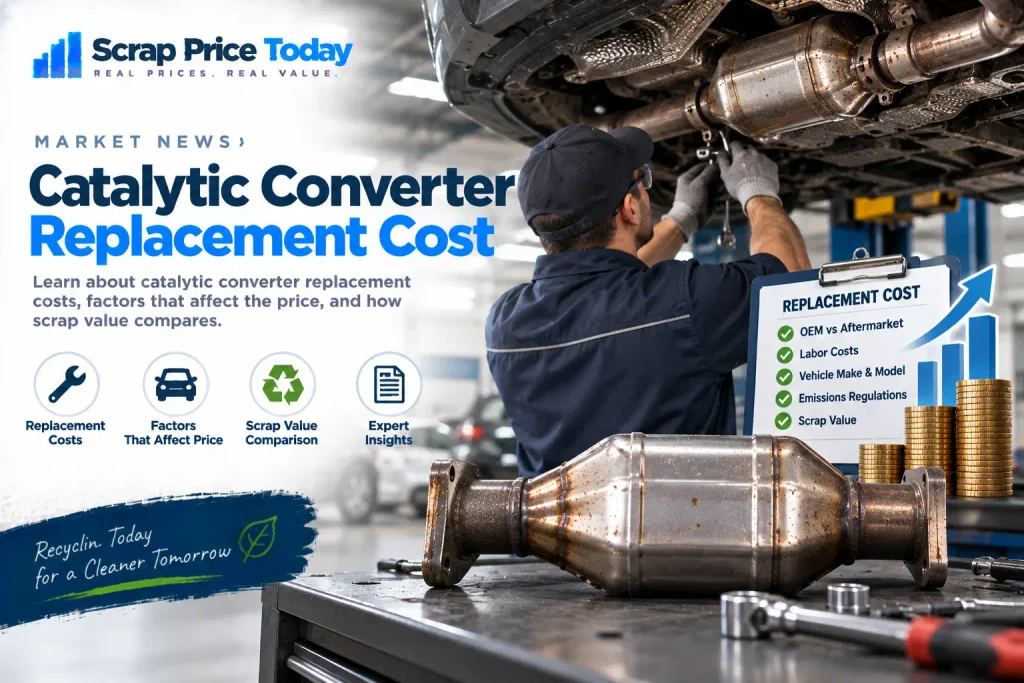
Replacing a catalytic converter typically costs $900 to $3,500, with most drivers paying somewhere between $1,300 and $2,500, and luxury or multi-converter vehicles running past $5,000. Parts, not labour, are the bulk of it: a universal aftermarket unit runs a few hundred dollars, a direct-fit aftermarket unit $300 to $1,200, and an OEM converter frequently over $2,500. The line almost nobody mentions is that your failed converter still contains platinum, palladium and rhodium, and it has a core value the shop will keep unless you ask.
What you should do next depends less on the price than on why you are reading this.
Three arrivals, three different answers
| Warning light or P0420 | Failed emissions test | Stolen converter | |
|---|---|---|---|
| Measurement | Why you are facing this bill and what changes because of it | Same | Same |
| Is the converter definitely at fault? | Often not | Usually yes | Not applicable |
| First step | Diagnose properly before buying anything | Confirm which converter failed | Police report and insurance claim |
| Part required | Whatever your state’s rules allow | Emissions-compliant for your state | Same, plus cut pipe repair |
| Old unit | Yours, and worth money | Yours, and worth money | Gone with the thief |
| Biggest risk | Replacing a good converter | Buying a part that fails re-test | Paying a deductible on a repeat target |
That first column matters most. A P0420 or P0430 code reports that the converter is not working efficiently, which is not the same as the converter being broken. Failed oxygen sensors, exhaust leaks, misfires and burning oil all produce the same code, and every one of them is cheaper to fix. A converter that failed because the engine was feeding it oil will fail again within months if only the converter is replaced.
So the first money you spend is on diagnosis, not parts.
What the bill is made of
The part dominates, which is unusual for a repair of this size.
- Universal aftermarket, roughly $100 to $500, requires cutting and welding, and is not road legal in every state.
- Direct-fit aftermarket, roughly $300 to $1,200, bolts into the original layout and is the middle ground most drivers land on.
- OEM from the manufacturer, often $1,000 to $3,500 and beyond, typically 40 to 70 percent more than an equivalent aftermarket part.
- CARB-compliant parts, required in California and several other states, add roughly 30 to 60 percent over a federal-spec part.
- Labour is comparatively small, commonly $100 to $400, at shop rates of $150 to $300 an hour for a job that usually takes one to three hours.
- Oxygen sensors often seize or fail at the same time, adding about $150 to $300 each.
Why the part costs so much is the subject of our gram maths on converter value: the precious metals inside are priced per ounce well above gold, and a new unit has to buy them at market.
The offset nobody mentions
Here is the part that belongs on a scrap site and appears almost nowhere else.
Your old converter is not waste. It is a core, and it still contains recoverable platinum, palladium and rhodium even after it has stopped working, because failure is usually about the substrate cracking, melting or clogging rather than the metals disappearing.
- Shops routinely sell removed converters to recyclers. That revenue is real, and by default it stays with the shop.
- Ask before the work starts: will the old converter be returned to me, or will its core value be credited against the bill?
- Some shops will happily deduct it. Some cannot, because a warranty or emissions programme requires them to surrender the old unit. Both answers are legitimate, and only silence is not.
- What a specific unit is worth depends entirely on its identification, not its size, which is why our converter price page prices them by type rather than by weight.
This is the same mechanism as the core charge on a car battery, described on our battery page, except that the battery industry made the refund automatic and the converter trade never did.
If you keep the old unit and sell it yourself, note that most states now regulate converter sales tightly: identification, proof of ownership, records and delayed payment are common requirements, as our converter law page explains. Those rules exist because of theft, and a legitimate seller has to satisfy them like anyone else.
When the repair costs more than the car
On an older vehicle, a converter quote frequently exceeds the market value of the car itself, and that changes the question entirely.
Run three numbers before deciding:
- The quote, itemised, with the part type named.
- The car’s private sale value in its current, failing state.
- The car’s scrap value, which our junk car arithmetic sets out, and which includes the converter still bolted underneath.
If the quote is close to or above the second figure, repair is usually the worse deal, and a scrap yard buying the whole car pays partly because that converter is still attached. If you are keeping the car for several more years, the calculation flips and an OEM or quality direct-fit part is defensible.
One route is not available: removing the converter, or fitting a hollow replacement pipe. It is a federal offence to tamper with emissions equipment, it fails inspection anywhere testing exists, and it destroys the resale value of the car. We do not cover how it is done.
Before you approve the work
- Get a second quote. The same job routinely varies by $300 to $500 between shops in one city, and two quotes within about 15 percent of each other tell you that you are seeing the real market price.
- Ask which part is being fitted, by name: universal, direct-fit aftermarket, or OEM.
- Confirm state compliance before purchase if you live somewhere requiring CARB-certified parts.
- Get the estimate itemised: parts, labour, diagnostics, sensors, shop fees and tax.
- Ask about the old unit, as above.
- Fix the cause, not only the symptom, or you will buy the same part twice.
Questions people actually ask
Can I drive with a bad catalytic converter? Briefly and carefully, if it is not clogged. A blocked converter chokes the engine, causes overheating and can leave you stranded, and it will fail any emissions test in the meantime.
Is aftermarket as good as OEM? For most cars past their warranty, a quality direct-fit aftermarket unit is the sensible middle. For a newer vehicle you are keeping, OEM protects the emissions warranty and the fit.
Does insurance cover it? For theft, usually under comprehensive cover, subject to your deductible. For ordinary failure, no.
Why is my quote double my neighbour’s? Converter count, mostly. Many vehicles have two or more, and V-engines often need both banks, which doubles the parts line before anything else varies.
Common mistakes
- Buying a converter off a trouble code alone, when sensors, leaks and misfires produce the same code.
- Letting the old unit leave without asking what happens to its core value.
- Fitting a federal-spec part in a CARB state, then failing the re-test and paying twice.
- Approving the first quote on a repair where shop-to-shop spread is measured in hundreds.
- Repairing a car worth less than the repair, without checking its scrap value first.
- Ignoring the underlying cause, which sends the new converter the way of the old one.
Where this fits
What makes the part so valuable is broken down in why converters are expensive, current scrap levels are on the converter price page, the selling rules are in converter laws, and the whole-car comparison is in what a junk car is worth.
Frequently asked questions
How much does a catalytic converter replacement cost?
Typically $900 to $3,500, with most drivers paying $1,300 to $2,500 and luxury or multi-converter vehicles exceeding $5,000. Parts dominate the bill: universal aftermarket units run a few hundred dollars, direct-fit aftermarket $300 to $1,200, and OEM frequently over $2,500.
Why are catalytic converters so expensive to replace?
Because the part contains platinum, palladium and rhodium, metals priced per ounce well above gold, and a new unit has to buy them at market. Labour is comparatively small at roughly $100 to $400 for a one to three hour job.
Does a P0420 code mean I need a new catalytic converter?
Not by itself. The code reports that the converter is not working efficiently, which failed oxygen sensors, exhaust leaks, misfires and oil burning all cause too. Diagnose first, because replacing a good converter is the most expensive mistake available here.
What happens to my old catalytic converter?
It is a core with real value, since the precious metals remain even after the substrate cracks or clogs. Shops routinely sell removed units to recyclers, and that revenue stays with the shop unless you ask about it before the work starts.
Can I get credit for my old converter?
Sometimes. Ask whether the old unit will be returned to you or its core value credited against the bill. Some shops will deduct it, others cannot because a warranty or emissions programme requires them to surrender it. Both answers are fine; silence is not.
What is the difference between universal, direct-fit and OEM converters?
Universal units are cheapest but need cutting and welding and are not legal everywhere. Direct-fit aftermarket bolts into the original layout at $300 to $1,200. OEM matches the factory part exactly and costs roughly 40 to 70 percent more than an equivalent aftermarket unit.
Do I need a CARB-compliant converter?
In California and several other states, yes, and a federal-spec part will fail the re-test. CARB-certified parts typically cost 30 to 60 percent more, so confirm the requirement before the shop orders anything.
When is a catalytic converter not worth replacing?
When the quote approaches or exceeds what the car is worth. Compare the itemised quote against the vehicle's private sale value in its current state and against its scrap value, remembering that a yard buying the whole car is partly paying for the converter still attached.
Can I just remove the catalytic converter instead?
No. Tampering with emissions equipment is a federal offence, fails inspection anywhere testing exists, and destroys resale value. It is not a cheaper option, only a deferred and larger cost.
Why do quotes vary so much between shops?
Parts sourcing, labour rates and overhead differ, and the same job routinely varies $300 to $500 within one city. Converter count matters too, since many vehicles carry two or more. Two quotes within about 15 percent of each other indicate the real market price.