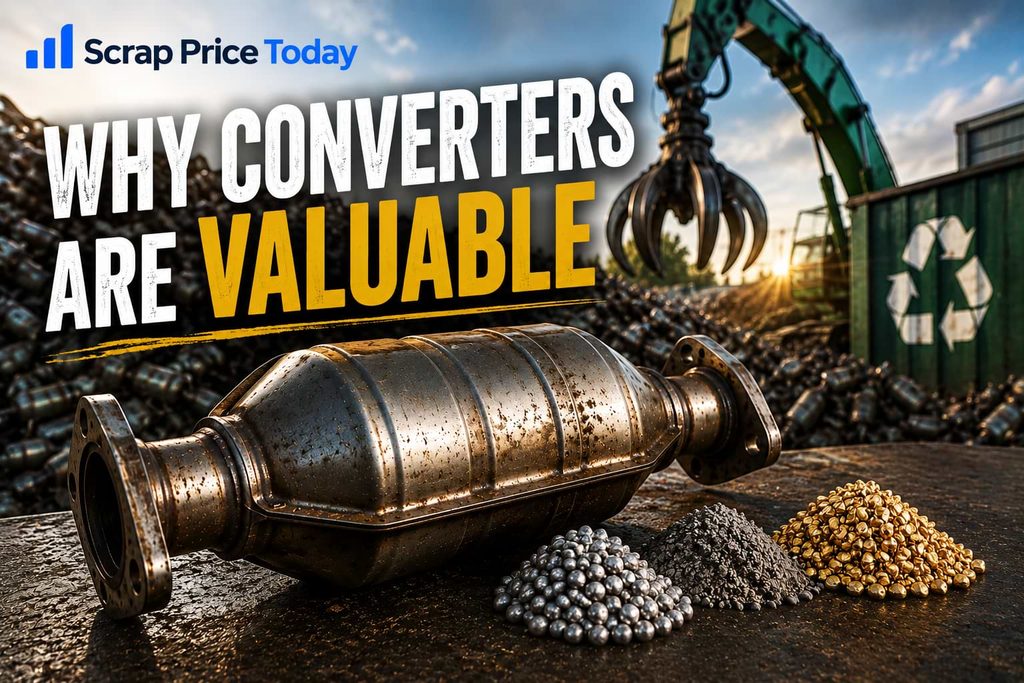
A catalytic converter is expensive because of a few grams of platinum, palladium and rhodium coated onto a ceramic honeycomb inside the shell. At current prices rhodium alone runs about $285 a gram, roughly three times the gold price. Autocatalysts consume around 80 percent of world rhodium, and platinum has been in supply deficit for four consecutive years, which is why the metal in an exhaust part costs more than the rest of the exhaust.
Scrap Price Today market analysis, written from exchange settlement data, mill and refiner pricing practice and published policy documents. Figures are examples; today’s numbers are on the live scrap price board.
The question arrives from two directions: a driver facing a repair bill, and a scrapper holding an old unit. Both answers start in the same place, and the numbers are more specific than most explanations admit.
What is actually inside
Cut a converter open and there is no block of precious metal. There is a ceramic honeycomb with thousands of thin channels, designed to give exhaust gas an enormous surface area to touch as it passes.
That surface carries a washcoat, and the washcoat carries the metal as a microscopically thin catalytic layer. A typical passenger car unit holds three to seven grams of platinum group metals across the whole assembly.
The steel shell is ordinary scrap. Almost the entire value sits in a coating you cannot see, which is why weight is a poor guide to worth.
Why these three metals, and why nothing cheaper
Each metal does a different job in the same reaction. Platinum and palladium oxidise carbon monoxide and unburnt fuel into carbon dioxide and water. Rhodium handles the harder task of breaking nitrogen oxides back into nitrogen and oxygen.
Manufacturers have substituted between platinum and palladium repeatedly as their relative prices crossed. Nobody has substituted away from rhodium, because nothing else does its job at the temperatures and cycles an exhaust demands.
That is the whole cost problem in one sentence: two of the three metals are interchangeable at the margin, and the most expensive one is not.
What the metals cost, per gram
| Platinum | Palladium | Rhodium | |
|---|---|---|---|
| Measurement | USD per troy ounce and per gram | USD per troy ounce and per gram | USD per troy ounce and per gram |
| Current level | $1,895.60 an ounce, about $60.94 a gram | $1,422.50 an ounce, about $45.73 a gram | $8,850 an ounce, about $284.55 a gram |
| Priced by | NYMEX, settled daily | NYMEX, settled daily | Refiner published price, no exchange |
| Share of world demand from autocatalysts | Significant, alongside industrial and jewellery use | Dominated by petrol autocatalysts | Around 80 percent |
| Supply position | In deficit for a fourth consecutive year | Small surplus forecast | Narrow surplus forecast, inside forecast error |
Apply those figures to a unit holding three grams of platinum, 1.5 grams of palladium and 0.3 grams of rhodium and the contained metal comes to roughly $337. Rhodium is six percent of that weight and about a quarter of the value.
Why supply cannot respond
Platinum group metals are mined in a handful of countries, largely as co-products of platinum or nickel operations. A producer cannot raise rhodium output on its own without mining more of everything else, and new capacity takes years.
Johnson Matthey reports that the platinum deficit widened from 559,000 ounces to 951,000 ounces year on year, a 70 percent increase, driven by eroding mine supply from South Africa and Russia alongside firm industrial demand. Rhodium production is measured in tens of tonnes a year worldwide.
When a market that small meets demand set by emissions law rather than by price, the price does all the adjusting. Rhodium reached a three-year high of about $12,000 an ounce in late February before easing back to current levels.
Why a replacement costs thousands and scrap pays hundreds
These are two different numbers and confusing them causes most of the frustration at both ends.
A new original part carries the metal, plus engineering and emissions certification for one specific engine, plus distribution and dealer margin, plus labour, gaskets and often sensors. A scrap buyer pays only for recoverable metal, minus refining and recovery charges, minus handling and the wait for settlement.
The chain between the two is set out in our article on how converter recycling works. Neither number is unfair; they measure different things.
Why one converter is worth ten times another
Loading is the variable, and the code on the housing is what tells a buyer about it.
Original units built for a specific engine during periods when emissions limits tightened faster than substitution technology tend to carry heavier loadings. Larger engines and diesel applications need more. Hybrid units were often loaded higher still, because an engine that runs cooler and cycles on and off gives the catalyst a harder job.
Aftermarket shells built to a price carry a fraction of the loading, sometimes under two grams total, which is why they are quoted close to shell value.
What this means if you are selling
- Find the code and photograph it before asking anyone for a price. A quote given without the code is a guess priced conservatively.
- Do not cut the unit open. An opened shell cannot be matched to its code and is bought as steel.
- Get two quotes from converter specialists rather than one from a general yard.
- Bring identification and proof of ownership, now required in most markets; our note on converter laws covers what a licensed buyer must record.
- Check the direction of the metals before you accept. They have moved sharply this year, as our converter price analysis shows.
Key numbers
- Platinum $1,895.60 an ounce and palladium $1,422.50 an ounce from our daily series; rhodium $8,850 an ounce on a refiner’s published price.
- Rhodium works out at roughly $285 a gram, several times the gold price per gram.
- Autocatalysts account for about 80 percent of world rhodium demand (US Geological Survey commodity data).
- The platinum market deficit widened from 559,000 ounces to 951,000 ounces year on year (Johnson Matthey PGM Market Report, published in May).
- Rhodium reached about $12,000 an ounce in late February, a three-year high, before easing.
- A typical converter holds three to seven grams of platinum group metals; aftermarket units can hold under two (Recycled Materials Association and refiner data).
How we produced these figures
Platinum and palladium come from our own daily series built on NYMEX settlements. Rhodium is a refiner’s published price, labelled as such wherever it appears on this site, because no public daily exchange price exists for it. Gram values convert at 31.1035 grams per troy ounce.
The loadings in the worked example are a mid-range illustration rather than a specification for any vehicle, and real units vary widely. Supply figures are attributed in the text to Johnson Matthey and the US Geological Survey so you can verify them directly.
Current levels are on the catalytic converter price page, the derivation of every figure is on the editorial policy page, and the rest of a scrapped vehicle is covered on the live board.