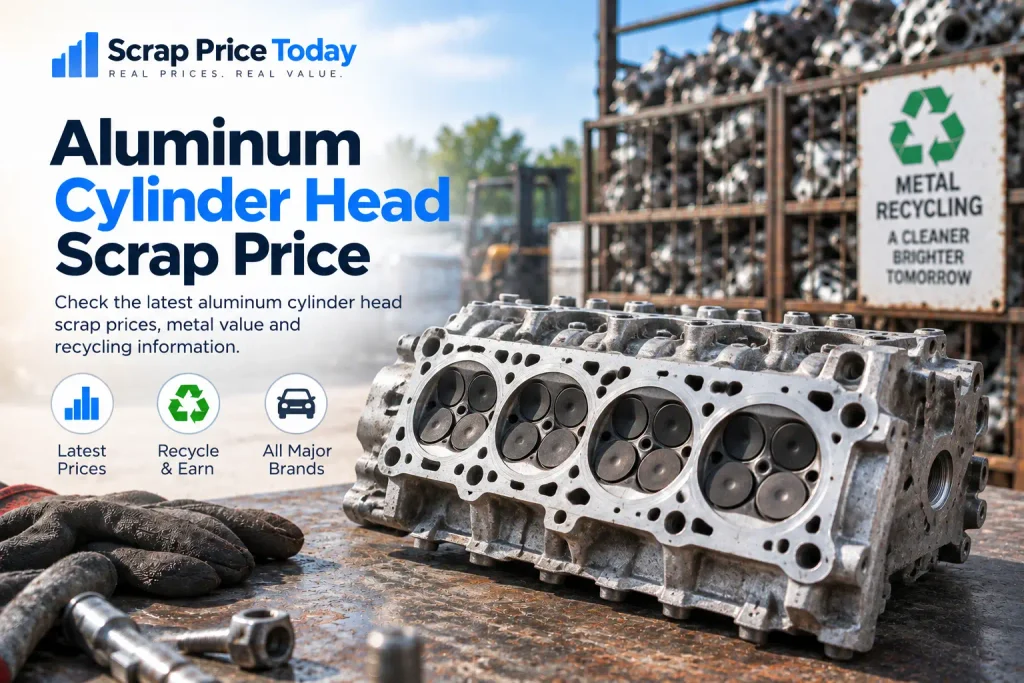
A stripped aluminium head weighs about 25 pounds and a cast iron head about 48, yet the lighter one is worth roughly three times more. Left with valves and springs in, either drops to an irony grade. A sound used head is worth more than both, because rebuilding one costs $365 to $2,000.
Why heads do not get the clean rate
One scrapper put the problem in a single sentence, asking about old boat motors: the heads are cast iron, but they contain steel valves and steel springs, so what do you actually do?
That is the whole issue. A cylinder head is a casting stuffed with hardened steel: valves, springs, retainers, keepers, and often the camshaft and rockers as well. Present it whole and a yard grades it as irony, meaning mixed material at a discount. That is why the aluminum heads with valves scrap price sits well below the bare figure.
The same trade reports engine cases going in as irony aluminium, with some cases even coming up magnetic, and parts becoming clean cast aluminium or extrusion only once cut or unbolted free. Heads follow the same rule.
Today’s head rate vs clean aluminum: the scrap value of engine heads
Route or component Basis Notes Value today (USD) Measurement What the figure is based on What changes it Computed from the live rate unless marked a reference Sound used head, rebuildable core Per head Against $365 to $2,000 to rebuild one $75 to $400 Aluminium head, stripped bare 25 lb measured Valves, springs and retainers out $19 to $35 Aluminium head, valvetrain still in 35 to 55 lb gross Irony aluminium; the steel is what costs you $8.00 to $16 Cast iron head, stripped bare 48 lb measured Twice the weight of aluminium, a third the value $6.48 to $9.36 Cast iron head, cracked Per head Welding rarely pays; the scrap bin is the normal route $6.48 to $9.36 Valves, springs and retainers removed 8 to 12 lb per head Hardened steel; a separate ticket $1.20 to $1.80
The comparison in the middle of that table is the one worth sitting with.
An owner who weighed a matched pair recorded the iron head at 48 pounds and the aluminium head at 25. So the iron head is nearly twice the weight and worth around a third as much, because cast iron is one of the lowest-paying ferrous grades and aluminium is several times better per pound.
Swapping a pair of iron heads for aluminium is commonly described as taking 40 pounds off the nose of a car. For a scrapper that means the aluminium head you are holding is the good outcome even though it feels lighter.
Valvetrain steel by engine family: pulling the valves, worth it or not
The honest answer depends on how many heads you have.
A head carries roughly 8 to 12 pounds of valvetrain steel. Removing it moves the casting from irony to clean, which on aluminium is a large proportional gain and on cast iron is barely worth measuring.
So the rule that follows:
- Aluminium head: stripping to bare aluminum head scrap usually pays, because clean aluminium is several times the irony rate and the gain scales with the value of the metal underneath.
- Cast iron head: rarely worth it. You are moving low-value iron into slightly-less-low-value iron, and a spring compressor is not free labour.
The valves and springs themselves go as hardened steel on a separate ticket, which is the same three-tickets-not-one discipline the battery cable page sets out for copper, lead and insulation.
Camshafts and the extra steel question
Overhead-cam heads carry more steel than pushrod heads, since the camshaft, bearing caps and often the rockers sit in the casting rather than in the block.
That cuts both ways. It means more steel to remove before a clean grade, and it also means a heavier gross weight if you sell the head as irony. Weigh it both ways before deciding, because on a twin-cam aluminium head the difference is not small.
A related note from the engine block page: the same irony deduction applies there for iron sleeves, and the arithmetic is the same shape.
Cylinder head core value: when the rebuild market beats the scale
This is where most heads should actually go, and the numbers are not close.
Resurfacing alone runs $150 to $350 per head for the milling, and a full job with valve work reaches $365 to $2,000 per head. Rebuilding is reported to save 30 to 60 percent against a new OEM head.
Against that, new assembled heads are not cheap either. One aftermarket aluminium head is listed at $613.99 fully assembled, most assembled aluminium heads run $800 or more, and the cheapest fully assembled cast iron head found in the same comparison was $691.74. A good pair can reach $1,647.
So selling cylinder heads to rebuilders beats the scale on anything sound. The test rebuilders apply is straightforward:
- No major cracks.
- Valves or seals worn but replaceable.
- Warping minimal and correctable by machining.
Meet those three and you are holding a core, not scrap. The core value page covers how that market works across the trade.
The cracked-head exception
One case where scrap genuinely is the answer, and it is worth knowing because it saves argument.
Welding cast iron properly means baking the head beforehand, welding it, then wrapping it in thermal blankets to bring the temperature down slowly. The process is described as so labour intensive that unless the head is incredibly rare, it is normally cheaper to throw the cracked head in the scrap iron bin and buy a new one.
Aluminium is different. It machines and welds readily, which makes repair viable on a head that would be written off in iron. So a cracked aluminium head is worth asking about; a cracked iron head usually is not.
Checking for cracks before you decide
Visual inspection is described as an effective preliminary method, and it costs nothing.
Clean the head thoroughly, then examine the areas between the valve seats, around the spark plug holes, and the coolant passages. Those are where cracks appear first.
If it looks sound, quote it as a core before quoting it as metal. If it is visibly cracked and made of iron, the decision is already made.
Head prices around the world
Aluminium and iron settle in US dollars, so the metal in a head is worth the same everywhere. Currency and local buyer depth are what change.
Market Equivalent range Local market note United States $1.20 to 400.00 Deepest buyer pool. Even within the US, state to state runs $50 to $60 per ton apart. United Kingdom £0.86 to 286.72 Strong processing capacity. Battery and PGM material reported 20 to 40 percent above thin markets. Canada C$1.64 to 545.07 Similar structure to the US; thinner in the prairies and the north. Australia A$1.62 to 540.82 Good coastal capacity, long hauls inland. Distance is the main discount. Germany €1.09 to 363.24 Dense processing and strict documentation. Good grades pay well; paperwork matters. India ₹104.43 to 34,811 Large volume, but black mass export restrictions have compressed local payables. Bangladesh ৳130.63 to 43,545 Ferrous depth is good. Specialist converter, PGM and battery buyers are scarce. United Arab Emirates AED4.19 to 1,396 Re-export hub with real processing depth. Among the better-paying markets outside the West. Saudi Arabia SAR4.19 to 1,395 Growing capacity; specialist PGM and battery buyers still limited. Turkey ₺61.95 to 20,651 Major ferrous importer, so steel grades hold up better than non-ferrous here. South Africa R16.70 to 5,567 Reported below UAE and UK on battery material; processing infrastructure is the constraint. China CN¥7.87 to 2,622 Aggressive bidder on imported battery material; 2026 recycling rules moved payables down.
Treat these as a metal-value anchor rather than a local quote. The core route depends on whether machine shops and rebuilders operate near you, which varies far more than the metal price does.
Questions people actually ask
“What is the aluminum head price per pound?”
Clean stripped aluminium earns the aluminium rate. With valves and springs still fitted it drops to an irony grade, which is a substantial deduction on an otherwise good casting.
“Are cylinder heads worth scrapping?”
The cylinder head scrap value is modest on aluminium and small on cast iron. As a rebuildable core, either can be worth several times more, so check for cracks before deciding.
“What is a v6 cylinder head weight?”
Measured examples put an aluminium head near 25 pounds and a cast iron head near 48. A V6 has two heads, so double whichever applies to your engine.
Common mistakes
- Selling a sound head as scrap, when rebuilding one costs $365 to $2,000 and used cores have real buyers.
- Leaving valves and springs in an aluminium head, which drops a good casting to an irony grade.
- Stripping a cast iron head, where the labour outweighs the small grade gain.
- Assuming the heavier head is worth more. The 48 pound iron head is worth about a third of the 25 pound aluminium one.
- Mixing valvetrain steel in with the castings rather than selling it as a separate hardened steel ticket.
- Writing off a cracked aluminium head, which machines and welds far more readily than iron.
- Skipping the visual crack check between valve seats, around plug holes and in the coolant passages.
Figures on this page are indicative. Metal rows are computed from the site’s tracked daily benchmarks, and weights are published or owner-measured figures for representative heads. Machining and rebuild costs are published 2025 and 2026 shop references and vary by region and engine.
Frequently asked questions
What is the aluminum cylinder head scrap price today?
A stripped aluminium head of about 25 pounds earns the clean aluminium rate. Left with valves and springs fitted it drops to an irony grade at a substantial discount, which is why preparation matters more on heads than the metal price does.
Why is a cast iron head worth less than an aluminium one?
Because cast iron is one of the lowest-paying ferrous grades. An owner who weighed a matched pair recorded the iron head at 48 pounds and the aluminium at 25, yet the lighter aluminium head is worth roughly three times more.
Is it worth pulling the valves out of a head?
On aluminium usually yes, since clean aluminium is several times the irony rate and a head carries 8 to 12 pounds of valvetrain steel. On cast iron rarely, because you are moving low-value iron into slightly-less-low-value iron for real labour.
Are cylinder heads worth more to a rebuilder?
Usually far more. Resurfacing alone runs $150 to $350 per head and a full rebuild with valve work reaches $365 to $2,000, while new assembled heads run $614 to $800 or more each. A sound used head has genuine buyers.
What makes a head rebuildable rather than scrap?
Three things: no major cracks, valves or seals worn but replaceable, and warping minimal enough to correct by machining. Meet those and you are holding a core rather than metal.
Is a cracked cast iron head worth repairing?
Rarely. Welding cast iron requires baking the head first, welding, then wrapping it in thermal blankets to cool slowly, and the process is described as so labour intensive that unless the head is incredibly rare it is cheaper to scrap it and buy new.
Can a cracked aluminium head be saved?
More often than an iron one. Aluminium machines and welds readily, which makes repair viable on a head that would be written off in cast iron. It is worth asking a machine shop before scrapping one.
How do I check a head for cracks?
Clean it thoroughly and inspect visually, which is described as an effective preliminary method. Look between the valve seats, around the spark plug holes and in the coolant passages, since those are where cracks appear first.
What is a v6 cylinder head weight?
Measured examples put an aluminium head at about 25 pounds and a cast iron head at about 48. A V6 carries two heads, so double whichever material applies. Overhead-cam heads run heavier again because the camshaft sits in the casting.
Do overhead-cam heads scrap differently?
They carry more steel, since the camshaft, bearing caps and often the rockers sit in the head rather than the block. That means more to remove before a clean grade, and a heavier gross weight if you sell the head as irony instead.