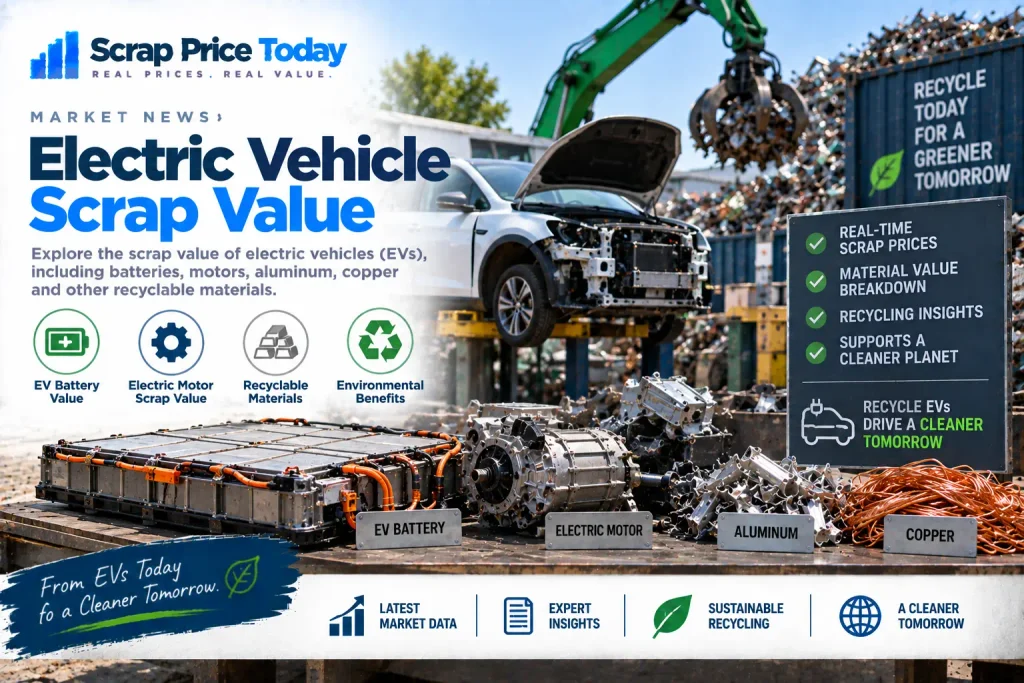
An electric car contains about 83 kg of copper against 23 kg in a petrol car, roughly three and a half times as much. At our board that is about $1,058 of copper against $293, and the difference alone is worth more than three catalytic converters. The battery is the opposite story: a nickel-rich pack can fetch $2 a kilogram or more, while a cheaper lithium iron phosphate pack often costs money to dispose of rather than earning any.
Scrap Price Today market analysis, written from exchange settlement data, mill and refiner pricing practice and published policy documents. Figures are examples; today’s numbers are on the live scrap price board.
That split, high copper and uncertain batteries, is reshaping what an end-of-life vehicle is worth and where the value sits inside it.
Copper is the immediate story
| Electric vehicle | Petrol vehicle | |
|---|---|---|
| Copper content | About 83 kg, or 183 lb | About 23 kg, or 51 lb |
| Value at our board | About $1,058 | About $293 |
| Where it sits | Motor windings, battery interconnects, charging system, harnesses | Harness, alternator, starter, small motors |
The extra 60 kg is worth about $765, which is more than three times the contained metal in a typical catalytic converter. Our converter analysis puts a mid-range unit at about $332 of platinum group metal.
So the component that made a scrapped car interesting for two decades has been displaced by wiring. That is a genuine change in where value sits, and it favours dismantlers who take motors and harnesses out carefully rather than shredding.
The shell is worth less, not more
A petrol sedan at 3,400 pounds is about $612 as shredder feed on our car body price. An electric hatchback at 1,400 kg, roughly 3,086 pounds, is about $556.
Electric vehicles are heavier overall, but much of that weight is the battery pack, which is removed before the shell is weighed. What remains is often lighter than the equivalent combustion car and increasingly aluminium rather than steel.
So the shell is not where the change is. The change is in what comes out before it.
The battery, where the arithmetic breaks
This is the part with no settled answer, and being honest about that matters more than picking a number.
Recyclers pay $2 a kilogram or more for scrap from nickel-rich packs, because there is cobalt and nickel worth recovering. For lithium iron phosphate packs, which contain neither, some recyclers charge a gate fee instead. On a 450 kg pack that is the difference between roughly $900 received and several hundred dollars paid.
| Pack | If paid at $2 a kg | If a gate fee applies |
|---|---|---|
| 300 kg | About $600 received | Several hundred dollars paid |
| 450 kg | About $900 received | Several hundred dollars paid |
| 600 kg | About $1,200 received | Several hundred dollars paid |
Academic modelling puts net recycling profit across chemistries, processes and locations anywhere from minus $21 to plus $22 a kilowatt-hour, depending heavily on transport distance, wages, pack design and method. Cobalt-containing chemistries come out best; lithium iron phosphate and lithium manganese oxide come out worst, because beyond copper there is little of value to recover.
The practical consequence for anyone holding a vehicle: the pack chemistry decides whether the battery is an asset or a liability, and shipping cost can cancel out the recycling value entirely on a low-value pack.
Second life beats recycling, when it is available
A pack with usable capacity is worth far more repurposed than shredded.
Research has put repurposing costs as low as $20 a kilowatt-hour and second-life selling prices between $60 and $175 a kilowatt-hour. On a 60 kWh pack that is $3,600 to $10,500, against a scrap value measured in hundreds.
| Pack size | At $60 per kWh | At $175 per kWh |
|---|---|---|
| 40 kWh | $2,400 | $7,000 |
| 60 kWh | $3,600 | $10,500 |
| 75 kWh | $4,500 | $13,125 |
The best outcome described in trade commentary is removing a pack, testing its cells and selling it to a certified refurbisher within days of the vehicle arriving. Batteries degrade in storage and the testing window matters, which is why speed is part of the value.
The motor, and why shredding destroys it
Electric motors contain rare earth magnets, and shredding disperses those elements through the scrap stream where recovery is close to impossible.
Removing motors whole and dismantling them in controlled conditions preserves both the copper windings and the magnets. The market for recovered rare earth magnets is still developing, but the parallel with converters is exact: an overlooked component becomes a revenue stream once the recovery infrastructure exists.
Our motors and compressors analysis explains why whole motors are bought at a discount to their contained copper, and the same logic applies here with magnets added.
What this means at different scales
For a vehicle owner. Do not treat an electric car like a petrol one at end of life. The battery has to be assessed rather than assumed, and a pack with capacity left is worth taking to someone who tests it.
For a dismantler. The value has moved from a few grams of precious metal in one component to copper and electronics spread across the vehicle. One analysis of more than a thousand tonnes of material found electric end-of-life vehicles generating 18 percent more value than combustion cars, with 87 percent of that value in electronic components.
For a general scrap yard. High-voltage packs require training, equipment and insurance that most yards do not have, and a damaged lithium pack is a fire risk of a different order, as our lithium battery article sets out. Refusing them is a reasonable business decision rather than a failing.
What has not changed
The fluids, the paperwork and the refrigerant rules still apply. Electric vehicles still contain coolant, brake fluid and air conditioning refrigerant that must be recovered by a certified technician, and the title and deregistration process is identical, as our how to scrap a car guide covers.
The wheels, radiator, glass and interior are the same materials they always were.
What this metal pays around the world
Scrap is a global market priced in US dollars, but what reaches a seller depends on trade position, freight to the nearest consumer and how many buyers compete locally. The table below converts the same grade into each market’s own currency and units at the day’s exchange rate, and shows the factor we apply.
| Market | Local price | USD per lb | Market factor |
|---|---|---|---|
| Turkey | ₺633.98 / kg | $5.79 | 1.04 |
| Germany | €11.15 / kg | $5.68 | 1.02 |
| United States | $5.57 / lb | $5.57 | 1.00 |
| China | CN¥80.50 / kg | $5.46 | 0.98 |
| Canada | C$7.59 / lb | $5.40 | 0.97 |
| United Kingdom | £8.80 / kg | $5.35 | 0.96 |
| Australia | A$16.60 / kg | $5.29 | 0.95 |
| United Arab Emirates | AED42.84 / kg | $5.29 | 0.95 |
| Saudi Arabia | SAR42.83 / kg | $5.18 | 0.93 |
| India | ₹1,069 / kg | $5.12 | 0.92 |
| Bangladesh | ৳1,337 / kg | $4.90 | 0.88 |
| South Africa | R170.92 / kg | $4.73 | 0.85 |
Method
Copper content figures of 83 kg for electric and 23 kg for combustion vehicles are published industry estimates and vary by model, size and drivetrain. Values apply our own copper board, documented on the editorial policy page with live figures on the board.
Battery payment and gate fee figures are from published trade reporting and represent conditions that vary by chemistry, location and shipping distance rather than fixed rates. The net recycling profit range and second-life pricing come from published academic and laboratory research and are modelling outputs rather than quoted prices.
This is a market in active change and the numbers here will move. We would rather give the mechanism, which is durable, than a price that is not.
Questions people ask
How much copper is in an electric car?
About 83 kg, or 183 pounds, against roughly 23 kg in a petrol car. At our board that is about $1,058 of copper against $293, and the extra 60 kg alone is worth more than three times the contained metal in a typical catalytic converter.
Is an electric car worth more as scrap than a petrol one?
Overall yes, but not because of the shell. One analysis of more than a thousand tonnes found electric end-of-life vehicles generating 18 percent more value, with 87 percent of it in electronic components. The stripped shell is often worth slightly less because much of an EV’s weight is the battery.
What is an EV battery pack worth?
It depends entirely on chemistry. Recyclers pay $2 a kilogram or more for nickel-rich packs because of the cobalt and nickel, while some charge a gate fee for lithium iron phosphate packs, which contain neither. On a 450 kg pack that is the difference between roughly $900 received and several hundred paid.
Why do some EV batteries cost money to recycle?
Because beyond copper there is little of value to recover from lithium iron phosphate chemistry. Published modelling puts net recycling profit anywhere from minus $21 to plus $22 a kilowatt-hour depending on chemistry, process, wages and transport distance, and shipping can cancel out the value of a low-value pack entirely.
Is a used EV battery worth more than its scrap value?
Usually, if it has capacity left. Research puts repurposing costs as low as $20 a kilowatt-hour and second-life selling prices at $60 to $175, so a 60 kWh pack could be worth $3,600 to $10,500 against a scrap value in the hundreds. Testing quickly matters because packs degrade in storage.
Why should EV motors not be shredded?
Because they contain rare earth magnets, and shredding disperses those elements through the scrap stream where recovery is nearly impossible. Removing motors whole preserves both the copper windings and the magnets for specialist recyclers.
Will a normal scrap yard take an electric car?
Many will take the shell after the pack is removed, but most will not handle high-voltage packs, which need training, equipment and insurance. A damaged lithium pack is a fire risk of a different order, so refusing them is a reasonable business decision.
Do the usual end-of-life rules still apply to EVs?
Yes. Coolant, brake fluid and air conditioning refrigerant still have to be handled properly, refrigerant still requires a certified technician, and the title and deregistration process is identical to a combustion vehicle.
Frequently asked questions
How much copper is in an electric car?
About 83 kg, or 183 pounds, against roughly 23 kg in a petrol car. At our board that is about $1,058 of copper against $293, and the extra 60 kg alone is worth more than three times the contained metal in a typical catalytic converter.
Is an electric car worth more as scrap than a petrol one?
Overall yes, but not because of the shell. One analysis of more than a thousand tonnes found electric end-of-life vehicles generating 18 percent more value, with 87 percent of it in electronic components. The stripped shell is often worth slightly less because much of an EV's weight is the battery.
What is an EV battery pack worth?
It depends entirely on chemistry. Recyclers pay $2 a kilogram or more for nickel-rich packs because of the cobalt and nickel, while some charge a gate fee for lithium iron phosphate packs, which contain neither. On a 450 kg pack that is the difference between roughly $900 received and several hundred paid.
Why do some EV batteries cost money to recycle?
Because beyond copper there is little of value to recover from lithium iron phosphate chemistry. Published modelling puts net recycling profit anywhere from minus $21 to plus $22 a kilowatt-hour depending on chemistry, process, wages and transport distance, and shipping can cancel out the value of a low-value pack entirely.
Is a used EV battery worth more than its scrap value?
Usually, if it has capacity left. Research puts repurposing costs as low as $20 a kilowatt-hour and second-life selling prices at $60 to $175, so a 60 kWh pack could be worth $3,600 to $10,500 against a scrap value in the hundreds. Testing quickly matters because packs degrade in storage.
Why should EV motors not be shredded?
Because they contain rare earth magnets, and shredding disperses those elements through the scrap stream where recovery is nearly impossible. Removing motors whole preserves both the copper windings and the magnets for specialist recyclers.
Will a normal scrap yard take an electric car?
Many will take the shell after the pack is removed, but most will not handle high-voltage packs, which need training, equipment and insurance. A damaged lithium pack is a fire risk of a different order, so refusing them is a reasonable business decision.
Do the usual end-of-life rules still apply to EVs?
Yes. Coolant, brake fluid and air conditioning refrigerant still have to be handled properly, refrigerant still requires a certified technician, and the title and deregistration process is identical to a combustion vehicle.