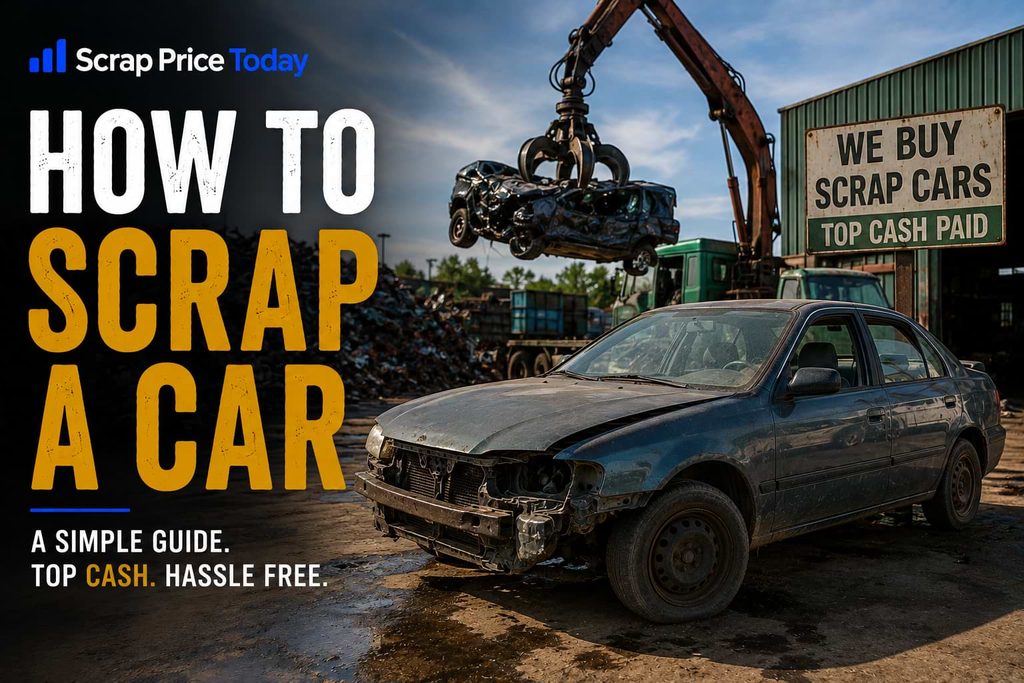
Scrap a car in this order: settle the paperwork first, have the refrigerant recovered by a certified technician, pull the converter, battery, wheels and radiator, then weigh the shell. The paperwork decision matters most, because applying for a certificate of destruction or a non-repairable designation is irreversible in most states and the vehicle can never be registered again.
Scrap Price Today market analysis, written from exchange settlement data, mill and refiner pricing practice and published policy documents. Figures are examples; today’s numbers are on the live scrap price board.
Getting the sequence wrong costs money in one direction and legal exposure in the other. Here is the order, and what each step actually requires.
Step one: decide which document you are applying for
This is the part most guides skip and the one you cannot undo.
States generally offer two routes. A salvage certificate covers a vehicle that has been written off but could in principle be rebuilt and re-registered through an inspection process. A certificate of destruction, or a non-repairable designation, permanently ends the vehicle’s life; it can only be sold for parts or scrap.
In California the non-repairable designation is explicitly irreversible and the vehicle can never be driven on state roads again. In Florida the equivalent application covers both options on one form, and the guidance is clear that a certificate of destruction is the correct choice if you are junking the car for parts.
If there is any chance the car gets rebuilt, do not take the destruction route.
Step two: transfer and notification
| Selling to a licensed dismantler | Applying yourself for destruction | Insurance total loss | |
|---|---|---|---|
| Measurement | Who files what, and when | Same | Same |
| Who applies | Usually the dismantler, on your assignment | You, at the tax collector or DMV | The insurer |
| Typical documents | Title in your name, photo ID, signed assignment | State application form, VIN and odometer verification | Settlement letter and insurer filing |
| Notification duty | The licensee notifies the DMV once the vehicle is demolished or processed | You complete the application before disposal | Insurer files within a set period, commonly around 15 days |
| Plates | Remove and return or transfer per state rule | Same | Same |
| Common mistake | Handing over the car without completing the assignment | Choosing salvage when you meant destruction | Assuming the insurer handled deregistration |
The consistent principle across states is that liability follows the registration until the paperwork closes it. Removing plates and keeping a copy of everything you signed is not bureaucracy, it is how you stop receiving tickets for a car you no longer own.
Rules differ substantially by state and country, so treat the examples above as illustrations and check your own authority.
Step three: refrigerant, before anything else is cut
If the car has air conditioning, the refrigerant must be recovered by a certified technician before the vehicle is scrapped. This is a federal requirement under the Clean Air Act rather than a yard policy, and most yards will ask for evidence.
Do not vent it, and do not cut lines to see what happens. Arrange recovery first; many dismantlers include it.
Step four: fluids and the battery
Drain engine oil, coolant, transmission fluid, brake fluid and fuel into sealed containers, or hand the car to a licensed dismantler with interceptors and let them do it. Fluids on the ground are an environmental offence in every jurisdiction we cover.
Take the battery out early. It is only worth about $9 at today’s board, but it is thirty seconds of work and yards deduct for a car delivered with one still fitted in some markets.
Step five: what to pull, in order of value per minute
- Catalytic converter, if the vehicle is genuinely being destroyed. A mid-range unit holds roughly $337 of platinum group metal at current prices, though a buyer pays a fraction of contained value.
- Alloy wheels, about 80 pounds of aluminium across four, worth roughly $67 and more if sold as clean wheels.
- Wiring harness, around 35 pounds of insulated wire at $2.81 a pound.
- Starter and alternator, sold as motors rather than mixed metal.
- Radiator, heater matrix and any copper or brass cooling parts.
- Battery, wheel weights and the small motors in seats and windows if you have the time.
The full arithmetic, including what the shell itself is worth by vehicle class, is in our companion analysis on what a junk car is worth.
Step six: the weighbridge
A complete car is weighed on the vehicle, so the ticket is a gross and tare figure rather than a grade breakdown. Watch for three things.
- The tare is measured, not estimated.
- Non-ferrous parts you removed are weighed separately, on their own lines, not tipped in with the shell.
- Any collection or towing charge is stated before the car leaves your driveway, because it comes out of your price.
Selling the converter legally
Most markets now require identification, proof that you owned the vehicle, buyer records and non-cash payment for converters, and California added a seller licence requirement for scrap copper at the start of the year. The detail is in our converter laws article.
Bring the title or the destruction paperwork when you sell the converter, not just when you sell the car. A buyer who does not ask is a buyer to avoid.
Key numbers
- Refrigerant must be recovered by a certified technician before disposal under EPA Section 608 requirements.
- A non-repairable or certificate of destruction designation is permanent; California states the vehicle can never again be driven on state roads (California DMV guidance).
- Insurers in several states must file total loss paperwork within a set period, commonly around 15 days (state DMV rules, for example New York).
- A 3,400 lb sedan is worth about $612 as shredder feed at our car body price of $360 a short ton.
- Recoverable parts other than the converter are worth roughly $295 on that sedan at today’s grade prices.
- A mid-range converter contains about $337 of platinum, palladium and rhodium at current levels.
What this metal pays around the world
Scrap is a global market priced in US dollars, but what reaches a seller depends on trade position, freight to the nearest consumer and how many buyers compete locally. The table below converts the same grade into each market’s own currency and units at the day’s exchange rate, and shows the factor we apply.
| Market | Local price | USD per ton | Market factor |
|---|---|---|---|
| Turkey | ₺20,488 / tonne | $374 | 1.04 |
| Germany | €360 / tonne | $367 | 1.02 |
| United States | $360 / ton | $360 | 1.00 |
| China | CN¥2,601 / tonne | $353 | 0.98 |
| Canada | C$491 / ton | $349 | 0.97 |
| United Kingdom | £284 / tonne | $346 | 0.96 |
| Australia | A$537 / tonne | $342 | 0.95 |
| United Arab Emirates | AED1,384 / tonne | $342 | 0.95 |
| Saudi Arabia | SAR1,384 / tonne | $335 | 0.93 |
| India | ₹34,535 / tonne | $331 | 0.92 |
| Bangladesh | ৳43,200 / tonne | $317 | 0.88 |
| South Africa | R5,523 / tonne | $306 | 0.85 |
How we produced this
The procedural steps are drawn from published state motor vehicle authority guidance, including California, Florida, Virginia and New York, and from federal refrigerant rules. They are examples of how the process works rather than a complete account of any one jurisdiction, because titling, deregistration and dismantler licensing are set locally and change.
The values come from our own daily price series, documented on the editorial policy page, with live figures on the board and a weight converter at the calculator.
This is general information, not legal advice, and we have no relationship with any dismantler or buyer. Check your own state or country’s requirements before you sign anything, particularly the difference between a salvage and a destruction designation, since one of those cannot be reversed.