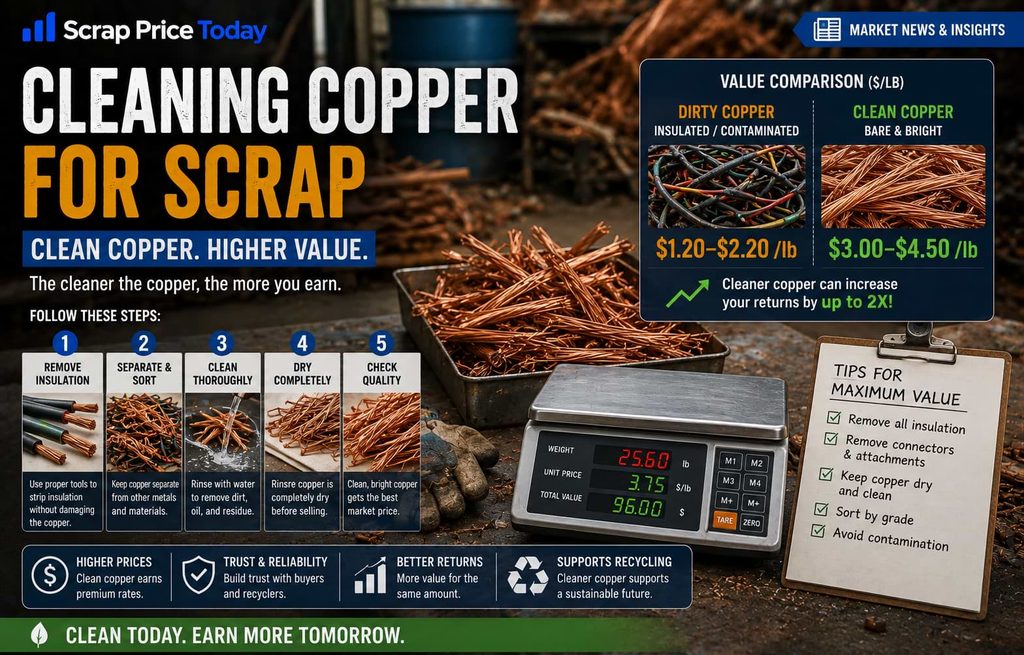
Cleaning copper does not raise its scrap grade. Polishing, vinegar, lemon juice and wire wheels remove tarnish, and tarnish is not what a yard grades on. What moves copper between grades is solder, paint, tin plating, attached fittings and insulation, all of which have to be cut or removed rather than cleaned. Oxidised but otherwise clean copper is still number 1 copper.
Scrap Price Today market analysis, written from exchange settlement data, mill and refiner pricing practice and published policy documents. Figures are examples; today’s numbers are on the live scrap price board.
This question is really two questions wearing the same words. One group wants a pan, a sink or a roof to look right. The other wants a better price at the scale. The answers point in opposite directions, so this covers both and says clearly which is which.
If you are selling it: what actually changes the grade
Grading is about what a refinery has to remove, not about appearance. A dull brown surface costs the refiner nothing. Solder, paint and tin cost real money.
| Raises or holds the grade | Does not change the grade | Lowers the grade | |
|---|---|---|---|
| Measurement | Action and its effect on price per pound | Same | Same |
| Examples | Cutting off brass fittings, removing solder joints, stripping insulation | Polishing, washing, removing tarnish or patina | Leaving solder, paint, tin plating, steel clamps or insulation attached |
| Why | Removes material the refiner must separate | Surface oxide burns off in the furnace | Contaminants require extra refining |
| Typical price effect | Moves number 2 copper up to number 1, worth 5 to 10 percent | None | Drops number 1 to number 2, or to brass |
| Time cost | Minutes per joint with cutters | Hours, for nothing | None, and it costs you |
So the honest answer to a scrapper is: put the polish down and pick up the cutters. Our copper grades guide sets out what each grade contains, and the preparation guide covers the cutting.
The one exception worth knowing
Heavy corrosion is different from tarnish. A green crust on buried or long-outdoor copper is copper carbonate, and it has weight and volume without being copper the refiner can use.
A yard may grade badly corroded copper down, not because it looks poor but because the material genuinely is not all copper any more. Knocking loose crust off with a wire brush is worth the two minutes. Polishing sound copper to a shine is not.
Tinned copper looks clean and is not number 1
The most expensive mistake in this area is tinned copper wire, which is copper with a thin silver-coloured tin coating used in marine and older electrical work.
It looks cleaner than bare copper, so people put it in the bright pile. Yards grade it as number 2 because the tin has to come off at the refinery. Scratch the surface: if silver shows over copper underneath, it is tinned and belongs in its own pile.
If you are cleaning it to keep: what works
For cookware, fittings and decorative copper, the practical methods are the traditional ones, and they work because copper oxide dissolves in weak acid.
- Salt and white vinegar, or salt and lemon, applied as a paste and rinsed thoroughly.
- A commercial copper cream for a controlled finish, particularly on lacquered pieces.
- Bicarbonate of soda paste for stubborn spots, worked gently.
- A clear lacquer afterwards if you want the shine to last, because bare copper starts oxidising again immediately.
Two cautions. Rinse and dry completely, because acid residue keeps working and pits the surface. And do not strip the patina from anything that might be antique or architectural; on those, the patina is often most of the value.
Copper roofs, flashing and exterior work
Green patina on a roof is a protective layer and removing it shortens the life of the metal. It is also nearly impossible to keep clean, since it re-forms within months.
If that copper eventually comes off the building, it goes to the yard as roofing or light copper. Its scrap grade is set by thickness and by whether tar, paint and fixings have been removed, not by colour.
What people get wrong
- Spending an evening polishing pipe before a yard visit, which changes nothing on the ticket.
- Leaving one soldered joint on an otherwise clean bundle, which drops the whole bundle.
- Putting tinned wire in with bare bright because it looks cleaner.
- Using an angle grinder to clean copper, which removes metal you are paid for by weight.
- Burning insulation off to save stripping time, which is illegal in most places and downgrades the copper.
Key numbers
- Number 2 copper is still 94 to 96 percent copper; the discount reflects refining cost from solder and coatings rather than metal content (Recycled Materials Association grade specifications).
- Cutting soldered joints out of plumbing pipe typically moves it from number 2 to number 1, a difference of roughly 5 to 10 percent on the price.
- Our board today has bare copper at $5.82 a pound against insulated wire at $2.81, which is why removing insulation matters far more than removing tarnish.
- Bare bright, the cleanest grade, is defined by being uncoated and unalloyed rather than by being polished.
What this metal pays around the world
Scrap is a global market priced in US dollars, but what reaches a seller depends on trade position, freight to the nearest consumer and how many buyers compete locally. The table below converts the same grade into each market’s own currency and units at the day’s exchange rate, and shows the factor we apply.
| Market | Local price | USD per lb | Market factor |
|---|---|---|---|
| Turkey | ₺633.98 / kg | $5.79 | 1.04 |
| Germany | €11.15 / kg | $5.68 | 1.02 |
| United States | $5.57 / lb | $5.57 | 1.00 |
| China | CN¥80.50 / kg | $5.46 | 0.98 |
| Canada | C$7.59 / lb | $5.40 | 0.97 |
| United Kingdom | £8.80 / kg | $5.35 | 0.96 |
| Australia | A$16.60 / kg | $5.29 | 0.95 |
| United Arab Emirates | AED42.84 / kg | $5.29 | 0.95 |
| Saudi Arabia | SAR42.83 / kg | $5.18 | 0.93 |
| India | ₹1,069 / kg | $5.12 | 0.92 |
| Bangladesh | ৳1,337 / kg | $4.90 | 0.88 |
| South Africa | R170.92 / kg | $4.73 | 0.85 |
How we produced this
The grading logic follows published scrap specifications, which define grades by contamination and alloy rather than by surface condition. We have stated the price effects as ranges because they vary by yard and by market rather than being fixed.
The household cleaning methods are the established ones for copper oxide and are included because a large share of people searching this question are not selling anything. We have kept them separate from the scrap advice rather than blending the two, since following the wrong half wastes either time or money.
Current grade prices are on the live board, and the wire stripping analysis covers the one preparation task that genuinely changes what you are paid.