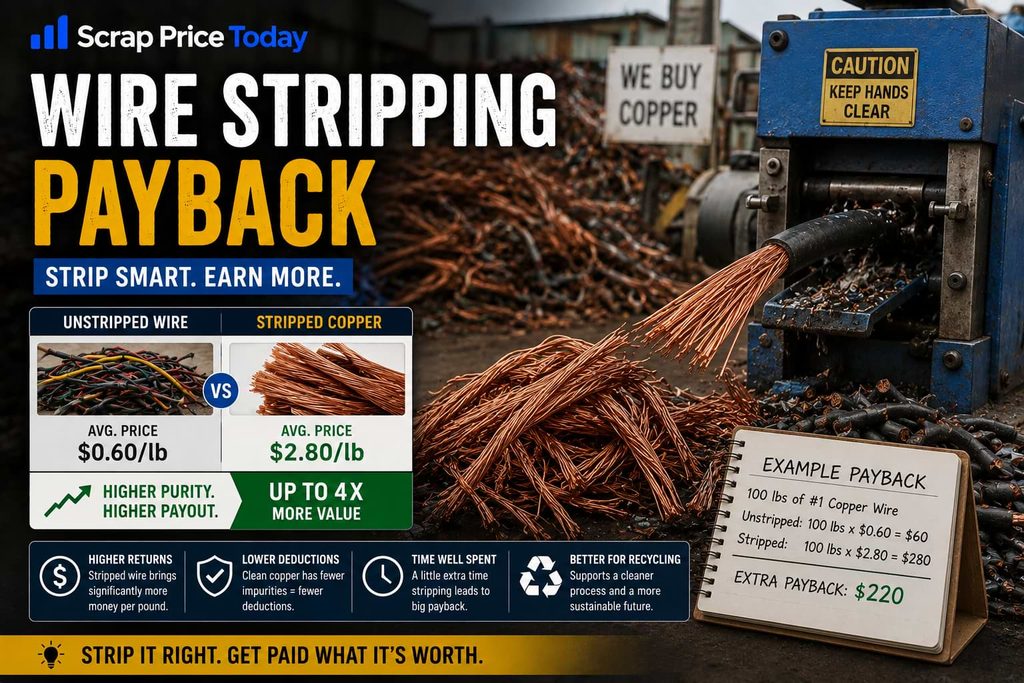
Strip the wire only if it is more than about 48 percent copper by weight. Below that, the insulated wire price beats what you would get for the recovered copper. Our board today has bare copper at $5.82 a pound and insulated wire at $2.81, which puts the break-even at 48.3 percent. Heavy building wire clears it comfortably. Thin cord does not.
Scrap Price Today market analysis, written from exchange settlement data, mill and refiner pricing practice and published policy documents. Figures are examples; today’s numbers are on the live scrap price board.
Every guide tells you to strip heavy wire and leave thin wire alone. None of them tell you where the line actually sits, which changes with the price. Here is the arithmetic, using today’s board, and what it means for whether a machine is worth buying.
The break-even rule
A yard buys insulated wire on the copper it expects to recover. So the question is never whether stripping produces copper, it is whether the copper you recover is worth more than the insulated price you gave up.
Divide the insulated price by the bare copper price and you have the break-even copper content.
- Insulated wire grade: $2.81 divided by $5.82 gives 48.3 percent.
- Low-grade cable: $1.87 divided by $5.82 gives 32.1 percent.
If the wire in your hand contains more copper by weight than that figure, stripping pays. If it contains less, the yard’s insulated price is already the better deal, and stripping costs you money as well as time.
What that looks like per hundred pounds
| 75% copper (heavy building wire) | 65% copper | 50% copper (household cable) | 35% copper (thin multi-core) | 25% copper (cord and data) | |
|---|---|---|---|---|---|
| Measurement | USD per 100 lb of wire as received | Same | Same | Same | Same |
| Sold as insulated wire grade | $281 | $281 | $281 | $281 | $281 |
| Sold as low-grade cable | $187 | $187 | $187 | $187 | $187 |
| Stripped and sold bare | $437 | $378 | $291 | $204 | $146 |
| Gain against wire grade | +$156 | +$97 | +$10 | -$77 | -$136 |
| Gain against cable grade | +$250 | +$191 | +$104 | +$17 | -$42 |
Read the bottom two rows carefully, because they answer two different questions. If your yard is already paying you the insulated wire grade, stripping a 50 percent wire earns you ten dollars for a hundred pounds of work. If your yard is calling the same material low-grade cable, stripping it earns you $104.
So the first thing to establish is not whether to strip. It is which grade the yard is applying, which our copper grades guide sets out.
How to estimate copper content without guessing
Weigh a measured length, strip it, weigh the copper, and divide. A metre of cable is enough. That single test tells you more than any chart, because it uses the actual wire in front of you rather than a category.
As a rough guide before you test, published buyer bands run roughly like this: heavy single-conductor building wire at 75 percent or better, household twin and earth cable around 50 to 65 percent, and thin cord, telephone and data cable frequently under 40 percent. Equipment suppliers put household wiring at 60 to 75 percent copper by weight, which sits at the top of that range.
When a machine pays for itself
At today’s prices, stripping heavy wire gains $1.56 for every pound you process. That number is the whole basis of any tool decision.
| Hand-crank stripper | Drill-driven stripper | Powered bench stripper | Compact granulator | |
|---|---|---|---|---|
| Measurement | Purchase price and pounds of heavy wire to break even | Same | Same | Same |
| Typical price | $40 to $76 | $75 to $155 | $155 to $360 | From about $3,000 |
| Pays for itself at | About 39 lb | About 100 lb | About 200 to 232 lb | About 1,928 lb |
| Best for | Occasional renovation wire | Regular trade offcuts | Steady weekly volume | Material you cannot hand-strip |
| Limitation | Slow, single gauge at a time | Still one pass per length | Struggles with flat and armoured | Space, power, plastic disposal |
Those prices are current retail listings for common models; granulator ranges run from about $3,000 for compact units up to $55,000 for production machines, with published throughputs from 44 to nearly 4,000 pounds an hour.
The payback figures look easy, and that is the trap. They assume you have heavy wire to feed the machine. A granulator bought to process low-grade cable at 35 percent copper earns roughly $17 per hundred pounds against the cable grade, which is a payback measured in tens of thousands of pounds of material rather than hundreds.
What the forums recommend, tested against the arithmetic
A lot of people searching for a stripper want the community answer rather than a review, so it is worth setting the two side by side.
The consensus among experienced scrappers on public forums is consistent and sensible: buy a cheap manual or drill-driven stripper first, expect to sharpen or replace blades, and do not buy a granulator until you have a steady feedstock. The frequent complaint is blade life and fiddly setup on multi-gauge loads rather than the machines failing outright.
The arithmetic supports that ordering. A manual unit clears its own cost at about 39 pounds of heavy wire, a powered bench unit at about 200, and a compact granulator at nearly 2,000 pounds, and that last figure assumes heavy wire rather than the low-grade cable most people buy a granulator to handle.
Where the forum view and the numbers diverge is on thin wire. Enthusiasm for processing everything is common in discussion threads; the break-even calculation says material under roughly 48 percent copper content should be sold as it is. Treat the community advice as good on tools and cautious on economics.
Where a granulator genuinely changes the answer
Granulating is not the same job as stripping. It handles what a stripper cannot: multi-core, fine-stranded, flat and mixed cable, and it recovers more of the metal.
Suppliers report automated separation recovering up to 99 percent of the metal in a cable against 85 to 90 percent by hand, and clean granules at 99 percent purity trading at a premium over number 2 copper. Both claims come from equipment vendors, so treat them as best-case rather than typical.
For a contractor generating a steady tonne a month of mixed cable, that recovery difference is real money. For someone clearing a house, it is not.
What not to do
Burning is the shortcut that costs money twice. It is illegal in most jurisdictions, the fumes from PVC insulation are genuinely dangerous, and burnt copper is bought as a downgraded grade rather than as bare bright. You lose the premium you were trying to capture.
Cutting the ends off a coil to make it look stripped, mixing tinned wire into a bare bright pile, and leaving steel armour attached all have the same effect: the yard grades the whole bundle down.
The practical routine
- Ask which grade the yard applies to your wire before you decide anything.
- Test one metre for copper content and compare it with 48.3 percent today, or with whatever the current ratio is on the live board.
- Strip everything above the line, sell everything below it as it is.
- Keep bare recovered copper separate from tinned or oxidised copper; they are different grades.
- Buy the cheapest tool that clears your volume, not the one with the best video.
Key numbers
- Break-even copper content today is 48.3 percent against the insulated wire grade and 32.1 percent against low-grade cable (Scrap Price Today board: bare copper $5.82, insulated wire $2.81, cable $1.87 per pound).
- Stripping heavy wire at 75 percent copper gains $1.56 a pound, or $156 per hundred pounds.
- Stripping wire at 35 percent copper loses $77 per hundred pounds against the insulated grade.
- Hand-crank strippers retail from about $40, powered bench units to about $360, and compact granulators from about $3,000 (current retail and manufacturer listings).
- Household wiring is typically 60 to 75 percent copper by weight (equipment supplier figures).
- Automated granulation is reported to recover up to 99 percent of cable metal against 85 to 90 percent by hand (equipment supplier figures).
What this metal pays around the world
Scrap is a global market priced in US dollars, but what reaches a seller depends on trade position, freight to the nearest consumer and how many buyers compete locally. The table below converts the same grade into each market’s own currency and units at the day’s exchange rate, and shows the factor we apply.
| Market | Local price | USD per lb | Market factor |
|---|---|---|---|
| Turkey | ₺306.18 / kg | $2.80 | 1.04 |
| Germany | €5.39 / kg | $2.74 | 1.02 |
| United States | $2.69 / lb | $2.69 | 1.00 |
| China | CN¥38.88 / kg | $2.64 | 0.98 |
| Canada | C$3.67 / lb | $2.61 | 0.97 |
| United Kingdom | £4.25 / kg | $2.58 | 0.96 |
| Australia | A$8.02 / kg | $2.56 | 0.95 |
| United Arab Emirates | AED20.69 / kg | $2.56 | 0.95 |
| Saudi Arabia | SAR20.68 / kg | $2.50 | 0.93 |
| India | ₹516 / kg | $2.47 | 0.92 |
| Bangladesh | ৳646 / kg | $2.37 | 0.88 |
| South Africa | R82.54 / kg | $2.29 | 0.85 |
How we produced this
The break-even ratio is calculated from our own board: the insulated wire and cable grades divided by the bare copper grade, all derived from exchange settlements using published recovery shares and documented on our editorial policy page. It moves as prices move, so recompute it on the day rather than treating 48.3 percent as fixed.
Tool prices are taken from current retail listings for widely sold models and are indicative rather than a recommendation; we do not sell equipment, take affiliate commission, or accept payment for placement. Throughput and recovery claims are attributed to the manufacturers and distributors who publish them, and vendor figures are best-case by nature.
The copper content bands are published buyer guidance, not a specification for any particular cable. The one-metre test is the only number that describes your actual material, which is why it appears before the bands rather than after them.