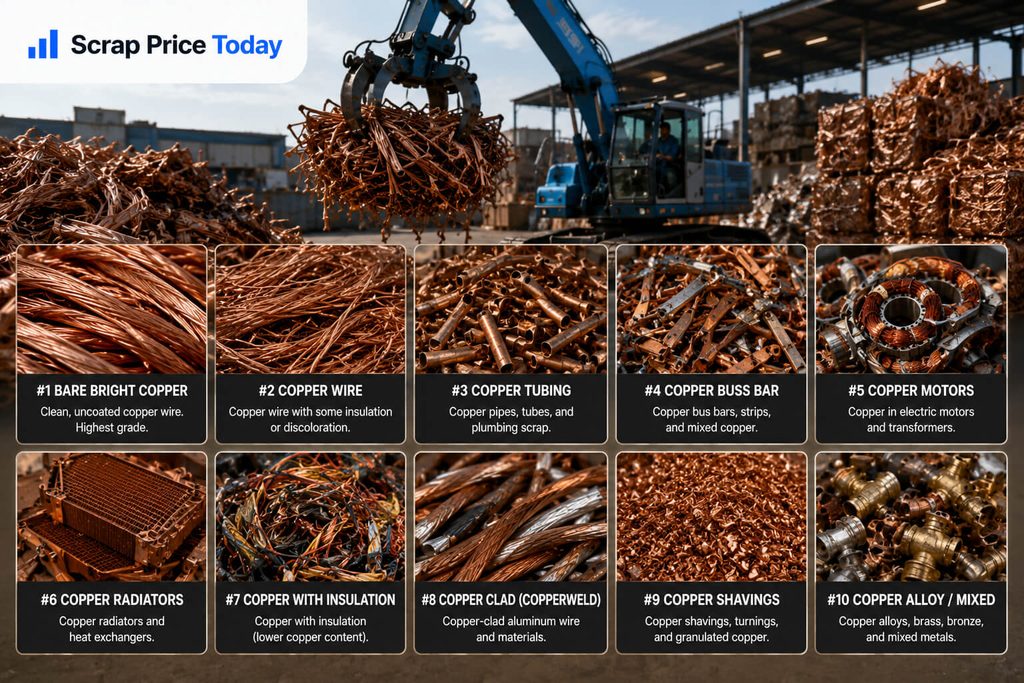
Copper scrap is graded by purity and cleanliness. Bare bright is clean, uncoated wire; number 1 is clean pipe, bus bar and thick wire; number 2 has solder, paint or oxidation; light copper is thin sheet and roofing; insulated wire is bought on the share of its weight that is copper. The spread from top grade to bottom on one board is often 30 percent.
Scrap Price Today editorial guide, checked against current exchange settlements, recycler grade specifications and mill buying programs. Figures are examples; today’s prices are on the live scrap price board.
Grading is decided before the yard sees the load. Knowing the grades tells you what to cut, what to separate and which price to expect for each pile.
Bare bright
Bare bright is uncoated, unalloyed copper wire, 16 gauge or thicker, with a clean shiny surface: stripped cable strands, bus bar, clean clippings. No insulation, tinning, solder or heavy tarnish.
It sells to refiners at 95 to 98 percent of the exchange price, which makes it the highest copper price on most boards.
Number 1 copper
Number 1 is clean unalloyed copper that is not quite bare bright: clean tubing and pipe, bus bar, clippings and thick wire with slight oxidation. It must be free of solder, paint, insulation and fittings, and at least about 1.6 millimetres thick.
Plumbing pipe cut away from its joints is the typical example. It usually pays 2 to 5 percent under bare bright.
Number 2 copper
Number 2 needs more work at the refinery: pipe with solder joints, painted or corroded tubing, thin copper, light coatings and burnt wire. The metal is still 94 to 96 percent copper, but solder and oxide cost the refiner, so it pays roughly 5 to 10 percent under number 1.
Most household plumbing lands here unless the joints are cut out.
Light copper
Light copper is thin sheet, roofing, flashing, gutters and downspouts, often oxidised or tarred. Copper content is lower and surface area high, so it pays another step down. Some yards fold it into number 2; others keep a separate price.
Insulated wire
Wire is bought on copper recovery, the share of the weight that is metal once the insulation is gone. Buyers group it in bands.
- Number 1 insulated: heavy gauge with thin insulation, such as THHN building wire, typically 75 percent recovery or better.
- Number 2 insulated: household cable, extension cords and appliance leads, around 50 to 65 percent.
- Low grade: telephone, data and Christmas light wire, often under 40 percent.
The grades compared
| Bare bright | Number 1 | Number 2 | Light copper | Number 1 insulated | |
|---|---|---|---|---|---|
| Measurement | Price per lb or kg | Price per lb or kg | Price per lb or kg | Price per lb or kg | Price per lb or kg of wire, on copper recovery |
| What it is | Clean uncoated wire, 16 gauge and up | Clean pipe, bus bar, thick wire | Solder, paint, oxidation, thin copper | Sheet, roofing, gutters | Heavy gauge cable, thin insulation |
| Typical share of exchange | 95 to 98 percent at the refinery | 2 to 5 percent under bare bright | 5 to 10 percent under number 1 | A further step down | Copper price times recovery, less stripping |
| Common sources | Stripped cable, bus bar | Plumbing pipe, clippings | Household plumbing, burnt wire | Roofing, flashing | Building wire |
Copper-bearing scrap
Electric motors, transformers, sealed compressors and armatures are priced per pound on the whole item, because copper is only part of the weight. Radiators are graded separately: copper and brass, aluminum and copper, and dirty units with steel tanks or brackets.
The ReMA names
Export contracts and price lists use the Recycled Materials Association code words: Barley for number 1 copper wire, Berry for clean number 1 wire and clippings, Birch for number 2 wire, Candy for number 1 heavy copper, Cliff for number 2 copper and Dream for light copper. Knowing them lets you check a quote against the published specification.
Telling copper from its lookalikes
Brass is yellower and rings when struck. Bronze is redder than brass and usually cast. Copper-plated steel sticks to a magnet and shows silver where scratched. Tinned copper looks dull silver but is copper underneath and grades as number 2.
A file, a magnet and a fresh cut settle most doubts.
Key numbers
- Refined copper trades on the LME and COMEX every trading day; every copper grade is priced as a share of those settlements.
- Recycled copper meets roughly a third of world copper demand, and copper can be recycled repeatedly without losing quality (International Copper Association).
- Number 2 copper is still 94 to 96 percent copper; the discount reflects refining cost, not metal content (ReMA specifications).
- The spread between bare bright and light copper on a typical board is 25 to 35 percent (published yard price lists).
British merchants use dry bright, number 1 and number 2 with braziery for the low grade; Australian yards use bright, candy and burnt copper. The logic is the same, and the country pages show the copper price in local units with the daily change.
Questions people ask
Is my old plumbing pipe number 1 or number 2 copper?
Number 2 if the soldered joints are still on it, number 1 if you cut the joints out and the pipe is clean and unpainted. The cut usually pays for itself on anything over a few kilograms.
Why does the yard pay so little for wire when copper is expensive?
Wire is bought on the copper it contains, and insulation is a large share of the weight. Heavy cable with thin insulation is paid close to its copper value; thin cord is mostly plastic by weight and priced accordingly.
How do I know if something is copper or copper-plated?
Test it with a magnet and a file. Plated steel sticks to the magnet and shows silver under the plating; solid copper does not stick and stays copper-coloured through the cut.
Common mistakes
- Leaving brass valves and fittings on pipe, which drops the whole bundle a grade.
- Mixing tinned or painted copper into a number 1 pile.
- Stripping thin wire that is mostly insulation by weight.
- Assuming a soldered joint or two will not matter; one joint downgrades the bundle.
- Selling motors and radiators as mixed scrap instead of as their own grade.
Sources and further reading
- Recycled Materials Association: copper grade specifications and code names
- London Metal Exchange: copper settlement prices
- International Copper Association: recycling and copper demand data
Related guides
- How Scrap Metal Prices Are Determined: From LME and COMEX benchmarks to the number a yard writes on its board.
- How to Prepare Scrap Metal for Sale: Cleaning, separating and loading scrap so it grades higher at the scale.
- Best Metals to Scrap: The metals and items that return the most per pound, and the ones not worth the trip.
Check today’s numbers before you sell: the scrap price board, the price charts, the scrap value calculator and local rates on our scrap prices by country pages.
Frequently asked questions
Is my old plumbing pipe number 1 or number 2 copper?
Number 2 if the soldered joints are still on it, number 1 if you cut the joints out and the pipe is clean and unpainted. The cut usually pays for itself on anything over a few kilograms.
Why does the yard pay so little for wire when copper is expensive?
Wire is bought on the copper it contains, and insulation is a large share of the weight. Heavy cable with thin insulation is paid close to its copper value; thin cord is mostly plastic by weight and priced accordingly.
How do I know if something is copper or copper-plated?
Test it with a magnet and a file. Plated steel sticks to the magnet and shows silver under the plating; solid copper does not stick and stays copper-coloured through the cut.