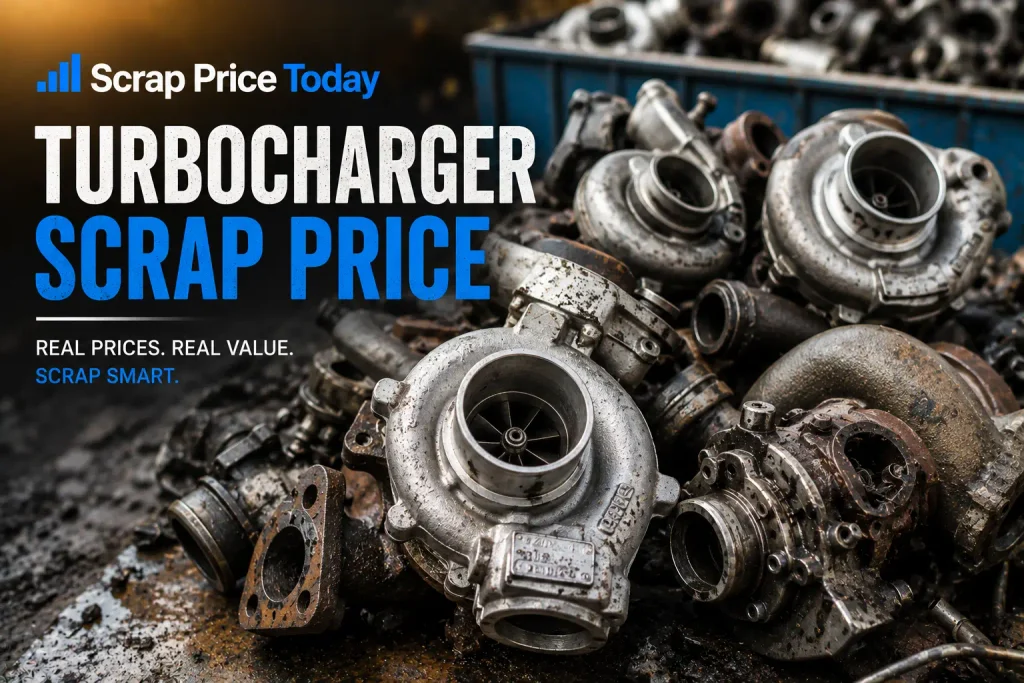
A turbocharger weighs about ten to twenty pounds and grades as mixed metal, so its scrap value runs to single or low double figures. The same unit sold as a rebuildable core can be worth many times that, and the remanufacturing trade publishes exactly how it grades them. Check the grade before you weigh it.
Stop before the aluminium pile
Most parts on this site are worth roughly what their metal is worth. The turbocharger is not one of them.
It is small, it is heavy for its size, and it looks like a snail-shaped lump of iron and aluminium. Onto the pile it goes, and that is usually a mistake worth tens or hundreds of dollars.
The reason is that turbochargers are a remanufactured product category. Rebuilders need used housings and hubs constantly, and they buy them graded rather than by the pound.
Core market vs scrap scale: today’s gap
Route or component Basis Notes Value today (USD) Measurement What the figure is based on What changes it Computed from the live rate unless marked a reference Good core, no meaningful wear Per unit Core market. Top of the rebuilder grading ladder $80 to $400 Core with one critical fault Per unit Actuator, shaft and wheel, or compressor wheel $30 to $150 Core with one good end housing Per unit Bottom of the ladder, still above metal value $10 to $60 Cast iron turbine housing 6 to 12 lb The heaviest single piece $0.86 to $1.73 Aluminium compressor housing 3 to 6 lb Only clean once fully separated $2.31 to $4.62 Whole unit as mixed metal 10 to 20 lb Breakage grade; the outcome to avoid $3.00 to $12
As metal, a turbo is unexciting. The turbine housing is cast iron, the compressor housing is aluminium, the centre section is a mixed casting, and everything is bolted together with steel.
That combination grades as mixed or breakage material rather than as clean anything, which is the same problem the transmission has. Nobody is paying you a clean aluminium rate for a unit with an iron housing bolted to it.
Is a turbo worth scrapping at those numbers? Only when the core route is genuinely closed, and that is rarer than people assume.
The core ladder the trade actually uses
Here is the part that changes the decision, taken from turbo remanufacturing guidance rather than from guesswork.
Rebuilders grade incoming cores on a ladder, roughly in this order:
- Good core. All parts show little or no damage or wear.
- Good core with one fault. Either a bad actuator with a sound rotor assembly, or a good actuator with play in the rotor.
- Damage to one critical component. The critical three are the actuator, the shaft and wheel, and the compressor wheel.
- Damage to more than one critical component.
- Good actuator plus one good end housing, either compressor or turbine side.
- One good end housing only.
Notice how far down that ladder you can go and still be on it. A turbo with a wrecked shaft and a cracked compressor wheel is at tier four or five, not off the list. A blown turbo is often still worth money, which is the single most useful thing on this page.
The trade is candid about why the grade matters to them: lower grades need extra machining such as shaft grinding or bearing housing honing, and where good core is unavailable it becomes more economical to supply a new unit instead.
What rebuilders pay and why
Core value makes sense once you see the numbers the rebuild market runs on.
- A professional variable geometry rebuild averages around $2,500, against $4,500 to $7,500 for a new replacement.
- For a Cummins ISX variable geometry unit, remanufactured runs roughly $2,100 to $3,200 against $6,000 to $10,000 new at the dealer.
- A pre-balanced centre cartridge alone costs $400 to $700.
- Certified remanufactured turbos typically sell 30 to 50 percent below new original equipment price.
Against a used turbo price at that level, a rebuilder can afford to pay properly for a sound core. Core buyers across the parts trade are reported to pay 50 to 200 percent above scrap value, the same pattern the alternator and starter pages describe, and on turbos the multiple is often far higher than that.
Inconel: the exotic metal inside
The turbine wheel is the interesting part metallurgically, and the most misunderstood commercially.
Turbine wheels are cast from Inconel, a nickel-based superalloy that survives exhaust temperatures which destroy ordinary steel. It is genuinely valuable material, used in gas turbine blades, high-temperature fasteners and motorsport exhausts.
But the turbocharger inconel scrap story has a catch that matters more than the alloy. Scrap Inconel trades across a wide band, roughly $0.50 to $6.00 per pound, and yards require it to be analysed and free of attachments. Mixed or contaminated pieces fetch pocket change.
A turbine wheel is a few hundred grams, welded to a steel shaft, sitting inside an iron housing. Extracting it destroys the core value and leaves you with a small contaminated piece of superalloy scrap price material that no yard will pay a premium for.
So the Inconel is real, and chasing it is the wrong move.
When scrapping is the right call
Three situations where the metal route genuinely wins.
- The housings are cracked on both ends. With no good end housing you are off the bottom of the core ladder.
- The unit is from a rare or obsolete application. No rebuilder demand means no core buyer, however good the condition.
- You have one unit and no seller time. A single common turbo may not justify the listing and postage, though a box of them will.
Even then, take thirty seconds to photograph the identification plate first. It costs nothing and it is the only way to find out which of these applies.
Where to sell a core
Four routes, in rough order of effort.
- Turbo rebuilders. Searching for turbo rebuilders near me finds the specialists who actually remanufacture units, and they are the ones who grade properly rather than weighing.
- Core dealers. Businesses that buy and grade cores for onward sale to rebuilders, which is how the graded ladder above exists.
- Online marketplaces. Sell turbo core online listings are common, and a photographed identification plate plus honest damage description does most of the work.
- Auto recyclers with a parts arm, who may already have a core channel.
Whichever route, quote the identification plate rather than the vehicle. A Garrett turbo core value depends on the specific part number and application, not on the badge, in the same way converter values depend on the stamped code rather than the car.
Turbocharger prices around the world
Metal settles in US dollars, so the material in a turbo is worth the same everywhere. Currency and local buyer depth are what change.
Market Equivalent range Local market note United States $0.86 to 4.62 Deepest buyer pool. Even within the US, state to state runs $50 to $60 per ton apart. United Kingdom £0.62 to 3.31 Strong processing capacity. Battery and PGM material reported 20 to 40 percent above thin markets. Canada C$1.17 to 6.30 Similar structure to the US; thinner in the prairies and the north. Australia A$1.16 to 6.25 Good coastal capacity, long hauls inland. Distance is the main discount. Germany €0.78 to 4.20 Dense processing and strict documentation. Good grades pay well; paperwork matters. India ₹74.84 to 402.06 Large volume, but black mass export restrictions have compressed local payables. Bangladesh ৳93.62 to 502.94 Ferrous depth is good. Specialist converter, PGM and battery buyers are scarce. United Arab Emirates AED3.00 to 16.12 Re-export hub with real processing depth. Among the better-paying markets outside the West. Saudi Arabia SAR3.00 to 16.11 Growing capacity; specialist PGM and battery buyers still limited. Turkey ₺44.40 to 238.52 Major ferrous importer, so steel grades hold up better than non-ferrous here. South Africa R11.97 to 64.30 Reported below UAE and UK on battery material; processing infrastructure is the constraint. China CN¥5.64 to 30.29 Aggressive bidder on imported battery material; 2026 recycling rules moved payables down.
The table above converts the metal value alone, because core markets are regional and do not translate into currency this way. In markets with an active rebuild trade the core figure will dominate; where there is none, the metal number is what you have.
Questions people actually ask
“It is completely blown, surely it is just scrap now?”
Probably not. The published grading ladder runs several tiers below fully working, down to units with only one sound end housing. Damage moves you down the ladder rather than off it.
“Can I just cut out the Inconel wheel?”
You can, and you should not. The wheel is small and welded to a steel shaft, scrap Inconel must be analysed and free of attachments to earn a premium, and cutting it out ends any core value the unit had.
“How do I know what mine is?”
The identification plate on the centre housing carries the part number. Photograph it and quote that number. It is the equivalent of the stamped code on a catalytic converter.
Common mistakes
- Throwing a turbo on the metal pile without photographing the identification plate first.
- Assuming a failed turbo has no core value, when the trade grades damaged units across several tiers.
- Cutting out the turbine wheel for Inconel, which destroys core value and yields contaminated scrap that pays little.
- Quoting the vehicle rather than the part number, when core value tracks the specific application.
- Separating the actuator from the unit, since it is one of the three components rebuilders grade on.
- Expecting a clean aluminium rate on a part with a cast iron housing bolted to it.
Figures on this page are indicative buyer ranges, not offers to buy. Metal rows are computed from the site’s tracked daily benchmarks; core values, rebuild costs and Inconel ranges are published market references and are not futures-linked.
Frequently asked questions
What is a turbocharger worth as scrap?
Very little relative to its other value. A turbo weighs roughly ten to twenty pounds and combines a cast iron turbine housing, an aluminium compressor housing and steel fasteners, so it grades as mixed or breakage material rather than clean metal. The core route is almost always worth more.
Is a blown turbo worth money?
Usually yes. Turbo remanufacturers grade cores on a ladder that runs from fully sound units down through damage to one or more critical components, and as far as units with only a single good end housing. Damage moves a turbo down the ladder rather than off it.
What do rebuilders check when grading a turbo core?
Three critical components: the actuator, the shaft and wheel, and the compressor wheel. Grades run from a good core with no meaningful wear, through units with one fault, to units with damage to one or more of those three, down to units offering only a usable end housing.
How much more is turbo core value than scrap?
Substantially more. Core buyers across the parts trade are reported to pay 50 to 200 percent above scrap value, and turbos often exceed that because the rebuilt product sells high. A professional variable geometry rebuild averages around $2,500 against $4,500 to $7,500 for a new unit.
Is the Inconel in a turbo worth extracting?
No. The turbine wheel is cast Inconel and the alloy is genuinely valuable, but scrap Inconel trades from roughly $0.50 to $6.00 per pound and must be analysed and free of attachments to earn the higher end. A small wheel welded to a steel shaft is contaminated scrap, and removing it ends the core value.
What is turbocharger inconel scrap actually worth?
Clean, segregated and certified high-grade material can fetch several dollars per pound, while mixed or contaminated pieces get very little. A turbine wheel cut from a turbo falls firmly into the second category, which is why the whole-unit core route pays better.
Where can I sell a turbo core?
Turbo rebuilders, specialist core dealers who grade and resell to rebuilders, online marketplaces, and auto recyclers with a parts operation. Whichever route you choose, quote the part number from the identification plate rather than the vehicle it came from.
Does a Garrett turbo core value differ from other brands?
Value tracks the specific part number and application rather than the badge alone. A widely fitted unit with active rebuilder demand is worth more than a rare one from the same manufacturer, in the same way converter values depend on the stamped code rather than the car.
When is scrapping a turbo the right decision?
When both housings are cracked, leaving no usable end housing, or when the application is so rare that no rebuilder wants the core. Even then, photograph the identification plate first, because it costs nothing and is the only way to confirm which situation applies.
Why is a VGT turbo worth more than a fixed geometry one?
Because it contains more precision hardware. A variable geometry unit adds adjustable turbine vanes, a nozzle ring and unison ring, and an electronic actuator that must be calibrated to the engine, which is why a VGT for the same engine family can cost twice as much.