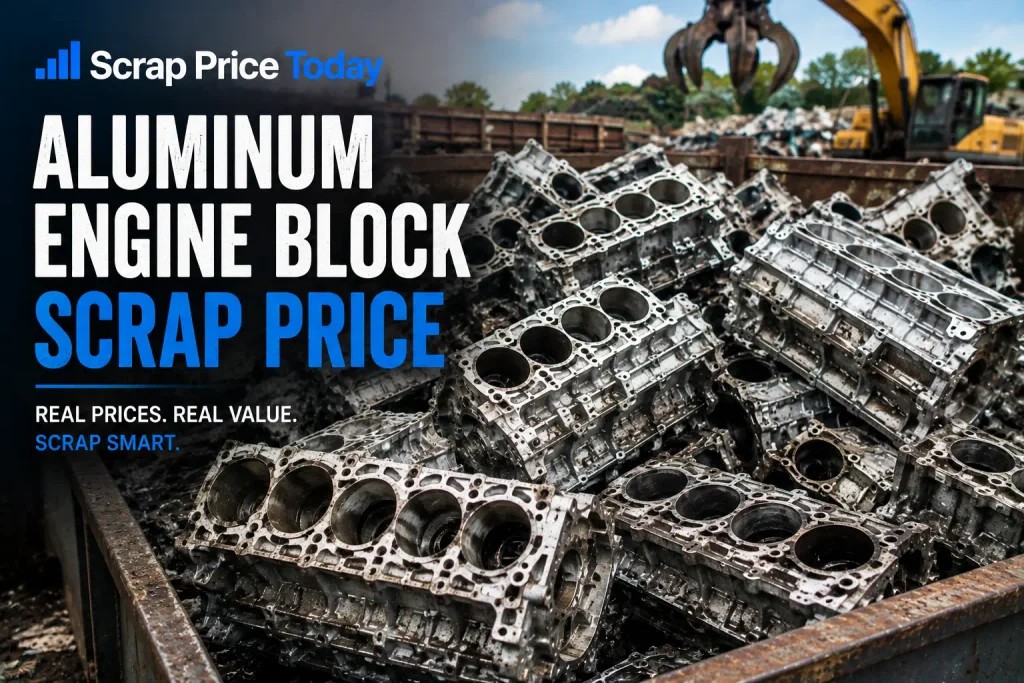
A clean aluminium block is paid at the cast aluminium rate. A block with iron sleeves and steel bolts still in it is graded as irony aluminium, which is commonly quoted around $0.36 per pound nationally and trades roughly 81 percent below the aluminium exchange price. Cleaning it is worth more than most people expect, and takes less time.
Clean versus dirty: today’s two rates
Route or component Basis Notes Value today (USD) Measurement What the figure is based on What changes it Computed from the live rate unless marked a reference BMW N52 magnesium-aluminium block About 90 lb bare Magnesium composite, own grade; ask before mixing with aluminium $40 to $120 Aluminium V8 block, bare (LS 5.7 example) 109 lb A measured figure, stripped $84 to $84 Aluminium block, stripped clean 80 to 110 lb Sleeves, bolts and crank removed $62 to $85 Aluminium block, unstripped 150 to 200 lb gross Irony aluminium at a discount $116 to $154 Cast iron V8 block, bare (LS 5.3 example) 218 lb Exactly twice the aluminium equivalent $31 to $31 Cast iron block, typical 300 to 400 lb Most pre-2000 engines $43 to $58 Complete aluminium V8 engine 387 to 480 lb gross Mixed grade: steel crank and rods inside an alu block $90 to $170 Complete iron-block V8 engine 505 to 605 lb gross Iron LS, Hemi, Chevy 350, Ford 302 $70 to $110 Complete big-block V8 650 to 800 lb gross Chevy 454, Ford 460 $90 to $145 Complete four-cylinder 250 to 400 lb gross Honda K20 about 275 lb; iron Duke 350 to 400 $45 to $110 Heavy-duty pickup diesel engine 800 to 1,150 lb gross The heaviest common case; core value usually beats this $110 to $210 Steel internals removed 40 to 60 lb Crank, rods, sleeves $6.00 to $9.00
The gap between those first two rows is the entire subject of this page. Same block, same metal, different grade, and a very different aluminum engine block price per pound depending on which one the yard writes on your ticket.
One scrapper’s rule of thumb puts it plainly: irony aluminium should return about half what clean aluminium does. Published grade data is harsher still, placing irony and breakage aluminium at roughly 81 percent below the aluminium exchange price, with a national average near $0.36 per pound and a range from $0.25 for heavily contaminated pieces up to $0.57 for pieces that are mostly aluminium.
What makes a block dirty, exactly
The grade has a definition rather than a vibe. Irony aluminium is aluminium with iron or other materials attached, where no more than 30 percent of the total is the contaminant. Above roughly 70 percent aluminium by weight, you are in the grade. Below it, you are into mixed metals and worse.
On an engine block the contaminants are predictable:
- Iron cylinder sleeves, pressed into the bores. These are the big one.
- Steel bolts, studs and dowels left in the deck and mains.
- Steel main bearing caps on many designs.
- Oil residue, which yards may deduct for separately.
- Plastic and rubber, from sensors, seals and gaskets.
Once those are gone the block is graded against the cast aluminum scrap price today rather than the mixed-metal minimum, which is the whole reason for the work.
A magnet settles most of it in seconds. If it sticks, it is costing you, because every magnetic pound pulls your ticket toward the dirty aluminum block scrap price rather than the clean one.
One warning that applies beyond the block itself. A single steel bolt in a thousand-pound bin can move that entire load from a clean price to a dirty one. Sorting laziness costs more than the bolt weighs.
The two-minute method nobody mentions
Here is the part that changes the arithmetic, and it is specific to cast parts.
Cast aluminium is brittle. You do not need to unbolt a block to clean it. A heavy hammer and a chisel, worked near the steel inserts, will shatter the aluminium away from the iron so the clean chunks fall free.
One published yard tip puts the result in numbers: fifty pounds of breakage at $0.36 can become clean cast aluminium in less than two minutes.
Compare that with the alternator on this site, where twenty-five minutes of careful stripping buys only a few dollars. Breaking down an engine for scrap is the rare case where the labour genuinely pays, because the material does most of the work for you.
Two cautions. Wear eye protection, because cast shards travel. And do not break up a block that has core value to a rebuilder, since that decision is not reversible.
The two weigh-ins
The honest way to decide is to weigh the same block twice.
A 3.5 litre aluminium block runs roughly 150 to 200 pounds as it comes out, and about 80 to 110 pounds once the sleeves, bolts and crank are gone. The difference is not aluminium you lost; it is the iron you were being charged for. That gap is the whole engine block scrap value question in one number.
Run the arithmetic on your own yard’s two rates rather than on a national average, because the gap varies. A real forum example shows the scale: a yard paying $0.16 per pound for irony aluminium paid $0.45 per pound for the same seller’s cleaned intakes and brackets once sorted, which is close to three times.
It is also worth asking one question before you start. Some yards accept 5 to 15 percent contamination and still pay clean prices. If yours is one of them, you may be doing work you are not being paid for.
Iron sleeves: the deduction that stays
Bolts come out with a socket. Sleeves do not, and that is why they dominate the grade on most aluminium blocks.
Cylinder sleeves are iron liners pressed into the bores under interference fit. They are not fasteners and they will not unthread. On many engines they are the single heaviest piece of ferrous material left in the casting once the crank is out.
This is precisely where the hammer earns its place. Working the casting around a sleeve breaks the aluminium away rather than trying to press the iron out, which is a workshop job with a press and no place in a scrap run.
Some blocks are sleeveless, with a coated or silicon-rich bore surface instead. Those are already close to clean once the fasteners are out, so check the bores before planning any work.
Break-even: when stripping pays
Work it in three numbers rather than by feel.
- The gap. Your yard’s clean cast rate minus its irony rate, per pound. If that gap is small, stop here.
- The weight that moves. Only the aluminium that changes grade counts, not the whole block. On a 3.5 litre that is roughly 80 to 110 pounds.
- The time. Minutes with a hammer, not hours with a socket set, which is what separates this part from most others on the site.
Multiply the gap by the moving weight and divide by the time. On the published figures that calculation clears most hourly rates comfortably, which is why this is one of the few parts where the labour is genuinely worth doing.
Aluminium or cast iron? Check first
Before any of this, confirm which block you have, because the aluminum vs cast iron block scrap answer is not close.
Aluminium blocks are non-magnetic in the casting itself, noticeably lighter for their size, and dull grey where clean. Cast iron blocks grab a magnet everywhere, weigh far more, and rust orange.
A v8 engine block weight of 400 pounds or more almost certainly means iron. Cast iron sells by the ton at a fraction of the aluminium rate, so the labour maths is completely different and generally not worth it.
For how the block ranks against the rest of the vehicle by return per hour, see the most valuable parts ranking. The alternator page covers the opposite case, where stripping usually does not pay.
Weights by engine family, and the magnesium exception
Two blocks of the same displacement can differ by a factor of two in weight and by several times in rate, so the engine family matters more than the badge on the car.
The cleanest published comparison comes from the GM LS family, where the same architecture was cast both ways. A bare aluminium 5.7 litre LS block weighs about 109 pounds. A bare iron 5.3 litre LS block weighs about 218 pounds. Exactly twice the weight, at roughly a fifth of the rate per pound.
Complete engines, for when the block is still assembled:
- Aluminium V8s: LS1 and LS6 about 430 lb, LS2 435, LS3 445, LS7 387 in Z06 trim, Ford Coyote 5.0 about 430.
- Iron-block V8s with aluminium heads: 5.7 Hemi 485 lb bare and 560 dressed, Vortec 5.3 iron 525 to 550, iron 6.0 LQ4 and LQ9 around 580 to 585.
- Traditional cast iron small blocks: Chevy 350 and Ford 302 at 575 to 605 lb.
- Cast iron big blocks: Chevy 454 and Ford 460 at 650 to 800 lb.
- Four-cylinders: Honda K20 about 275 lb bare, Toyota 2AR-FE about 300, turbo Subaru EJ20 350 to 380, and the older iron GM Duke 350 to 400.
- Heavy-duty pickup diesels: 800 to 1,150 lb, where core value almost always beats metal.
One genuine exception worth knowing. The BMW N52 straight six, built from 2004 to 2015, was the first water-cooled engine to use a magnesium and aluminium composite block. Magnesium is not aluminium and does not grade as aluminium. An owner who weighed one recorded 311 pounds with starter, alternator and water pump fitted, against a published range of 305 to 320 dressed.
If you have an N52 block, say so at the counter rather than putting it on the aluminium pile. Some yards handle magnesium separately and some will not take it at all.
Engine block prices around the world
Aluminium settles in US dollars, so the metal in a block is worth the same everywhere. Currency and local buyer depth are what change.
Market Equivalent range Local market note United States $6.00 to 154.00 Deepest buyer pool. Even within the US, state to state runs $50 to $60 per ton apart. United Kingdom £4.30 to 110.39 Strong processing capacity. Battery and PGM material reported 20 to 40 percent above thin markets. Canada C$8.18 to 209.85 Similar structure to the US; thinner in the prairies and the north. Australia A$8.11 to 208.21 Good coastal capacity, long hauls inland. Distance is the main discount. Germany €5.45 to 139.85 Dense processing and strict documentation. Good grades pay well; paperwork matters. India ₹522.16 to 13,402 Large volume, but black mass export restrictions have compressed local payables. Bangladesh ৳653.17 to 16,765 Ferrous depth is good. Specialist converter, PGM and battery buyers are scarce. United Arab Emirates AED20.93 to 537.29 Re-export hub with real processing depth. Among the better-paying markets outside the West. Saudi Arabia SAR20.93 to 537.08 Growing capacity; specialist PGM and battery buyers still limited. Turkey ₺309.77 to 7,951 Major ferrous importer, so steel grades hold up better than non-ferrous here. South Africa R83.51 to 2,143 Reported below UAE and UK on battery material; processing infrastructure is the constraint. China CN¥39.33 to 1,010 Aggressive bidder on imported battery material; 2026 recycling rules moved payables down.
Treat these as the metal-value anchor rather than a local quote. Grade names differ by market, so describe what is attached rather than asking for a grade by name.
Questions people actually ask
“The yard offered me fourteen cents a pound for a truckload of engine parts.”
That is the unsorted rate. When a load contains clean, cast, sheet and irony together, the yard grades the whole thing at close to the lowest value in it. Sorting before you arrive is where the money is.
“Do I have to get every bolt out?”
No. The grade allows contamination up to about 30 percent, and some yards allow 5 to 15 percent at clean prices. Get the sleeves and the heavy steel out; do not chase every dowel.
“Is a complete engine worth more than a stripped block?”
As scrap, no. A complete engine scrap price is quoted at a mixed or irony rate because of everything bolted to it. As a rebuildable core, sometimes yes, which is worth checking before anything gets broken.
Common mistakes
- Bringing an unsorted load, which gets graded at close to the lowest value present.
- Leaving iron sleeves in, which is the single largest contaminant on most aluminium blocks.
- Unbolting when you could be breaking, since cast aluminium shatters away from steel far faster than it unthreads.
- Dropping one steel bolt into a clean bin, which can downgrade the entire container.
- Leaving oil in the block, which some yards deduct for on top of the grade.
- Breaking up a block a rebuilder would have bought as a core, which is not reversible.
- Assuming a heavy block is aluminium. Check with a magnet before planning any of this.
Figures on this page are indicative buyer ranges, not offers to buy. Metal rows are computed from the site’s tracked daily benchmarks, and grade discounts cited are published market references. Weights vary by engine family, so weigh your own block before applying any of these figures.
Frequently asked questions
What is the aluminum engine block scrap price today?
It depends entirely on grade. A cleaned block is paid at the cast aluminium rate, while a block with iron sleeves and steel bolts still fitted is graded as irony aluminium, commonly quoted near $0.36 per pound nationally with a range from about $0.25 to $0.57.
Why is my engine block priced as dirty aluminum?
Because of what is still attached. Irony aluminium is aluminium with iron or other materials making up no more than 30 percent of the total. On a block that usually means iron cylinder sleeves, steel bolts and bearing caps, plus any oil or plastic left in place.
Is it worth stripping an engine block?
Usually yes, and more than people expect. Published grade data puts irony aluminium at roughly 81 percent below the aluminium exchange price, and one scrapper's rule of thumb is that irony returns about half of clean. One real example showed $0.16 per pound for irony against $0.45 for the same seller's cleaned pieces.
What is the fastest way to clean an aluminum block?
Break it rather than unbolt it. Cast aluminium is brittle, so a heavy hammer and chisel worked near the steel inserts shatters the aluminium free of the iron. One published yard tip reports turning fifty pounds of breakage into clean cast aluminium in under two minutes. Wear eye protection.
How much does an aluminium engine block weigh?
A 3.5 litre block runs roughly 150 to 200 pounds as removed and about 80 to 110 pounds once sleeves, bolts and crank are out. A v8 engine block weight above 400 pounds almost certainly indicates cast iron rather than aluminium.
How do I tell an aluminium block from a cast iron one?
Use a magnet. Cast iron grabs it everywhere, weighs far more for its size and rusts orange. Aluminium castings are non-magnetic, noticeably lighter and dull grey when clean. The aluminum vs cast iron block scrap values are not close, so check before planning any work.
What is the cast aluminum scrap price compared to other grades?
Cast sits mid-tier. Clean extrusion grades such as 6063 fetch the most, cast aluminium including blocks and housings prices below that when properly cleaned, and mixed or irony aluminium gets the minimum. Contamination alone can cut value by 80 percent or more.
Is a complete engine worth more than a stripped block?
Not as scrap. A complete engine scrap price is quoted at a mixed or irony rate because of everything bolted to it. As a rebuildable core it can be worth considerably more, so check core value before breaking anything up.
Do scrap yards deduct for oil in an engine block?
Some do, separately from the grade. Draining the block and letting it sit to dry avoids a deduction that has nothing to do with the metal. It also makes the block safer and cleaner to handle and transport.
How much contamination will a yard accept at clean prices?
It varies, and it is worth asking. Some yards accept 5 to 15 percent contamination and still pay clean rates, while the irony grade itself allows up to about 30 percent. If your yard is lenient, you may be doing preparation work you are not being paid for.