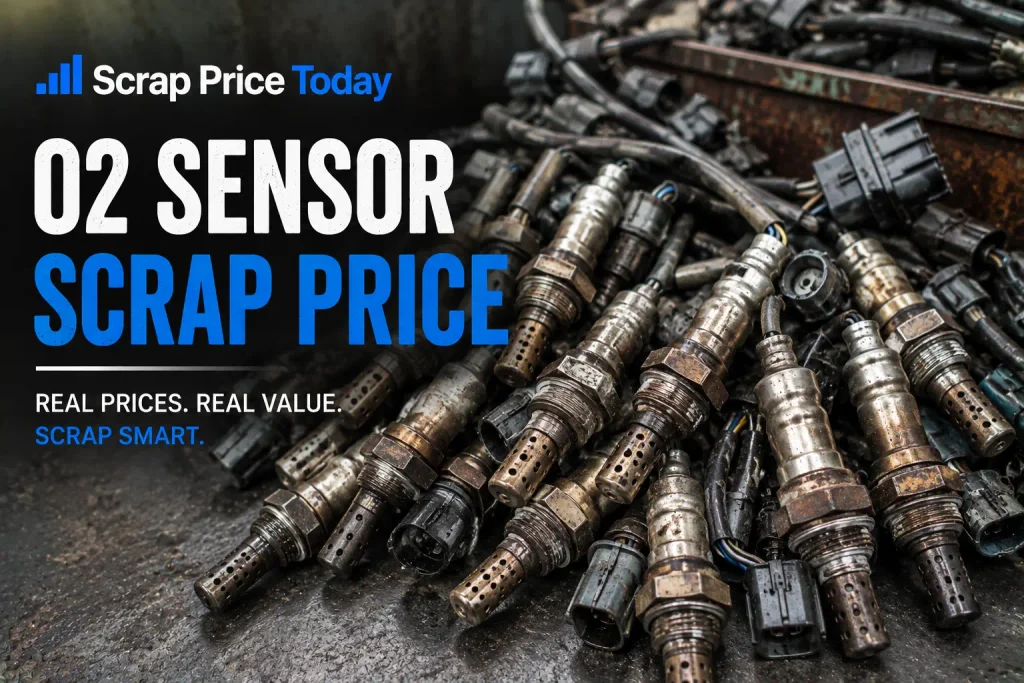
Oxygen sensors are commonly quoted at around $3 per pound, and a sensor weighs 0.15 to 1 pound, so one unit is worth roughly $0.45 to $3.00. They do contain platinum, but published estimates of how much range from 0.008 to 0.2 grams per sensor. Sell by weight in volume rather than chasing the metal.
Why your yard might say no
Oxygen sensors sit in an awkward place in the trade. They contain precious metal, which makes them sound valuable, but each one holds so little that handling a single unit costs more than it returns.
Some yards take them happily. Others decline, because sorting a handful of small parts with wires attached is not worth the counter time.
That is the practical problem this page solves. Not what the sensor contains, but who will actually pay you for it.
What is really inside: platinum by the gram
How much platinum in an o2 sensor is the question every guide answers confidently, and the honest response is that the sources disagree badly.
- One widely cited estimate puts sensor content at 0.1 to 0.2 grams of platinum each. The publisher notes plainly that this figure comes from various internet sources and was not confirmed by their own testing.
- A refiner who actually processed a batch reported 1.2 grams of platinum from 150 sensors. That works out to roughly 0.008 grams each, or twelve to twenty-five times less than the estimate above.
Both cannot be right. The refiner’s figure comes from real recovery, which is the stronger evidence, though the batch was not automotive.
What this means for you is simple. Treat the platinum as the reason a buyer exists, not as a number you can multiply into a payday. The o2 sensor precious metal content is real but small, and the sensor’s weight is what you will actually be paid on.
Two further points that are better established:
- Older sensors carry more. Manufacturers have reduced material use in newer designs, so pre-2000s units are reported to hold more recoverable metal than current ones.
- Position barely matters. Sensors before and after the converter hold broadly similar content, with post-converter units sometimes slightly lower.
Pricing per sensor: realistic ranges
Route or component Basis Notes Value today (USD) Measurement What the figure is based on What changes it Computed from the live rate unless marked a reference Lot of 100 mixed sensors Roughly 30 to 60 lb Volume is what makes the trip or the shipping worthwhile $90 to $180 Wideband / AFR / LAF sensor (5 or 6 wires) Per unit Extra pump cell means additional platinum electrodes $1.50 to $4.00 Older sensor, pre-2000s Per unit Reported to carry more metal than newer designs $1.00 to $4.00 Narrowband, heated (2 to 4 wires) Per unit The common case; around $3 per lb quoted $0.45 to $3.00 Narrowband, unheated (1 wire, older cars) Per unit Simplest construction, fewest electrodes $0.45 to $3.00 Downstream sensor (after the converter) Per unit Usually narrowband even where upstream is wideband $0.45 to $3.00 Sensor with wiring removed Per unit Some buyers require wires off; ask before cutting $0.40 to $2.50
The number to carry is roughly $3 per pound, with a single sensor weighing between 0.15 and 1 pound. That is the realistic lambda sensor scrap value, whichever name your market uses for the part.
That is the whole oxygen sensor recycling price picture: one sensor is pocket change, a hundred is a worthwhile box. That threshold, rather than the metal content, is what decides whether this is worth your time.
Not all sensors are the same: count the wires
Two quite different sensors get called oxygen sensors, and the difference is in how much platinum is inside.
A narrowband sensor uses a zirconia element with a platinum electrode on each side, one facing the exhaust and one facing the atmosphere. That is the original design, introduced by Bosch on Volvo models in 1976, and it simply reports rich or lean.
A wideband sensor, also called an air fuel ratio, AFR, LAF or lambda sensor, adds a second structure: a pump cell with its own electrodes that exchange oxygen with the exhaust gas under an applied current. More electrode structures means more platinum in the same small object. Honda fitted the first one to the 1992 Civic.
Count the wires. That is the whole identification method, and it takes a second:
- One wire: unheated narrowband, older vehicles.
- Two to four wires: heated narrowband, the common case.
- Five or six wires: wideband. Honda technicians first met these as a familiar-looking sensor that inexplicably had five wires.
Position matters too. The upstream sensor sits before the catalytic converter and on modern engines is usually the wideband one. The downstream sensor sits after the converter and is usually narrowband, since it only checks whether the converter is working.
Sort widebands from narrowbands when you have volume. Given how far published platinum estimates already disagree, nobody should quote you a precise gram difference between the two types, but more electrode structures in the same housing is not a difficult inference.
The refiners who do buy
Three routes, in increasing order of how much volume they want.
Local scrap yards. Many accept sensors and price them by weight alongside other small non-ferrous items. Call first, because a meaningful minority decline them. This is the easiest answer to the where to sell o2 sensors question if you have a handful.
National mail-in recyclers. Specialists such as the converter recycling arms of larger yards buy sensors directly and some offer free shipping for them. These o2 sensor buyers mail in programmes suit anyone with a box but no local buyer, and they remove the trip entirely.
PGM refiners. These process by assay rather than by piece and want thousands of units, clean and shipped to their dock. PGM refiners for individuals are largely out of reach at household volume, which is why the mail-in route exists in between.
The practical o2 sensor lot minimum is therefore set by economics rather than by rule. Below roughly a hundred units, shipping and handling eat the value. Above it, the mail-in route starts to make sense.
Lot minimums and mail-in logistics
No recycler publishes a hard minimum, but the economics set one for you. Below roughly a hundred sensors, packing and postage consume most of the value, so the box is better left growing on a shelf.
- Keep sensors dry and loose in one container rather than mixed through general scrap.
- Count them before shipping, since payment is usually reconciled against a count on arrival.
- Ask about free shipping before paying for it, as several sensor programmes cover postage.
- Do not mix sensors with converters in one box unless the buyer says to, because the two are graded on entirely different terms.
Wires on or off?
This one genuinely splits by buyer, and getting it wrong wastes value either way.
Some yards require the wires removed before they will take sensors, because the leads complicate their grading. Rockaway Recycling, for instance, states this plainly for its sensor intake.
Refiners handling small electronics often prefer the connectors left attached, because the pins are frequently gold plated and add recoverable value.
So ask before you cut. It takes one question and it is not reversible.
Where sensors sit against the rest of the exhaust
Sensors are the smallest precious-metal item on a car, and it helps to see the scale.
A catalytic converter from the same exhaust holds 10 to 15 grams of platinum group metals on a petrol vehicle. A sensor holds a fraction of a gram. That is why one is priced by stamped code and the other by the pound.
If you are working through an exhaust system, the catalytic converter hub covers the valuable part, and the muffler page explains how to tell the components apart. The most valuable parts ranking shows where sensors land against everything else on the car.
O2 sensor prices around the world
Platinum settles in US dollars, so sensor content is worth the same everywhere. Currency and local buyer depth are what change.
Market Equivalent range Local market note United States $0.40 to 180.00 Deepest buyer pool. Even within the US, state to state runs $50 to $60 per ton apart. United Kingdom £0.29 to 129.02 Strong processing capacity. Battery and PGM material reported 20 to 40 percent above thin markets. Canada C$0.55 to 245.28 Similar structure to the US; thinner in the prairies and the north. Australia A$0.54 to 243.37 Good coastal capacity, long hauls inland. Distance is the main discount. Germany €0.36 to 163.46 Dense processing and strict documentation. Good grades pay well; paperwork matters. India ₹34.81 to 15,665 Large volume, but black mass export restrictions have compressed local payables. Bangladesh ৳43.54 to 19,595 Ferrous depth is good. Specialist converter, PGM and battery buyers are scarce. United Arab Emirates AED1.40 to 628.00 Re-export hub with real processing depth. Among the better-paying markets outside the West. Saudi Arabia SAR1.40 to 627.75 Growing capacity; specialist PGM and battery buyers still limited. Turkey ₺20.65 to 9,293 Major ferrous importer, so steel grades hold up better than non-ferrous here. South Africa R5.57 to 2,505 Reported below UAE and UK on battery material; processing infrastructure is the constraint. China CN¥2.62 to 1,180 Aggressive bidder on imported battery material; 2026 recycling rules moved payables down.
Treat these as the metal-value anchor rather than a local quote. Mail-in programmes are largely North American, so sellers elsewhere depend more on whether a local yard grades sensors separately at all.
Questions people actually ask
“I have one sensor from my own car, what do I do with it?”
Keep it in a box with the next ones. A single sensor is worth roughly a dollar or two, which does not justify a trip. Sensors should not go in household waste, so storing them until you have a boxful is both the practical and the responsible answer.
“Someone told me there is a gram of platinum in each one.”
The published estimates top out around 0.2 grams, and actual recovery from a real batch came in near 0.008 grams per unit. Anyone quoting a full gram is describing a converter, not a sensor.
“Can I extract the platinum myself?”
No, not practically. The platinum is deposited as a thin catalytic layer on a ceramic element, and recovering it requires refining chemistry and volume. This is a sell-it-onward part, not a home-recovery one.
Common mistakes
- Cutting the wires before asking, when some buyers want them off and others want the connectors on.
- Making a trip for a handful of sensors, when the transport cost exceeds the value below roughly a hundred units.
- Believing a per-sensor platinum figure without checking whether the publisher tested it or copied it.
- Mixing sensors into a general non-ferrous bin, where they are paid as low-grade scrap rather than graded separately.
- Throwing sensors in household waste, which is both wasteful and, in many places, against disposal rules.
- Assuming all sensors are equal, when older units are reported to carry more metal than recent designs.
Figures on this page are indicative buyer ranges, not offers to buy. Sensor rows are published market references rather than futures-linked rates, because sensors are graded by weight and assay rather than against a daily benchmark. Precious metal content estimates vary widely between sources and are presented here with that disagreement stated.
Frequently asked questions
How much is an O2 sensor worth as scrap?
Oxygen sensors are commonly quoted at around $3 per pound, and a single sensor weighs between 0.15 and 1 pound. That puts one unit at roughly $0.45 to $3.00, which is why volume rather than individual units is what makes them worth selling.
How much platinum is in an O2 sensor?
Published figures disagree sharply. One widely cited estimate says 0.1 to 0.2 grams per sensor, while its publisher notes the figure was not verified by testing. A refiner processing an actual batch reported 1.2 grams from 150 sensors, or about 0.008 grams each. Treat the platinum as the reason a buyer exists rather than a number to multiply.
Where can I sell O2 sensors?
Three routes. Many local scrap yards take them by weight, though some decline. National mail-in recyclers buy them directly and some offer free shipping. PGM refiners process by assay but want thousands of units, which puts them out of reach at household volume.
Should I cut the wires off my O2 sensors?
Ask your buyer first, because it splits both ways. Some yards require the wires removed before they will take sensors. Refiners handling small electronics often prefer connectors left attached, since the pins are frequently gold plated and add recoverable value.
Is there an O2 sensor lot minimum for recyclers?
Not usually a stated rule, but economics set one. Below roughly a hundred units, shipping and handling costs consume the value. Above that, mail-in programmes start to make sense, and refiners working by assay want thousands.
Do older oxygen sensors contain more precious metal?
Reportedly yes. Manufacturers have reduced material use in newer designs, so pre-2000s sensors are described as holding more recoverable metal than current ones. The difference is not large enough to sort by, but it is worth knowing.
What is the lambda sensor scrap value?
The same as an oxygen sensor, since lambda sensor is simply the term used in much of Europe for the same component. Expect roughly $3 per pound by weight, with a single unit landing between about $0.45 and $3.00.
Can I get the platinum out of an O2 sensor myself?
Not practically. The platinum sits as a thin catalytic layer on a ceramic element, and recovering it requires refining chemistry and processing volume. This is a component to sell onward rather than to process at home.
Are pre-converter and post-converter sensors worth different amounts?
Barely. Sensors upstream and downstream of the converter hold broadly similar precious metal content, with post-converter units sometimes slightly lower. It is not a distinction worth sorting your box by.
Can I sell oxygen sensors online?
Yes. Several national recyclers accept sensors by post and publish their terms, with some offering free shipping on sensor loads. That route suits anyone holding a box without a local yard that grades sensors separately.