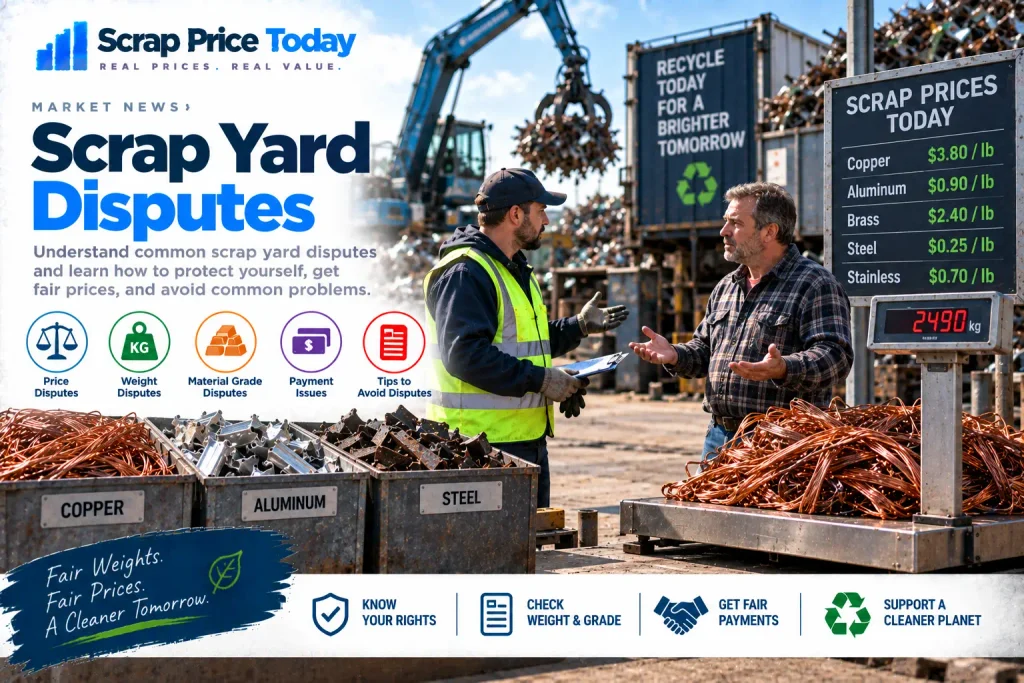
Most yards are honest, and the ones that are not tend not to last. But when a seller does lose money it is almost never through a dramatic swindle: it is through grade classification, which is subjective, unrecorded and worth far more than any rigged scale. Booking 200 pounds of yellow brass as irony brass costs $282. A 5 percent short weight on the same load costs $88. Watch the grade, not the needle.
Scrap Price Today market analysis, written from exchange settlement data, mill and refiner pricing practice and published policy documents. Figures are examples; today’s numbers are on the live scrap price board.
That ranking is the opposite of where most sellers focus their suspicion, and it is why the defence is documentation rather than vigilance.
What grade switching actually costs
Each row is 200 pounds of one material, correctly graded against the next grade down.
| Reclassification | Correct value | As booked | Loss |
|---|---|---|---|
| Yellow brass as irony brass | $704.00 | $422.40 | $281.60 |
| Insulated wire as low-grade cable | $558.00 | $372.00 | $186.00 |
| Number 1 copper as sheet copper | $1,156.00 | $1,003.41 | $152.59 |
| THHN as Romex | $730.00 | $600.00 | $130.00 |
| Stainless 304 as shred | $114.00 | $26.40 | $87.60 |
| Number 1 copper as number 2 | $1,156.00 | $1,069.30 | $86.70 |
| Clean aluminium as irony | $170.00 | $110.00 | $60.00 |
None of that requires anything to be tampered with. It requires only that nobody wrote down which grade was agreed before the material went on the scale.
The defence is correspondingly simple: agree the grade before weighing, and take a ticket that names it.
What short weighing costs, for comparison
| Shortfall | 200 lb copper | 500 lb brass | 1,500 lb light iron |
|---|---|---|---|
| 2% | $23.12 | $35.20 | $3.96 |
| 5% | $57.80 | $88.00 | $9.90 |
| 10% | $115.60 | $176.00 | $19.80 |
Cases exist. A customs enforcement operation in one market found eight of ten recycling shops raided were using scales rigged by remote control, some registering as much as 38 percent under true weight, with the elderly and informal collectors as the targets. In the United States, a state weights and measures office identified 16,000 transactions affected by one faulty truck scale at a single scrap company, which settled for nearly $128,000. A federal case in New Jersey alleged a conspiracy that altered documents to show lower weights, removed metal from hauls before weighing, and misrepresented the types of metal in a load.
Note what the last of those describes: weight fraud and grade fraud, running together. That is the realistic picture.
Rounding, which is not fraud
Worth separating out, because sellers often mistake it for cheating.
Dock scales typically resolve to one pound and drive-on scales to ten. A scale rounding down to the nearest increment costs at most $5.20 on a copper weighing and about $1.19 on a drive-on ferrous weighing. Across six grades on a mixed load it is pennies.
That is a rounding convention, not a swindle, and it cuts both ways over time. Save the suspicion for the grade line.
The five signals of a yard to leave
- You are asked to wait away from the scale. A yard that will not let you watch the weighing has no reason for that rule.
- The display faces away from you. Reputable yards turn it towards the seller.
- No printed ticket, or a ticket with one line for a mixed load. Each grade should appear separately with weight, price and any deduction.
- No certification sticker on the scale. Commercial scales must be legal for trade, inspected by weights and measures officials and sealed with a dated sticker.
- The grade is announced after weighing rather than agreed before. That sequence is the whole vulnerability.
What the law provides
Enforcement rests with state weights and measures officials, who spot check using certified field standards traceable to the national standards institute, test scales at capacity and at smaller loads, verify tare deductions, and seal approved devices with dated stickers.
State statutes commonly provide for certification of tare weight by a weighmaster, reweighing on complaint, records of public weighings, and penalties for false weighing or false certificates. Our scale ticket guide covers how those numbers fit together.
You rarely need any of it. Knowing it exists is what makes a polite question reasonable rather than confrontational.
How to protect yourself in five minutes
- Weigh at home. Write the weight on the item. One practitioner marks each piece, then phones for pricing before travelling.
- Agree grades on the phone, using the names from our copper grades guide, and note who you spoke to.
- Sort before arrival so nothing needs a judgement call at the scale.
- Watch the weighing and read the display yourself.
- Keep every ticket. A run of them across visits reveals a pattern that no single visit can.
- Get one independent certified weight on a non-ferrous load from a truck stop or grain elevator scale. It costs a few dollars and settles the question permanently.
The wider context
Fraud in this industry runs in both directions, and it is worth knowing that yards face it too.
One audit of a US yard found nearly 7 percent of inbound loads carried inaccurate weight or material classification, costing about $90,000 a year. Painted and mixed look-alike materials are presented as high grades deliberately. Yards have responded with photographic records, automated data matching and audit trails.
That is why a yard asking for identification, photographing loads and keeping records is behaving well rather than suspiciously. The documentation that protects them protects you.
What this metal pays around the world
Scrap is a global market priced in US dollars, but what reaches a seller depends on trade position, freight to the nearest consumer and how many buyers compete locally. The table below converts the same grade into each market’s own currency and units at the day’s exchange rate, and shows the factor we apply.
| Market | Local price | USD per lb | Market factor |
|---|---|---|---|
| Turkey | ₺391.59 / kg | $3.61 | 1.04 |
| Germany | €6.97 / kg | $3.54 | 1.02 |
| United States | $3.47 / lb | $3.47 | 1.00 |
| China | CN¥50.32 / kg | $3.40 | 0.98 |
| Canada | C$4.79 / lb | $3.37 | 0.97 |
| United Kingdom | £5.56 / kg | $3.33 | 0.96 |
| Australia | A$10.44 / kg | $3.30 | 0.95 |
| United Arab Emirates | AED26.69 / kg | $3.30 | 0.95 |
| Saudi Arabia | SAR26.68 / kg | $3.23 | 0.93 |
| India | ₹681 / kg | $3.19 | 0.92 |
| Bangladesh | ৳828 / kg | $3.05 | 0.88 |
| South Africa | R108.20 / kg | $2.95 | 0.85 |
Method
The grade switching table applies our own board prices and published market grade ratios to a fixed 200 pound load, so the losses are arithmetic rather than allegations. Rates are documented on the editorial policy page with live figures on the board.
The enforcement cases described are drawn from published news reporting and regulatory settlements and are illustrations of what has occurred rather than characterisations of the industry. Weights and measures requirements differ by state and by country.
We do not buy scrap, rank yards or take referral fees. Our position throughout is that most yards are honest, that grade classification is where money is genuinely lost, and that a printed ticket naming the grade solves most of it.
Questions people ask
Do scrap yards cheat customers?
Most do not, and the ones that do rarely last. Where sellers genuinely lose money it is usually through grade classification rather than weighing, because grade is subjective and often unrecorded. Booking 200 pounds of yellow brass as irony brass costs $282 against $88 for a 5 percent short weight.
What is grade switching?
Booking material at a lower grade than it qualifies for, such as number 1 copper as sheet, THHN as Romex, or clean aluminium as irony. It requires no tampering at all, only that nobody agreed and recorded the grade before the material went on the scale.
How do I stop being downgraded at the scale?
Agree the grade before weighing, using standard grade names, and take a printed ticket that names it. Sort before arrival so nothing requires a judgement call, and note who you spoke to when you phoned for prices.
Is a scale rounding down cheating me?
No. Dock scales typically resolve to one pound and drive-on scales to ten, so rounding costs at most about $5.20 on a copper weighing and $1.19 on a drive-on ferrous one. It is a rounding convention rather than a swindle. Save the scrutiny for the grade line.
What are the warning signs of a bad yard?
Being asked to wait away from the scale, a display facing away from you, no printed ticket or one line for a mixed load, no certification sticker on the scale, and grades announced after weighing rather than agreed before.
Are scrap scales inspected by anyone?
Yes. State weights and measures officials spot check them using certified field standards traceable to the national standards institute, test at capacity and at smaller loads, verify tare deductions, and seal approved devices with dated stickers.
How can I verify my weight independently?
Weigh loaded and empty at a truck stop or agricultural co-op scale, which costs a few dollars and gives a certified net weight to compare with the yard ticket. On a non-ferrous load it pays for itself if it protects about one pound of copper.
Why does the yard photograph my load and ask for ID?
Because yards face fraud too. One US audit found nearly 7 percent of inbound loads carried inaccurate weight or classification, costing about $90,000 a year, and look-alike materials are presented as high grades deliberately. The documentation that protects them also protects you.
Frequently asked questions
Do scrap yards cheat customers?
Most do not, and the ones that do rarely last. Where sellers genuinely lose money it is usually through grade classification rather than weighing, because grade is subjective and often unrecorded. Booking 200 pounds of yellow brass as irony brass costs $282 against $88 for a 5 percent short weight.
What is grade switching?
Booking material at a lower grade than it qualifies for, such as number 1 copper as sheet, THHN as Romex, or clean aluminium as irony. It requires no tampering at all, only that nobody agreed and recorded the grade before the material went on the scale.
How do I stop being downgraded at the scale?
Agree the grade before weighing, using standard grade names, and take a printed ticket that names it. Sort before arrival so nothing requires a judgement call, and note who you spoke to when you phoned for prices.
Is a scale rounding down cheating me?
No. Dock scales typically resolve to one pound and drive-on scales to ten, so rounding costs at most about $5.20 on a copper weighing and $1.19 on a drive-on ferrous one. It is a rounding convention rather than a swindle. Save the scrutiny for the grade line.
What are the warning signs of a bad yard?
Being asked to wait away from the scale, a display facing away from you, no printed ticket or one line for a mixed load, no certification sticker on the scale, and grades announced after weighing rather than agreed before.
Are scrap scales inspected by anyone?
Yes. State weights and measures officials spot check them using certified field standards traceable to the national standards institute, test at capacity and at smaller loads, verify tare deductions, and seal approved devices with dated stickers.
How can I verify my weight independently?
Weigh loaded and empty at a truck stop or agricultural co-op scale, which costs a few dollars and gives a certified net weight to compare with the yard ticket. On a non-ferrous load it pays for itself if it protects about one pound of copper.
Why does the yard photograph my load and ask for ID?
Because yards face fraud too. One US audit found nearly 7 percent of inbound loads carried inaccurate weight or classification, costing about $90,000 a year, and look-alike materials are presented as high grades deliberately. The documentation that protects them also protects you.