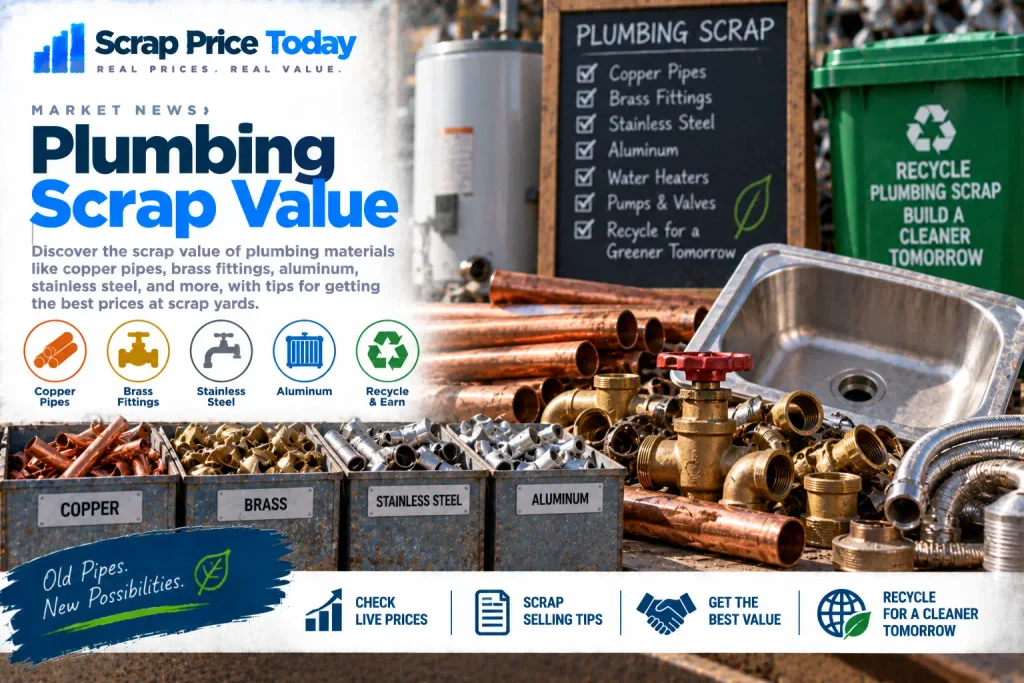
A bathroom and kitchen strip-out yields about 262 pounds of metal worth roughly $414, and copper accounts for $331 of it. The question every plumber asks, whether to cut the soldered joints off the pipe, is worth about $10 on that job. It is worth doing, but it is not where the money is. The money is in not letting the copper leave in the same skip as the bath.
Scrap Price Today market analysis, written from exchange settlement data, mill and refiner pricing practice and published policy documents. Figures are examples; today’s numbers are on the live scrap price board.
Plumbing is the highest value per pound of any trade material, and the grade rules are simpler than most people assume.
The copper ladder, in ratios rather than prices
Yard price lists move daily, so the durable version of this is the spread between grades rather than the numbers themselves. One published list gives bare bright, number 1, number 2 and sheet at a consistent spacing.
| Grade | Ratio to number 1 | At our board | Difference |
|---|---|---|---|
| Bare bright | 1.02 | $5.89 | +$0.11 |
| Number 1 | 1.00 | $5.78 | reference |
| Number 2 | 0.92 | $5.34 | -$0.44 |
| Sheet and light copper | 0.87 | $5.02 | -$0.76 |
The number 2 discount is about 7.5 percent. That is the entire financial consequence of solder, and it explains why the joint question is smaller than it feels.
What actually separates number 1 from number 2
Number 1 is clean, unalloyed, uncoated copper. Tubing qualifies when it is free of solder, fittings, paint and insulation. Tarnish and dullness are fine; oxidation does not change the grade.
Number 2 is the same metal with solder, paint, minor corrosion, enamel or brass joints attached. Old plumbing with soldered joints is the textbook example, and so is any pipe that carried oil, which is dirty number 2 regardless of how it looks.
The magnet test settles nothing here, since both grades are copper. What settles it is a visual check for silver solder at the joints and brass at the fittings.
What a bathroom and kitchen actually produce
| Material | Weight | Grade | Value |
|---|---|---|---|
| Copper hot water cylinder | 30 lb | Number 2 | $160.31 |
| Copper pipe, 60 ft mixed sizes | 24 lb | Number 1 after joint removal | $138.72 |
| Brass fittings, valves and taps | 14 lb | Yellow brass | $49.28 |
| Soldered joints and offcuts | 6 lb | Number 2 | $32.06 |
| Cast iron soil pipe | 90 lb | Cast iron | $12.96 |
| Steel bath | 80 lb | Light iron | $10.56 |
| Stainless sink | 18 lb | Stainless | $10.26 |
| Total | 262 lb | About $414 |
The cylinder and the pipe are 21 percent of the weight and 72 percent of the value. The bath and the soil pipe are 65 percent of the weight and 6 percent of the value.
That ratio is why the single most expensive habit in plumbing work is letting the copper go into the same skip as the sanitaryware.
Copper pipe by the foot
Useful for estimating before a job rather than weighing after it.
| Size | Weight per foot | Value per foot as number 1 |
|---|---|---|
| 15 mm, half inch | 0.285 lb | $1.65 |
| 22 mm, three quarter inch | 0.455 lb | $2.63 |
| 28 mm, one inch | 0.655 lb | $3.79 |
Sixty feet of mixed domestic pipework is around 24 pounds, so a full house rip-out of a hundred feet or more is a genuinely worthwhile pile on its own.
The joint question, answered with arithmetic
Cut the joints off and sell 24 pounds as number 1 plus 6 pounds as number 2, and you get $170.78. Leave the run whole and the yard grades all 30 pounds as number 2, giving $160.31.
The difference is $10.47, or about a third of an hour’s work at trade rates. Worth doing while the pipe is on a bench, not worth doing on a ladder.
The stronger reason to cut the joints is that the brass fittings themselves are a separate grade at $3.52 a pound, and on this job those are worth $49.28. Cutting joints and keeping brass separate are the same operation, and the brass is the part that pays.
The copper cylinder, and what replaced it
A copper hot water cylinder at 30 pounds is worth about $160 as number 2. A modern stainless cylinder at 45 pounds is worth about $26.
That is a six times difference in favour of the older, lighter item, and it is the single most valuable thing in most domestic plumbing strip-outs. Anyone quoting for a cylinder swap should know which one is coming out.
Cylinders also carry lagging, which on older installations is worth checking before anything is cut. Pipe insulation from before the late 1980s may contain asbestos, and the correct response is to stop, as our asbestos lagging guide explains for pressurised items and our pipe lagging article covers directly.
Sorting that takes no extra time
- Three buckets on the van: bare and clean copper, number 2 copper with solder, and brass.
- Cast iron soil pipe and steel baths go to the skip or a ferrous load, never into the copper bucket.
- Cut brass fittings off at the pipe rather than pulling them; a saw is faster than a wrench on corroded joints.
- Keep chrome-plated brass taps separate from bare brass; the plating drops them a grade, as our brass article sets out.
- Store dry. Copper does not rust but the steel in the same load does.
Provenance, because copper attracts questions
A van of copper pipe and a cylinder is exactly what a stolen load looks like, and licensed yards are required to ask.
Job addresses, customer names and a business account make it routine. Our note on copper selling rules covers the identification and record requirements, which tightened again this year in California.
What this metal pays around the world
Scrap is a global market priced in US dollars, but what reaches a seller depends on trade position, freight to the nearest consumer and how many buyers compete locally. The table below converts the same grade into each market’s own currency and units at the day’s exchange rate, and shows the factor we apply.
| Market | Local price | USD per lb | Market factor |
|---|---|---|---|
| Turkey | ₺647.79 / kg | $5.94 | 1.04 |
| Germany | €11.45 / kg | $5.82 | 1.02 |
| United States | $5.71 / lb | $5.71 | 1.00 |
| China | CN¥82.69 / kg | $5.60 | 0.98 |
| Canada | C$7.86 / lb | $5.54 | 0.97 |
| United Kingdom | £9.11 / kg | $5.48 | 0.96 |
| Australia | A$17.29 / kg | $5.42 | 0.95 |
| United Arab Emirates | AED43.92 / kg | $5.42 | 0.95 |
| Saudi Arabia | SAR43.90 / kg | $5.31 | 0.93 |
| India | ₹1,101 / kg | $5.25 | 0.92 |
| Bangladesh | ৳1,364 / kg | $5.02 | 0.88 |
| South Africa | R176.80 / kg | $4.85 | 0.85 |
Method
The grade ratios are calculated from a published yard price list covering bare bright, number 1, number 2 and sheet on the same day, then applied to our own copper board so the spacing holds as prices move. Pipe weights per foot are standard figures for common domestic tube sizes and vary with wall thickness.
The job profile is a constructed example based on a bathroom and kitchen strip-out; your own mix will differ, and the useful part is the ratio between weight and value rather than the totals. Our board prices are documented on the editorial policy page with live figures on the board.
We do not buy scrap or take referral fees.
Questions people ask
Is it worth cutting the soldered joints off copper pipe?
Worth doing, but smaller than most people assume. On a typical bathroom job it is worth about $10, because the number 2 discount for solder is only around 7.5 percent. The stronger reason is that cutting joints separates the brass fittings, which on that job are worth $49.
What makes copper pipe number 1 rather than number 2?
Number 1 is clean unalloyed copper free of solder, fittings, paint and insulation. Tarnish and dullness are fine. Number 2 has solder, paint, corrosion, enamel or brass attached, and any pipe that carried oil is dirty number 2 regardless of appearance.
How much is a copper hot water cylinder worth?
About $160 at 30 pounds as number 2 copper, which makes it the most valuable single item in most domestic plumbing strip-outs. A modern stainless cylinder of 45 pounds is worth about $26, roughly six times less.
What is copper pipe worth per foot?
At today’s number 1 price, roughly $1.65 a foot for 15 mm, $2.63 for 22 mm and $3.79 for 28 mm. Sixty feet of mixed domestic pipework weighs around 24 pounds, so a full house rip-out is a worthwhile pile on its own.
Where does most of the value sit in a bathroom strip-out?
In the copper. The cylinder and pipe are 21 percent of the weight and 72 percent of the value, while the bath and cast iron soil pipe are 65 percent of the weight and 6 percent of the value. Keeping copper out of the sanitaryware skip is the highest-value habit in the trade.
Do chrome-plated taps sell as brass?
At a lower grade. Chrome plating has to be dealt with at the smelter, so plated fixtures sit below clean yellow brass solids. The bigger risk is that a heavily chromed fitting turns out to be zinc die-cast rather than brass underneath.
What should I do about pipe lagging on old installations?
Stop and check the building age. Pipe insulation from before the late 1980s may contain asbestos, and cutting or pulling it is exactly what makes it dangerous. It cannot be identified by eye and needs testing by an accredited professional.
Will a yard question a van full of copper pipe?
It should, and a licensed yard is required to record identification and details for non-ferrous. Job addresses, customer names and a business account make it routine. Requirements tightened again this year in California, where sellers of scrap copper now need a licence.
Frequently asked questions
Is it worth cutting the soldered joints off copper pipe?
Worth doing, but smaller than most people assume. On a typical bathroom job it is worth about $10, because the number 2 discount for solder is only around 7.5 percent. The stronger reason is that cutting joints separates the brass fittings, which on that job are worth $49.
What makes copper pipe number 1 rather than number 2?
Number 1 is clean unalloyed copper free of solder, fittings, paint and insulation. Tarnish and dullness are fine. Number 2 has solder, paint, corrosion, enamel or brass attached, and any pipe that carried oil is dirty number 2 regardless of appearance.
How much is a copper hot water cylinder worth?
About $160 at 30 pounds as number 2 copper, which makes it the most valuable single item in most domestic plumbing strip-outs. A modern stainless cylinder of 45 pounds is worth about $26, roughly six times less.
What is copper pipe worth per foot?
At today's number 1 price, roughly $1.65 a foot for 15 mm, $2.63 for 22 mm and $3.79 for 28 mm. Sixty feet of mixed domestic pipework weighs around 24 pounds, so a full house rip-out is a worthwhile pile on its own.
Where does most of the value sit in a bathroom strip-out?
In the copper. The cylinder and pipe are 21 percent of the weight and 72 percent of the value, while the bath and cast iron soil pipe are 65 percent of the weight and 6 percent of the value. Keeping copper out of the sanitaryware skip is the highest-value habit in the trade.
Do chrome-plated taps sell as brass?
At a lower grade. Chrome plating has to be dealt with at the smelter, so plated fixtures sit below clean yellow brass solids. The bigger risk is that a heavily chromed fitting turns out to be zinc die-cast rather than brass underneath.
What should I do about pipe lagging on old installations?
Stop and check the building age. Pipe insulation from before the late 1980s may contain asbestos, and cutting or pulling it is exactly what makes it dangerous. It cannot be identified by eye and needs testing by an accredited professional.
Will a yard question a van full of copper pipe?
It should, and a licensed yard is required to record identification and details for non-ferrous. Job addresses, customer names and a business account make it routine. Requirements tightened again this year in California, where sellers of scrap copper now need a licence.