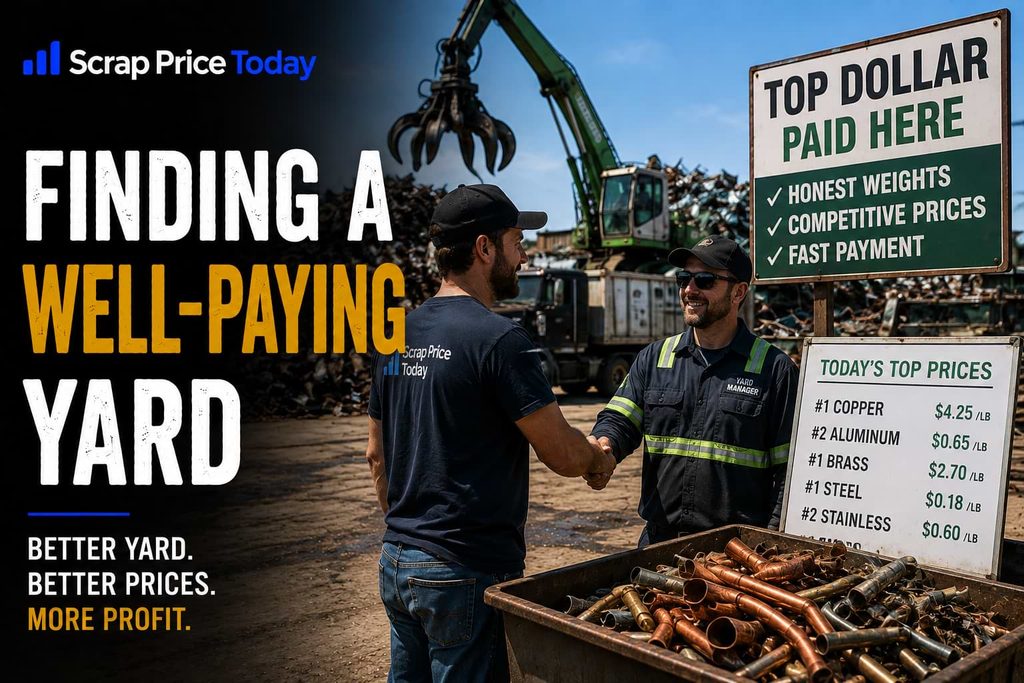
A well-paying yard is identifiable before you drive there, and it has nothing to do with the number on the sign. Ask what share of the exchange price the copper grade represents, whether the price is tiered by weight, whether the tare is measured, and whether each grade appears as its own line on the ticket. A yard paying 80 percent of exchange for clean copper with a measured tare beats one advertising a higher headline rate that grades everything down.
Scrap Price Today market analysis, written from exchange settlement data, mill and refiner pricing practice and published policy documents. Figures are examples; today’s numbers are on the live scrap price board.
We do not rank yards, take payment from them or run a directory. What follows is the method we would use ourselves, with the reference numbers to check any quote against.
The benchmark test
Every non-ferrous price a yard quotes is a share of an exchange settlement. Work out that share and you can compare any two yards in any two cities instantly.
Today, COMEX copper is $6.74 a pound. Our indicative board for clean number 1 copper is $5.82, which is 86.4 percent of the exchange. That is what the whole chain, refiner to yard, typically leaves for a clean grade.
So the question to ask on the phone is not what do you pay for copper. It is what do you pay for number 1 copper today, then divide by the exchange price. Anything in the low eighties is competitive. Anything in the sixties means the yard is either applying a lower grade than you think or keeping an unusually wide margin.
The grade ratios that expose a bad quote
A yard cannot quote a fair copper price and then underpay everything else without it showing. These are the ratios our board carries today, expressed against clean copper.
| Brass | Copper radiators | Insulated wire | Low-grade cable | Aluminium | Stainless | |
|---|---|---|---|---|---|---|
| Measurement | Grade price as a percentage of the clean copper price | Same | Same | Same | Same | Same |
| Our board today | 61.3% | 57.4% | 48.3% | 32.1% | 14.4% | 9.8% |
| What it means | Copper and zinc content | Copper with brass and plastic to remove | Copper recovery after stripping | Low copper share by weight | Different metal entirely | Priced for nickel content |
| Warning sign | Below about 50% | Below about 45% | Below about 40% | Below about 25% | Below about 10% | Below about 7% |
If a yard quotes competitively on copper but drops well below these ratios on the grades you actually have, the headline was bait. Ask about the grade you are bringing, not the grade they advertise.
The four questions that matter more than price
- Is the price tiered by weight, and where do the tiers start? Most yards pay better above a few hundred pounds and better again above a thousand, and a yard that will not discuss tiers is not competing for volume.
- Is the tare measured or estimated? An estimated tare on a loaded vehicle is a silent deduction you cannot audit.
- Does each grade get its own line on the ticket, with weight, price and any deduction? One weight and one price for a mixed load means everything was paid at the lowest grade present.
- What are your deductions and when do you apply them? Moisture, dirt and contamination deductions of 2 to 10 percent are normal and should be stated on the line, not applied silently.
A yard that answers all four without hesitation is usually the right one, whatever the board says.
Why two yards in the same city differ
The spread is not arbitrary. One yard sells copper to an exporter loading containers this month, another to a domestic refiner on a formula price. One is ten miles from a mill, another three hundred. One has a shredder and wants light iron, another has none and pays little for it.
Across markets the same forces produce a spread of more than 20 percent for identical metal on the same day, which our local prices analysis sets out country by country. Within a city the gap is smaller but still worth two phone calls.
Signals of a yard worth using
- It asks for identification and keeps records. That is a licensed operation, not an obstacle, and our copper selling rules explain why the paperwork protects you too.
- It posts a board and updates it. A yard whose prices are only available by asking is managing information rather than competing on it.
- It grades in front of you and explains the call.
- The scale is certified and the display faces the seller.
- It offers account terms to regular sellers, which is where the better prices actually live.
Signals to walk away from
- Cash offered for material the law says must be paid by transfer or cheque.
- No identification requested for non-ferrous.
- A single price for a mixed load without discussion of grades.
- Refusal to state the tiers, the deductions or the tare method.
- A quote given without asking what grade and how much, which means it will be revised downward at the scale.
Before you drive
- Sort by grade first. Sorting typically returns 15 to 25 percent more, which is larger than the difference between most yards.
- Check the live board and calculate the exchange share you should expect.
- Use the calculator to turn your weights into an expected figure so a poor quote is obvious.
- Phone two yards with the same description of grades and weights, and ask the four questions.
- Take the second-best price if the best one will not answer them.
Key numbers
- COMEX copper is $6.74 a pound today; our indicative clean copper board is $5.82, or 86.4 percent of it (Scrap Price Today series).
- Grade ratios against clean copper today: brass 61.3 percent, radiators 57.4, insulated wire 48.3, cable 32.1, aluminium 14.4, stainless 9.8.
- Moisture, dirt and contamination deductions of 2 to 10 percent are common and should appear on the ticket (published yard terms).
- Sorting a mixed load typically returns 15 to 25 percent more than selling it at one price (Recycled Materials Association grade definitions).
- The spread between the strongest and weakest of our national markets for the same metal is over 20 percent on the same day.
What this metal pays around the world
Scrap is a global market priced in US dollars, but what reaches a seller depends on trade position, freight to the nearest consumer and how many buyers compete locally. The table below converts the same grade into each market’s own currency and units at the day’s exchange rate, and shows the factor we apply.
| Market | Local price | USD per lb | Market factor |
|---|---|---|---|
| Turkey | ₺633.98 / kg | $5.79 | 1.04 |
| Germany | €11.15 / kg | $5.68 | 1.02 |
| United States | $5.57 / lb | $5.57 | 1.00 |
| China | CN¥80.50 / kg | $5.46 | 0.98 |
| Canada | C$7.59 / lb | $5.40 | 0.97 |
| United Kingdom | £8.80 / kg | $5.35 | 0.96 |
| Australia | A$16.60 / kg | $5.29 | 0.95 |
| United Arab Emirates | AED42.84 / kg | $5.29 | 0.95 |
| Saudi Arabia | SAR42.83 / kg | $5.18 | 0.93 |
| India | ₹1,069 / kg | $5.12 | 0.92 |
| Bangladesh | ৳1,337 / kg | $4.90 | 0.88 |
| South Africa | R170.92 / kg | $4.73 | 0.85 |
How we produced this, and what we will not do
The percentages are our own board grades expressed against the clean copper grade and against the COMEX settlement, derived from exchange data using published recovery shares and documented on the editorial policy page. They move daily, so recalculate rather than treating today’s figures as fixed.
We do not publish a yard directory, rank buyers, accept payment for listings or take referral fees, and no yard has ever influenced a price on this site. That is a deliberate limitation: a reference is only useful if it is independent of the people it is used to check.
If a yard in your area consistently pays away from these levels in either direction, we would like to know at info@scrappricetoday.com, because that is how the local factors on our country pages get better.