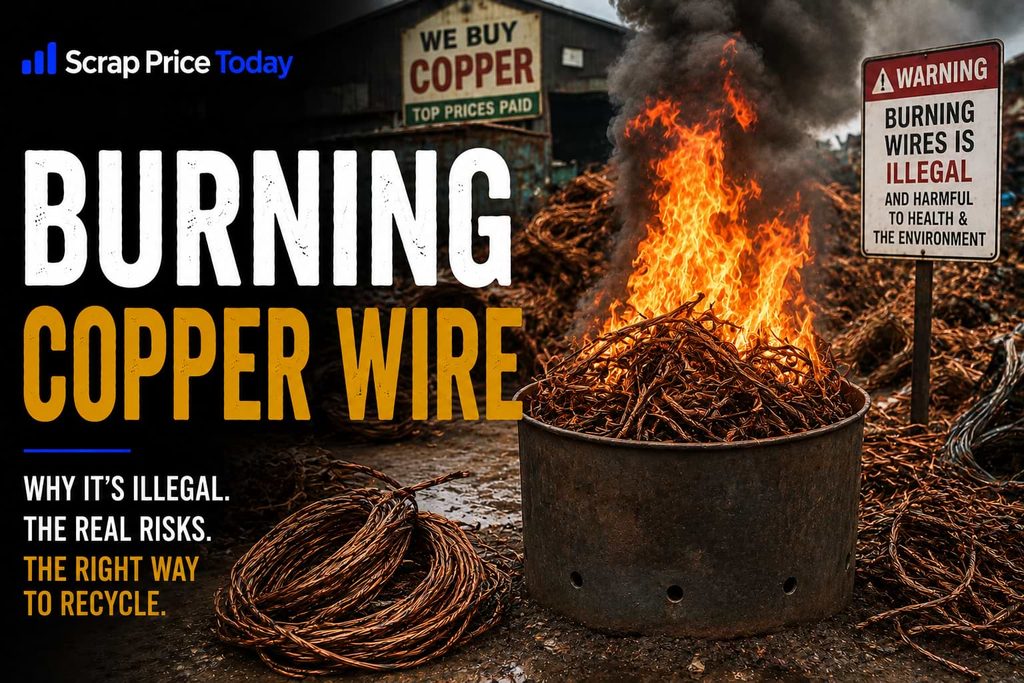
Burning wire to recover copper is an offence in the United States, the United Kingdom and most other countries, and it costs money as well. Burnt copper is downgraded or refused outright, so the seller gives up the bare bright premium to break the law. West Virginia lists insulation from copper wire among materials illegal to open burn, with fines up to $10,000 a day; in England the offence carries penalties under the Clean Air Act and clean-up costs on top.
Scrap Price Today market analysis, written from exchange settlement data, mill and refiner pricing practice and published policy documents. Figures are examples; today’s numbers are on the live scrap price board.
The question gets asked honestly by people who have seen it done, so it deserves a straight answer rather than a lecture. Here is the law, the chemistry, and the arithmetic that makes it a bad trade even where nobody is watching.
What the law actually says
Open burning of waste that releases toxic emissions is controlled under federal air pollution law in the United States, and state regulations name this material specifically. West Virginia’s open burning rule lists insulation from copper wire alongside tyres, asbestos-containing materials and waste oil, with refusal to comply attracting a fine of up to $10,000 a day.
In England, burning the insulation off cable to recover the metal is an offence under the Clean Air Act. Local authorities describe penalties including a fixed penalty, recovery of clean-up costs, and prosecution carrying an unlimited fine, imprisonment, or both.
Small scale and private property do not create an exemption. The rules address the emissions, not the quantity or the location.
Why it is treated so seriously
Insulation burns badly at the temperatures an open fire reaches, roughly 250 to 500 degrees Celsius, so combustion is incomplete. Worse, copper acts as a catalyst at exactly those temperatures.
The result is a mix that includes polychlorinated dioxins and furans, hydrogen chloride, sulphur dioxide, polycyclic aromatic hydrocarbons and heavy metals including lead. Dioxins and furans are among the more toxic compounds known, they persist in soil, and they accumulate rather than dispersing.
That is why the offence is written around emissions rather than nuisance, and why enforcement treats a small backyard fire the same way as a larger one.
The arithmetic, which says the same thing
Set the law aside for a moment and look at what burning does to the ticket.
| Stripped mechanically | Sold as insulated wire | Burnt | |
|---|---|---|---|
| Measurement | Grade achieved and price per pound of recovered copper | Same | Same |
| Grade | Bare bright or number 1 | Insulated wire grade, paid on recovery | Number 2 at best, frequently refused |
| Our board today | $5.82 a pound of copper | $2.81 a pound of wire | Discounted below number 1, or nothing |
| Legal exposure | None | None | Fines, clean-up costs, prosecution |
| Health exposure | None | None | Dioxins, furans, hydrogen chloride, lead |
| Time | Minutes per pound with a stripper | None | Hours, plus the fire |
Burning discolours and contaminates the copper, which disqualifies it from bare bright entirely. Many yards refuse burnt wire on sight, and some will report a seller they believe has burnt it, because accepting it puts their own licence at risk.
So the trade is: give up the top grade, take on a fine, and inhale dioxins, in order to avoid an hour with a stripping machine that pays for itself at about 39 pounds of heavy wire. Our wire stripping analysis sets out that payback in detail.
The one exception, and it is not you
Industrial incineration under permit at a licensed facility is a different process entirely: high temperature, controlled atmosphere, emissions abatement and monitoring. That is what the exemption in the regulations covers.
A fire in a yard, a drum or a field is not a smaller version of that. It is the process the regulations were written to stop.
What to do instead
- Strip mechanically. A hand-crank stripper costs about $40 and clears its own cost quickly on heavy wire.
- Sell thin wire as it is. Below roughly 48 percent copper content, the insulated grade pays more than the recovered copper anyway.
- Sort by gauge before you start, so the stripper is set once per batch rather than per length.
- Remove plugs, connectors and solder joints and sell them separately rather than trying to burn them off.
- For volume, granulation handles what a stripper cannot, and the recovered plastic has a small value of its own.
If you have already bought burnt wire
Buying burnt copper carries its own exposure. Several states require a seller to produce written proof that wire was lawfully burned or recovered from a burned structure before a dealer may buy it at all; Arizona is explicit about this, as our Phoenix page notes.
If you hold material of unclear origin, talk to a licensed yard about it rather than trying to blend it into a clean load. Blending is how an isolated problem becomes a pattern on your account.
Key numbers
- Insulation from copper wire is named in state open burning prohibitions, with West Virginia citing fines up to $10,000 a day for non-compliance (West Virginia Department of Environmental Protection).
- Burning cable insulation to recover metal is an offence under the Clean Air Act in England, with fixed penalties, clean-up cost recovery and prosecution available to authorities.
- Open fires burn insulation at roughly 250 to 500 degrees Celsius, temperatures at which copper catalyses the formation of dioxins and furans (published environmental analysis).
- Bare bright copper is $5.82 a pound on our board against $2.81 for insulated wire; burnt copper grades below number 1 and is often refused.
- A hand-crank stripper costs about $40 and pays for itself at roughly 39 pounds of heavy wire at current prices.
- The US Environmental Protection Agency publishes guidance on the health effects of backyard burning and dioxin formation.
What this metal pays around the world
Scrap is a global market priced in US dollars, but what reaches a seller depends on trade position, freight to the nearest consumer and how many buyers compete locally. The table below converts the same grade into each market’s own currency and units at the day’s exchange rate, and shows the factor we apply.
| Market | Local price | USD per lb | Market factor |
|---|---|---|---|
| Turkey | ₺633.98 / kg | $5.79 | 1.04 |
| Germany | €11.15 / kg | $5.68 | 1.02 |
| United States | $5.57 / lb | $5.57 | 1.00 |
| China | CN¥80.50 / kg | $5.46 | 0.98 |
| Canada | C$7.59 / lb | $5.40 | 0.97 |
| United Kingdom | £8.80 / kg | $5.35 | 0.96 |
| Australia | A$16.60 / kg | $5.29 | 0.95 |
| United Arab Emirates | AED42.84 / kg | $5.29 | 0.95 |
| Saudi Arabia | SAR42.83 / kg | $5.18 | 0.93 |
| India | ₹1,069 / kg | $5.12 | 0.92 |
| Bangladesh | ৳1,337 / kg | $4.90 | 0.88 |
| South Africa | R170.92 / kg | $4.73 | 0.85 |
How we produced this
The legal position is summarised from published state open burning regulations and United Kingdom local authority enforcement guidance, both named in the text. Rules and penalty levels differ by state and country, so check your own regulator rather than relying on the figures quoted here as universal.
The grade consequences reflect standard yard practice and published grade definitions: bare bright requires uncoated, untarnished copper, which burnt wire cannot meet. Prices come from our own daily series, documented on the editorial policy page, with live levels on the board.
We have deliberately not described any method for burning wire. This page exists to answer the question with the evidence, and every part of that evidence points the same way.