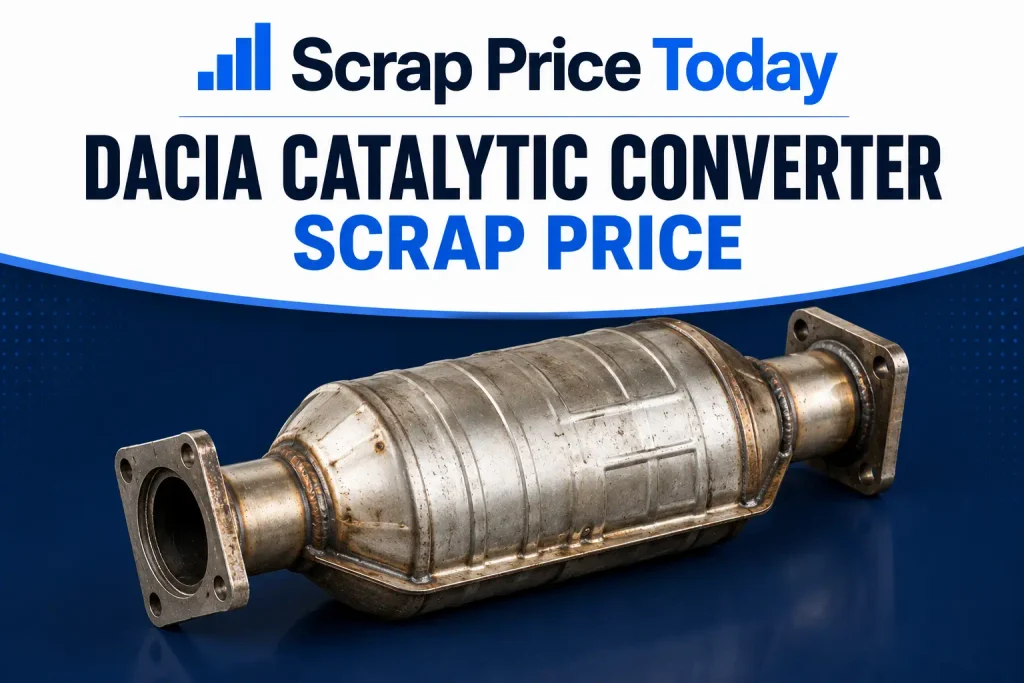
Dacia catalytic converters run about $25 to $250 for one original unit in 2026. Diesel particulate filters lead at $50 to $250, Duster 1.5 dCi units bring $40 to $175, Logan and Sandero units $40 to $150, and 1.5 dCi catalysts $25 to $125. These are small engines and the figures reflect that.
Your car has two names
Dacia and Renault sell the same vehicles under different badges depending on the market. The Duster, Sandero and Logan are Dacias across Europe and Renaults in Russia, Latin America, India and elsewhere.
Catalyst databases carry both. There are separate listings for the Dacia Duster and the Renault Duster, the Dacia Sandero and the Renault Sandero, the Dacia Logan and the Renault Logan, and they point at the same reference numbers.
So if a buyer says they have nothing under Dacia, ask them to look under Renault, and vice versa. On this brand that single question resolves most identification problems.
Dacia catalytic converter scrap prices by model
Model Years Notes Indicative range (USD) Measurement Model years covered What sets the unit apart Buyer quotes for one complete unit, honeycomb intact Diesel particulate filter (dCi) 2010 onward Platinum-bearing filter, priced separately $50 to $250 Duster 1.5 dCi (90 hp) 2010 onward Shares a reference with the Renault Captur and Clio IV $40 to $175 Duster 1.2 TCe (petrol) 2013 onward Listed with the Renault Kadjar and Nissan Qashqai $40 to $150 Logan, Sandero, Lodgy and Dokker 2004 onward Sold as Renaults in several markets $40 to $150 1.5 dCi catalyst (68 and 86 hp) 2004 onward One reference covers seven Renault, Nissan and Dacia models $25 to $125 Petrol 1.0 SCe and 1.6 MPI 2004 onward Smallest Dacia units $25 to $100 Manifold pre-cat, any model Various Small unit close to the engine $20 to $100 Aftermarket replacement, any model All years Universal unit, trace metal $5 to $50
Ranges are compiled from published core-buyer code lists, catalyst exchange transaction data and current scrap guides; they are not a live per-code feed. Figures are per unit.
One reference, seven vehicles
The 1.5 dCi diesel is among the most widely shared engines in Europe, and the catalyst entries show it.
One reference covers the Dacia Duster, Sandero and Logan Pick-Up together with the Renault Kangoo II and Clio and the Nissan Note and NV200. Seven vehicles across three marques on a single part.
A second reference for the 90 horsepower version of the same engine covers the Dacia Duster with the Renault Captur and Clio IV and the Nissan Micra, Note and NV200.
A third covers the Dacia Logan with the Renault Clio III, Kangoo and Megane and the Nissan Micra and Note.
Even the petrol side follows the pattern: a 1.2 TCe reference lists the Dacia Duster alongside the Renault Kadjar and Megane IV and the Nissan Qashqai.
The practical upshot is good news. Your unit is not an obscure item from a budget marque. It is one of the most heavily traded references in the European market, and the Renault and Nissan figures are both fair cross-checks.
Honest expectations
Worth saying plainly, because this is a budget brand and the numbers reflect that.
Dacia builds small cars with small engines, and precious metal loading scales with catalyst size. A 1.5 dCi catalyst at $25 to $125 is not a poor offer, it is what a unit of that size contains. The same applies to the small petrol engines at $25 to $100.
What lifts the figure is the diesel filter. On 2010 and later diesel models a particulate filter sits downstream of the catalyst as a separate component worth $50 to $250, frequently more than the catalyst ahead of it. If you are selling a diesel Duster or Sandero, that is where most of the value is, and a single quote covering the exhaust usually covers only one of the two parts.
Before you quote
Three steps, and they matter more here than on a premium brand because the margins are thinner.
Find the stamped reference. Renault group numbers generally run in the 8200 series, often as a pair with an H-prefixed variant.
Say which component you have. Catalyst and filter are different parts with different values, and on a diesel Dacia the filter is usually the better one.
And check it is original. Dacias are inexpensive to run and inexpensive to repair, which means aftermarket exhaust parts are common on them. A universal replacement brings $5 to $50 whatever the badge, so look for a factory reference, real weight and no fresh welds either side of the unit before setting expectations.
Dacia prices around the world
Platinum, palladium and rhodium settle in US dollars, so a Dacia reference holds the same metal value in every market. Currency and local buyer depth are what change. The table converts the Dacia span into each market’s money at today’s rate.
Market Currency Unit Equivalent range United States USD per unit $25.00 to 250.00 United Kingdom GBP per unit £18.49 to 184.93 Canada CAD per unit C$34.58 to 345.77 Australia AUD per unit A$34.69 to 346.92 Germany EUR per unit €21.53 to 215.27 India INR per unit ₹2,364 to 23,637 Bangladesh BDT per unit ৳3,073 to 30,732 United Arab Emirates AED per unit AED91.81 to 918.13 Saudi Arabia SAR per unit SAR93.75 to 937.50 Turkey TRY per unit ₺1,212 to 12,115 South Africa ZAR per unit R398.94 to 3,989 China CNY per unit CN¥167.98 to 1,680
Dacia sells across Europe, North Africa and the Middle East, with the same vehicles wearing Renault badges in Russia, Latin America, India and elsewhere. Whichever badge is on the car, the reference is the same.
Questions people actually ask
How much is a Dacia catalytic converter worth as scrap?
Between roughly $25 and $250 for one original unit in 2026. Small petrol units bring $25 to $100, 1.5 dCi catalysts $25 to $125, Logan and Sandero units $40 to $150, Duster 1.5 dCi units $40 to $175, and diesel particulate filters $50 to $250.
My buyer has no listing for Dacia. What now?
Ask them to search under Renault. The same vehicles are sold as Renaults in many markets, and catalyst databases carry separate listings for the Dacia Duster and Renault Duster, the Dacia Sandero and Renault Sandero, and so on, pointing at the same references.
Which other cars share a Dacia converter?
A great many. One 1.5 dCi reference covers the Dacia Duster, Sandero and Logan Pick-Up with the Renault Kangoo II and Clio and the Nissan Note and NV200. Another covers the Duster with the Renault Captur and Clio IV and three Nissans, and a petrol reference adds the Renault Kadjar and Nissan Qashqai.
Why are Dacia converter values modest?
Because these are small cars with small engines, and precious metal loading scales with catalyst size rather than with badge. The compensating factor is that diesel models carry a separate particulate filter worth $50 to $250, which is usually the more valuable of the two components.
Is my Dacia converter original?
Check for a stamped factory reference, usually in the Renault group 8200 series and often paired with an H-prefixed number. Also check the weight and look for fresh weld marks in the pipe either side. Aftermarket units are common on these cars and bring only $5 to $50.
Figures on this page are indicative buyer ranges for complete, uncut original units and are not offers to buy. Converter types, codes and selling rules are covered on the main catalytic converter price page.
Frequently asked questions
How much is a Dacia catalytic converter worth as scrap?
Between roughly $25 and $250 for one original unit in 2026. Small petrol units bring $25 to $100, 1.5 dCi catalysts $25 to $125, Logan, Sandero, Lodgy and Dokker units $40 to $150, Duster 1.5 dCi units $40 to $175, and diesel particulate filters $50 to $250.
My buyer has no listing for Dacia. What should I do?
Ask them to search under Renault. The same vehicles are sold as Renaults in many markets, and catalyst databases carry separate listings for the Dacia Duster and Renault Duster, the Dacia Sandero and Renault Sandero, and the Dacia Logan and Renault Logan, all pointing at the same references.
Which other cars share a Dacia catalytic converter?
One 1.5 dCi reference covers the Dacia Duster, Sandero and Logan Pick-Up alongside the Renault Kangoo II and Clio and the Nissan Note and NV200. Another covers the Duster with the Renault Captur and Clio IV and three Nissans, and a 1.2 TCe petrol reference adds the Renault Kadjar and Nissan Qashqai.
Why are Dacia catalytic converter values modest?
Because these are small cars with small engines, and precious metal loading scales with catalyst size rather than with the badge. The compensating factor is that diesel models carry a separate particulate filter worth $50 to $250, usually the more valuable of the two components.
How can I tell if a Dacia converter is original?
Look for a stamped factory reference, generally in the Renault group 8200 series and often paired with an H-prefixed variant. Check the weight and look for fresh weld marks in the pipe either side. Aftermarket units are common on these cars and bring only $5 to $50.
How many saleable parts does a diesel Dacia have?
Usually two. The oxidation catalyst comes first at $25 to $125, and on 2010 and later models a diesel particulate filter sits behind it as a separate component worth $50 to $250. A single quote for the exhaust normally covers only one of them.