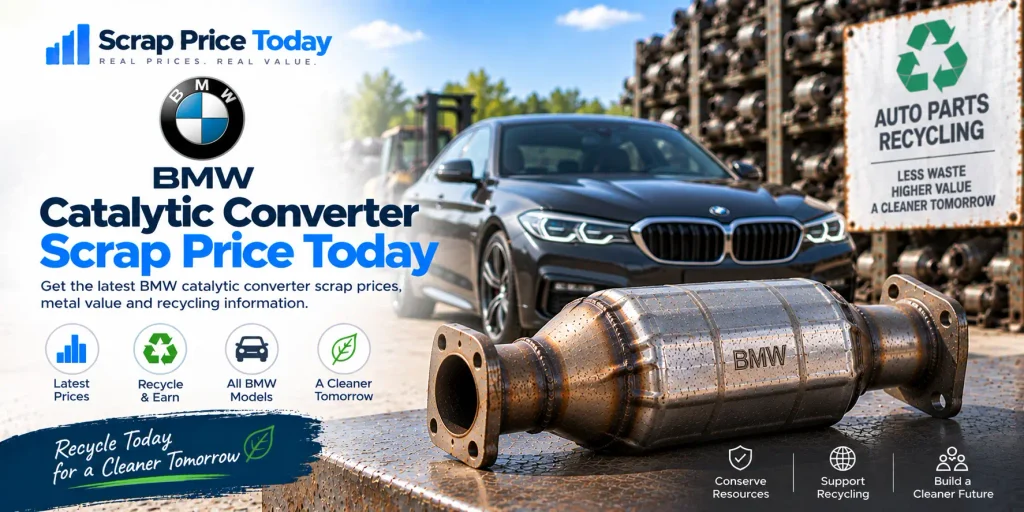
A BMW catalytic converter is worth about $75 to $400 for one original petrol unit in 2026. A 3 Series unit runs $150 to $300, an X5 or 7 Series unit $150 to $350, and M and V8 units $150 to $400. Most BMWs carry two units, so a whole car holds roughly double. Diesel catalysts sit far lower at $30 to $150.
Two things are true at once here, and holding both is the point of this page.
The premium is genuine. Buyer lists classify European premium marques above mainstream domestic and Japanese units, and a 3 Series converter sits meaningfully above a comparable Honda or Toyota unit. That is not marketing; it reflects heavier precious metal loadings on cars built to stricter European specifications.
The premium is also finite. A car that cost fifty thousand new does not produce a converter worth thousands. The realistic figure per unit is in the low hundreds, and sellers who arrive expecting more are working from the price of the car rather than the chemistry of the part.
Where the premium is real
Core buyers sort converters into grades, and European units from BMW, Mercedes, Audi and Land Rover sit in the higher tiers rather than the general foreign category. A 3 Series unit is typically listed as premium OEM at $150 to $300, against roughly $75 to $150 for a four-cylinder Honda Accord unit of similar age.
So the answer to “is a BMW worth more” is yes, by roughly double at the mainstream end of the range. What it is not is a different order of magnitude.
BMW catalytic converter scrap prices by model
Model Years Notes Indicative range (USD) Measurement Model years covered What sets the unit apart Buyer quotes for one complete unit, honeycomb intact M models and V8 (M3, M5, X5 4.8) 2000 to 2018 Largest petrol units, two fitted $150 to $400 X5 and X6 (petrol) 2000 to 2018 Large SUV, two units $150 to $350 7 Series (E38, E65, F01) 1995 to 2018 Executive saloon, two units $150 to $350 3 Series (E46, E90, F30 petrol) 1998 to 2018 The volume BMW; premium OEM class $150 to $300 5 Series (E39, E60, F10 petrol) 1996 to 2018 Mid-size executive, two units $125 to $300 X3 and X1 2003 to 2018 Compact crossover $100 to $275 Z3 and Z4 1996 to 2016 Roadster, often two small units $100 to $250 1 Series (116i, 118i, 120i) 2004 to 2018 Smallest BMW petrol units $75 to $225 Diesel particulate filter (DPF) 2005 onward Large platinum-bearing filter, priced separately $50 to $250 Diesel oxidation catalyst (320d, 520d, 30d) 1998 to 2018 Mostly platinum, almost no rhodium $30 to $150 Manifold pre-cat, any model Various Small unit close to the engine, easy to overlook $20 to $100 Aftermarket replacement, any model All years Universal unit, trace metal $5 to $50
Ranges are compiled from published core-buyer code lists, catalyst exchange transaction data and current scrap guides; they are not a live per-code feed. Petrol and diesel rows are separate components, not grades of the same part.
Two units, not one — and why that matters more than the badge
This is where most BMW sellers actually lose money, and it has nothing to do with expectations.
Six-cylinder and V8 BMWs run two exhaust banks with a converter on each. Many also carry a small pre-cat closer to the engine. The figures in the table are per unit, so a 5 Series or X5 commonly holds $250 to $700 in converters across the car, not the single-unit figure.
A buyer quoting one price for “the BMW cat” is quoting one part. Ask how many they are counting before agreeing to anything, and photograph each unit with its code visible.
By year: what a 2005 BMW search finds
BMW sellers search by year more than most, and the year does move the number — though not in the direction people expect.
Early 2000s cars, the E46 3 Series and E39 5 Series era, carry solid original units and sit comfortably in the ranges above. The complication is age rather than chemistry: a twenty-year-old BMW has often had exhaust work done, and an aftermarket replacement is worth $5 to $50 whatever badge the car wears.
Later cars, from roughly 2010, carry units built to tighter European standards with good loadings, but a higher share of them are diesels. On those, the diesel rows apply and the number drops substantially.
So the honest year-by-year answer: check what is actually bolted under the car before checking its model year. Originality and fuel type both matter more than the date.
BMW prices around the world
Platinum, palladium and rhodium settle in US dollars, so a BMW code holds the same metal value everywhere. Currency and local buyer depth are what change. The table converts the petrol BMW span into each market’s money at today’s rate.
Market Currency Unit Equivalent range United States USD per unit $75.00 to 400.00 United Kingdom GBP per unit £55.48 to 295.89 Canada CAD per unit C$103.73 to 553.23 Australia AUD per unit A$104.08 to 555.07 Germany EUR per unit €64.58 to 344.43 India INR per unit ₹7,091 to 37,819 Bangladesh BDT per unit ৳9,220 to 49,171 United Arab Emirates AED per unit AED275.44 to 1,469 Saudi Arabia SAR per unit SAR281.25 to 1,500 Turkey TRY per unit ₺3,635 to 19,384 South Africa ZAR per unit R1,197 to 6,383 China CNY per unit CN¥503.95 to 2,688
These conversions are the metal-value anchor rather than a local quote. Europe is the deeper BMW market and also the more diesel-heavy one, so many European sellers are holding the lower-priced diesel hardware rather than the petrol units above.
Original versus aftermarket: the deflator nobody mentions
The single largest threat to a BMW quote is not the buyer. It is whatever a previous owner fitted.
European cars attract aftermarket exhaust replacements at high rates, partly because original BMW parts are expensive and partly because these cars stay on the road long enough to need exhaust work twice. A thin universal shell with no stamped code brings $5 to $50 regardless of the roundel on the bonnet.
Three checks tell you which you have. A factory unit has clean pressed seams and real weight in the hand. It carries a stamped code, not a plain welded tag. And it does not rattle when shaken, which would indicate broken substrate.
Pass those and the ranges above apply. Fail them and no amount of badge value recovers the difference.
Questions people actually ask
Is a BMW catalytic converter worth more than a Honda or Toyota one?
Yes, at the mainstream end by roughly double. A 3 Series unit at $150 to $300 sits above a Honda Accord unit at $60 to $230. It does not reach Toyota Prius hybrid money, which tops the passenger-car market.
Does a BMW price higher than an Audi?
They sit close. Both are classed above mainstream, and an X5 unit and a Q7 unit occupy similar territory. Engine size and unit count separate them more reliably than the badge does.
Why is my BMW quote lower than I expected?
The usual reasons, in order of frequency: the unit is an aftermarket replacement rather than the original; only one of two units is being counted; the car is a diesel and the diesel rows apply; or the substrate rattles. The badge is rarely the problem.
Figures on this page are indicative buyer ranges for complete, uncut original units and are not offers to buy. Converter types, codes and selling rules are covered on the main catalytic converter price page.
Frequently asked questions
How much is a BMW catalytic converter worth as scrap?
About $75 to $400 for one original petrol unit in 2026. A 1 Series unit brings $75 to $225, a 3 Series unit $150 to $300, a 5 Series unit $125 to $300, an X5 or 7 Series unit $150 to $350, and M or V8 units $150 to $400. Diesel catalysts sit lower at $30 to $150.
Is a BMW catalytic converter worth more than a Honda or Toyota one?
Yes, at the mainstream end by roughly double. Buyer lists class European premium marques above general foreign units, so a 3 Series converter at $150 to $300 sits above a four-cylinder Honda or Toyota unit. It does not reach hybrid figures, which lead the passenger-car market.
How many catalytic converters does a BMW have?
Six-cylinder and V8 models run two exhaust banks with a converter on each, and many also carry a small pre-cat closer to the engine. Because the table figures are per unit, a 5 Series or X5 commonly holds $250 to $700 in converters across the whole car.
Which BMW catalytic converter is worth the most?
M models and V8 cars such as the M3, M5 and X5 4.8 at $150 to $400 per unit, followed by the X5, X6 and 7 Series at $150 to $350. All of these carry a pair, so the whole-vehicle total is roughly double.
Are BMW diesel converters worth less?
Considerably. A diesel oxidation catalyst on a 320d, 520d or 30d brings $30 to $150 because it uses mostly platinum with almost no rhodium. The diesel particulate filter fitted from 2005 is worth $50 to $250 and should be quoted as a separate item.
Why is my BMW converter quote so low?
Most often because it is an aftermarket replacement rather than the original, which brings $5 to $50 whatever the badge. Other common reasons are only one of two units being counted, the car being a diesel, or a rattling substrate indicating internal damage.