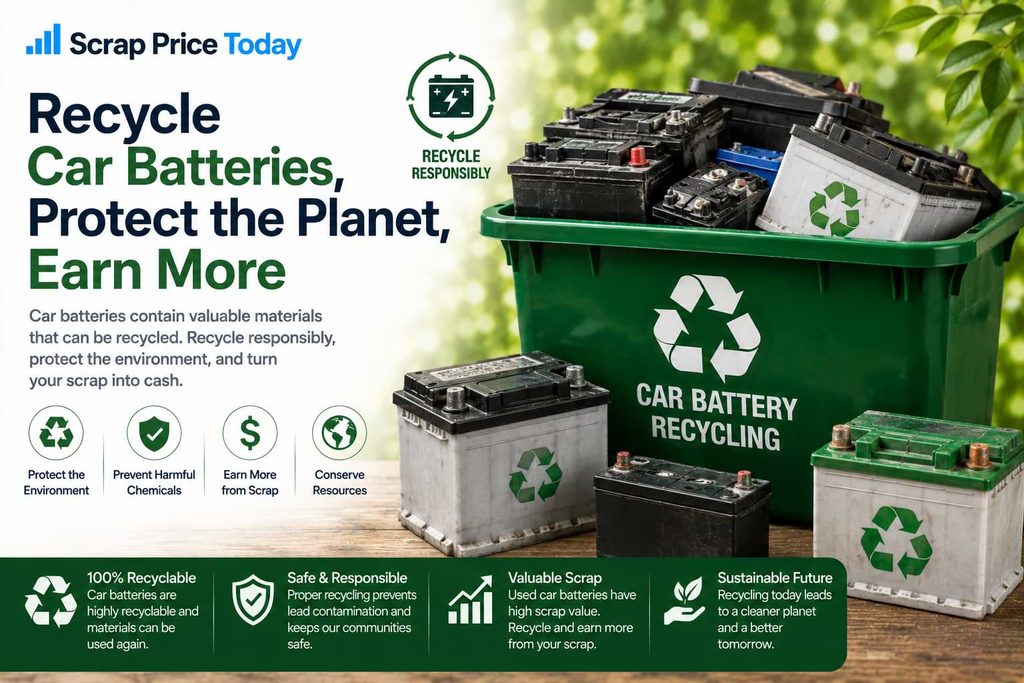
A dead car battery is the easiest recycling decision in the house, because it sits inside the only collection system in America that actually closes its loop. Lead-acid batteries are recycled at 99 percent, the highest rate of any product the EPA tracks, and a new battery is over 80 percent recycled material. Near me resolves to five places, four of which pay you: the counter selling your replacement refunds the core charge, parts chains hand over store credit with no purchase, scrap yards pay by weight, and hazardous waste sites take it free.
Everything else on this site asks why recycling fails. This page anatomises the one system that works, because the answer is four visible mechanisms, and you can see every one of them at the counter.
The four mechanisms
| Mechanism | What the law or market does | What you see |
|---|---|---|
| Measurement | How each part of the system operates and where it appears in your transaction | |
| Landfill ban | Forty-five states enacted versions of a model law making disposal illegal | The mandatory sign at the counter, and civil penalties for binning one |
| Core charge | A deposit of $5 to $20 built into every new battery, refunded on return of the old | The separate line on your receipt |
| Mandatory take-back | Retailers and wholesalers must accept used batteries, purchase or not | The counter takes it without argument |
| Real scrap value | Thirty to fifty pounds of lead in a box, worth money at any yard | A yard pays cash; parts chains offer credit |
No other household stream has all four. Aluminium cans have value but no mandate. Electronics have mandates in some states but negative value. Plastic film has neither. The battery has a ban pushing, a deposit pulling, a legal obligation catching and a lead price paying, and the 99 percent rate is what four mechanisms working together looks like.
The federal environment agency’s own case study credits exactly this combination, and adds the result: new American-made batteries now contain over 80 percent recycled material, which makes the car battery a rare product manufactured mostly from its own predecessors.
Where near me actually resolves
In order of what each route pays.
- The counter selling your replacement. Hand the old battery over at purchase and the core charge never appears, or return it within the window, commonly 30 to 90 days with the receipt, for the refund. This is the intended path and the reason the deposit exists. One state’s version is typical: a $5 incentive payment, refunded within 30 days, with retailers keeping what goes unclaimed.
- A parts chain, with no purchase at all. The large auto parts retailers run standing offers of around $10 in store credit for a dead battery walked in off the street. This is the best answer for the battery found in a garage clear-out.
- A scrap yard, for cash. Yards buy lead-acid batteries at roughly 10 to 30 cents a pound, so a 30 to 50 pound battery brings a few dollars to ten, and today’s board battery rate of $0.23 per lb makes a typical 40 pound unit about $9.20, with the underlying lead at $0.59 per lb. Multiple batteries make this the route, and our scrap battery price page tracks the live market.
- Household hazardous waste collection. Free, no transaction, and the right answer where the battery is cracked or leaking.
- A mechanic or dealership, which recycles it through the same wholesale chain, usually keeping the core value as part of the fitting price. Convenient, and worth knowing what you are trading.
Up to two batteries a month is a common statutory acceptance minimum at retail counters, so even a small backlog clears in a visit or two.
What the battery becomes
The recycler’s arithmetic explains why this loop closes when others do not.
- The lead, roughly six of every ten pounds, is smelted and returns as new battery plates, the demand that pays for everything else.
- The polypropylene case is chipped, washed and pelletised into new battery cases, a genuine plastic-to-same-plastic loop that kerbside plastics rarely achieve.
- The acid is neutralised, or processed into sodium sulphate for detergents and glass.
Three streams, three buyers, no residue worth mentioning: the whole box is feedstock, which is why a used battery has positive value at every stage of the chain rather than being a cost someone must be forced to carry.
Carrying one safely
- Upright, always. The acid is the hazard, and tilting a vented battery is how boots get burned.
- Terminals taped or bagged, since a spanner or another battery across both posts is a genuine fire start.
- A tray or split bin bag underneath for an older battery, against seepage.
- Lift with the case, not the posts, and remember fifty pounds is fifty pounds.
- Cracked or wet-looking batteries go to hazardous waste, not a shop counter.
- Do not stockpile in the house. The core refund has a receipt window, and the value does not improve with age.
The battery this page does not cover
Everything above is lead-acid: the black box in a petrol or diesel car, motorcycle, ride-on mower, boat or golf cart.
A hybrid or electric vehicle’s traction pack is a different object in a different system, with different hazards and genuinely different economics, and it must go through the manufacturer or a certified lithium processor. Our lithium battery page covers that world, including why nobody hands those packs across a parts counter.
Small household lithium batteries, the fire-starters of the sorting industry, are covered across our electronics pages, and they share exactly one rule with the car battery: never the kerbside bin.
Where this fits
The live lead market behind the battery’s value is on scrap battery prices, the deposit logic that the core charge shares with drinks containers is in recycling plastic bottles for cash, and what the recovered lead is worth in twelve markets sits below.
Market Local price USD per lb Market factor Turkey ₺67.15 / kg $0.61 1.04 Germany €1.18 / kg $0.60 1.02 United States $0.59 / lb $0.59 1.00 China CN¥8.53 / kg $0.58 0.98 Canada C$0.80 / lb $0.57 0.97 United Kingdom £0.93 / kg $0.57 0.96 Australia A$1.76 / kg $0.56 0.95 United Arab Emirates AED4.54 / kg $0.56 0.95 Saudi Arabia SAR4.54 / kg $0.55 0.93 India ₹113 / kg $0.54 0.92 Bangladesh ৳142 / kg $0.52 0.88 South Africa R18.10 / kg $0.50 0.85
Frequently asked questions
Where can I recycle a car battery near me?
Five places, four of which pay: the counter selling your replacement refunds the core charge, large parts chains give around $10 store credit with no purchase, scrap yards pay cash by weight, hazardous waste sites take them free, and any garage fitting a battery recycles the old one.
What is a core charge on a car battery?
A refundable deposit of $5 to $20 built into the price of a new battery, shown as a separate receipt line. Hand over the old battery at purchase and it never applies, or return one within the window, commonly 30 to 90 days with the receipt, for the refund.
Do stores have to take my old battery?
In most states, yes, by law. Forty-five states enacted versions of a model law requiring retailers and wholesalers to accept used lead-acid batteries and to post signs saying so, with acceptance of up to two batteries a month per person a common minimum.
How much is a dead car battery worth?
Scrap yards pay roughly 10 to 30 cents a pound, so a 30 to 50 pound battery brings a few dollars to about ten, moving with the lead market. Parts chains alternatively offer around $10 in store credit for a battery brought in with no purchase.
Why are car batteries recycled at 99 percent?
Four mechanisms working at once: landfill bans push, the core deposit pulls, mandatory retailer take-back catches, and the lead inside pays. No other household product has all four, and the federal case study credits exactly that combination.
What happens to a recycled car battery?
All three streams find buyers. The lead, about six of every ten pounds, becomes new battery plates. The polypropylene case is pelletised into new cases. The acid is neutralised or processed into sodium sulphate. New batteries are over 80 percent recycled material.
Is it illegal to throw a car battery in the trash?
In nearly every state, yes, with civil penalties attached, and haulers refuse them regardless. The landfill ban is one of the four mechanisms behind the 99 percent rate, and hazardous waste collection exists precisely for batteries with no other route.
How do I transport a car battery safely?
Upright always, terminals taped or bagged, a tray or split bag underneath an older one, lifted by the case rather than the posts. A cracked or leaking battery goes to hazardous waste collection, not across a shop counter.
Does this apply to motorcycle, mower and boat batteries?
Yes. Anything lead-acid follows the same routes, deposits and yard pricing by weight, and several state deposit laws explicitly cover automotive-type batteries from motorcycles, ATVs, golf carts, lawn equipment and boats.
What about hybrid and EV batteries?
A different system entirely. Traction packs are lithium chemistry with different hazards and economics, and they go through the manufacturer or a certified lithium processor, never a parts counter or scrap yard. Small household lithium batteries also never go in any kerbside bin.