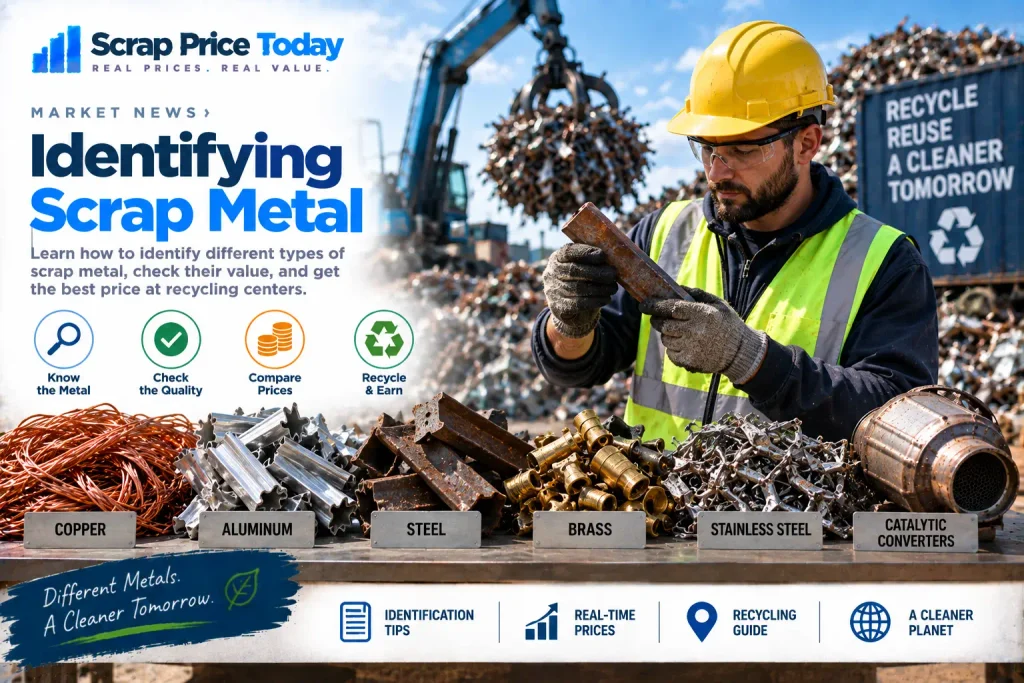
Four tests identify most scrap without any equipment: a magnet, a scratch, a weight comparison and a water displacement measurement. Together they separate ferrous from non-ferrous, solid metal from plated, and copper from brass from zinc, which covers almost every decision that changes a price. What they cannot do is confirm an alloy grade, and that is exactly where the money is: selling 100 pounds of brass as shred costs $339.
Scrap Price Today market analysis, written from exchange settlement data, mill and refiner pricing practice and published policy documents. Figures are examples; today’s numbers are on the live scrap price board.
The honest framing throughout is that these tests categorise rather than confirm. Knowing which is which is the point.
The four tests, in the order to run them
One: the magnet
A magnet sticks firmly to iron, carbon steel and cast iron, and to 400 series stainless. It does not stick to copper, brass, bronze, aluminium, lead, zinc or 300 series stainless.
That single test sorts a pile into two piles worth very different money, and it is why every article on this site starts there.
Two caveats. Cold working and welding can make normally non-magnetic stainless slightly magnetic, so test a flat undisturbed area. And a weak pull is not the same as a firm one; 400 series stainless snaps on hard, while worked 304 gives a faint drag at most.
Two: the scratch
Scratch an inconspicuous underside with a key, a coin or a file.
- Solid brass shows the same golden yellow beneath the surface. A plated item shows silver or grey.
- Solid copper shows salmon pink through the section.
- Tinned copper shows silver over copper, which grades as number 2 rather than bare bright.
- Chrome-plated brass mistaken for stainless shows yellow under the plating.
This one test resolves the most expensive routine error in scrapping, which is treating plated base metal as solid.
Three: weight in the hand
Density separates metals that look identical, and the ratios are large enough to feel.
| Metal | Density | Pounds per cubic foot | Times aluminium |
|---|---|---|---|
| Lead | 11.34 | 708 | 4.2 |
| Copper | 8.96 | 559 | 3.3 |
| Bronze | 8.80 | 549 | 3.3 |
| Brass | 8.50 | 531 | 3.1 |
| Stainless steel | 7.90 | 493 | 2.9 |
| Steel | 7.85 | 490 | 2.9 |
| Cast iron | 7.20 | 449 | 2.7 |
| Zinc die-cast | 6.60 | 412 | 2.4 |
| Titanium | 4.51 | 282 | 1.7 |
| Aluminium | 2.70 | 169 | 1.0 |
| Magnesium | 1.74 | 109 | 0.6 |
Aluminium against anything else is unmistakable. The dangerous pair is zinc die-cast against brass, at 6.60 against 8.50, because a chunky zinc casting feels convincingly heavy. That is why faucet handles fool people, and it is why weight alone is a screening test rather than an answer.
Four: water displacement, when weight is not enough
This is the test almost nobody uses and it settles the zinc question in two minutes.
Weigh the piece in grams. Submerge it in a measuring jug and record the volume of water it displaces in millilitres. Divide mass by volume and you have density in grams per cubic centimetre, which you can read straight off the table above.
A worked example: a piece weighing 500 grams displaces 56 millilitres of water. That is 8.93, which is copper. If the same 500 gram piece had displaced 76 millilitres, it would be 6.6, which is zinc.
No equipment beyond a kitchen scale and a jug, and it distinguishes the pairs that defeat every other cheap test.
What these tests cannot do
They categorise. They do not confirm an alloy grade, and the industry is direct about the limitation: a magnet tells you ferrous or non-ferrous, a spark test suggests a carbon range, visual inspection gives colour and weight. None of them separates 304 from 316 stainless, or 6061 from 7075 aluminium, and those distinctions carry real money per hundred pounds.
A worn piece of 316 stainless and a nickel alloy can give identical magnet results. Two aluminium alloys with very different values can look and feel the same.
That is why yards use handheld analysers, which read elemental composition in seconds without damaging the piece. They cost $10,000 to $50,000, which puts them beyond individual scrappers, but most yards have one and will identify material before weighing it. Asking is free.
The spark test, and its limits
Grinding metal on an abrasive wheel produces spark patterns that differ by carbon content and alloy. Austenitic stainless throws short orange sparks with few forks; 304 gives brighter branching sparks and 316 duller ones because of the molybdenum.
It is genuinely useful on ferrous alloys and close to useless elsewhere, and results depend heavily on operator experience. It is also destructive in a small way and requires eye protection. Treat it as a supplement rather than a primary test.
What misidentification actually costs
Each row is 100 pounds sold at the wrong grade.
| Error | Correct value | As sold | Loss |
|---|---|---|---|
| Zinc die-cast sold as brass, in reverse: brass sold as shred | $352.00 | $13.20 | $338.80 |
| Cupronickel sold as steel | $352.00 | $13.20 | $338.80 |
| Chrome-plated brass sold as stainless | $352.00 | $57.00 | $295.00 |
| Copper sold as brass | $578.00 | $352.00 | $226.00 |
| 304 stainless sold as shred | $57.00 | $13.20 | $43.80 |
| Clean aluminium sold as irony | $85.00 | $55.00 | $30.00 |
| Bronze sold as yellow brass | $369.60 | $352.00 | $17.60 |
The top rows are the argument for spending four minutes with a magnet and a key. The bottom rows are the argument for not obsessing over the last few percent.
A working sequence
- Magnet. Ferrous to one side, non-ferrous to the other.
- Scratch. Solid or plated, and what colour underneath.
- Weight. Aluminium and magnesium out immediately; note anything suspiciously light for its size.
- Displacement. Only for pieces where zinc, brass, bronze or copper are in question and the value justifies two minutes.
- Ask the yard. For anything where the grade decides the price and you are not certain, have it analysed before it is weighed.
That sequence, run on a bench before a trip, is the difference between the grade you expect and the grade you are given, which our disputes analysis prices out.
Where each metal turns up
- Copper: pipe, wire, roofing, motor windings, coils. Salmon pink, non-magnetic, heavy.
- Brass: valves, taps, fittings, casings, hardware. Yellow, non-magnetic, heavy. See our brass grades article.
- Aluminium: window frames, wheels, ladders, siding, cans. Light, dull grey, non-magnetic.
- Stainless: kitchen and food equipment, sinks, marine hardware. See our stainless article for the nickel arithmetic.
- Lead: flashing, pipe, wheel weights, batteries. Very heavy, marks with a fingernail.
- Cast iron: baths, radiators, engine blocks, cookware. Magnetic, brittle, coarse grain at a broken edge.
What this metal pays around the world
Scrap is a global market priced in US dollars, but what reaches a seller depends on trade position, freight to the nearest consumer and how many buyers compete locally. The table below converts the same grade into each market’s own currency and units at the day’s exchange rate, and shows the factor we apply.
| Market | Local price | USD per lb | Market factor |
|---|---|---|---|
| Turkey | ₺640.99 / kg | $5.91 | 1.04 |
| Germany | €11.41 / kg | $5.79 | 1.02 |
| United States | $5.68 / lb | $5.68 | 1.00 |
| China | CN¥82.37 / kg | $5.57 | 0.98 |
| Canada | C$7.85 / lb | $5.51 | 0.97 |
| United Kingdom | £9.09 / kg | $5.45 | 0.96 |
| Australia | A$17.09 / kg | $5.40 | 0.95 |
| United Arab Emirates | AED43.69 / kg | $5.40 | 0.95 |
| Saudi Arabia | SAR43.67 / kg | $5.28 | 0.93 |
| India | ₹1,116 / kg | $5.23 | 0.92 |
| Bangladesh | ৳1,356 / kg | $5.00 | 0.88 |
| South Africa | R177.11 / kg | $4.83 | 0.85 |
Method
Density figures are standard values for the pure metals and common alloys, and real pieces vary with alloy composition, coatings and porosity. The displacement method assumes a solid piece with no trapped air, which is why it fails on hollow items and filled candlesticks.
The misidentification table applies our own board prices to a fixed 100 pound weight, documented on the editorial policy page with live figures on the board. Test descriptions and analyser cost ranges are drawn from published scrap industry and metal identification sources.
These are screening tests. Where a grade decides a price and certainty matters, ask for an analysis rather than relying on a kitchen jug.
Questions people ask
What is the fastest way to identify scrap metal?
A magnet, then a scratch, then weight in the hand. The magnet separates ferrous from non-ferrous, the scratch shows whether a piece is solid or plated and what colour lies underneath, and weight immediately separates aluminium from everything else.
How do I tell brass from zinc die-cast?
Weight alone will not do it, because zinc at 6.60 and brass at 8.50 are close enough that a chunky zinc casting feels convincing. Use water displacement: weigh the piece in grams, measure the water it displaces in millilitres, and divide. Around 8.5 is brass, around 6.6 is zinc.
Does a magnet identify stainless steel?
Only partly. 400 series stainless is magnetic and snaps on hard, while 300 series is essentially non-magnetic. Cold working and welding can make even 304 slightly magnetic, so test a flat undisturbed area and treat a faint drag differently from a firm pull.
How does the water displacement test work?
Weigh the piece in grams, submerge it in a measuring jug and note the volume of water displaced in millilitres, then divide mass by volume for density. A 500 gram piece displacing 56 millilitres gives 8.93, which is copper. The same weight displacing 76 millilitres gives 6.6, which is zinc.
What does misidentifying metal actually cost?
On 100 pounds, selling brass or cupronickel as shred costs about $339, chrome-plated brass as stainless about $295, and copper as brass about $226. At the other end, bronze sold as yellow brass costs about $18, which is not worth agonising over.
Is a spark test worth doing?
On ferrous alloys, sometimes. Austenitic stainless throws short orange sparks with few forks, and 316 gives duller sparks than 304 because of the molybdenum. It is close to useless on non-ferrous, depends heavily on operator experience, and needs eye protection.
Should I buy an XRF analyser?
Almost certainly not. They cost $10,000 to $50,000, which puts them beyond individual scrappers. Most yards have one and will identify material before weighing it, so the practical move is to ask them to analyse anything where the grade decides the price.
Can these tests confirm an alloy grade?
No. They categorise rather than confirm. None of them separates 304 from 316 stainless or 6061 from 7075 aluminium, and a worn piece of 316 and a nickel alloy can give identical magnet results. Where the alloy grade sets the price, ask for an analysis.
Frequently asked questions
What is the fastest way to identify scrap metal?
A magnet, then a scratch, then weight in the hand. The magnet separates ferrous from non-ferrous, the scratch shows whether a piece is solid or plated and what colour lies underneath, and weight immediately separates aluminium from everything else.
How do I tell brass from zinc die-cast?
Weight alone will not do it, because zinc at 6.60 and brass at 8.50 are close enough that a chunky zinc casting feels convincing. Use water displacement: weigh the piece in grams, measure the water it displaces in millilitres, and divide. Around 8.5 is brass, around 6.6 is zinc.
Does a magnet identify stainless steel?
Only partly. 400 series stainless is magnetic and snaps on hard, while 300 series is essentially non-magnetic. Cold working and welding can make even 304 slightly magnetic, so test a flat undisturbed area and treat a faint drag differently from a firm pull.
How does the water displacement test work?
Weigh the piece in grams, submerge it in a measuring jug and note the volume of water displaced in millilitres, then divide mass by volume for density. A 500 gram piece displacing 56 millilitres gives 8.93, which is copper. The same weight displacing 76 millilitres gives 6.6, which is zinc.
What does misidentifying metal actually cost?
On 100 pounds, selling brass or cupronickel as shred costs about $339, chrome-plated brass as stainless about $295, and copper as brass about $226. At the other end, bronze sold as yellow brass costs about $18, which is not worth agonising over.
Is a spark test worth doing?
On ferrous alloys, sometimes. Austenitic stainless throws short orange sparks with few forks, and 316 gives duller sparks than 304 because of the molybdenum. It is close to useless on non-ferrous, depends heavily on operator experience, and needs eye protection.
Should I buy an XRF analyser?
Almost certainly not. They cost $10,000 to $50,000, which puts them beyond individual scrappers. Most yards have one and will identify material before weighing it, so the practical move is to ask them to analyse anything where the grade decides the price.
Can these tests confirm an alloy grade?
No. They categorise rather than confirm. None of them separates 304 from 316 stainless or 6061 from 7075 aluminium, and a worn piece of 316 and a nickel alloy can give identical magnet results. Where the alloy grade sets the price, ask for an analysis.