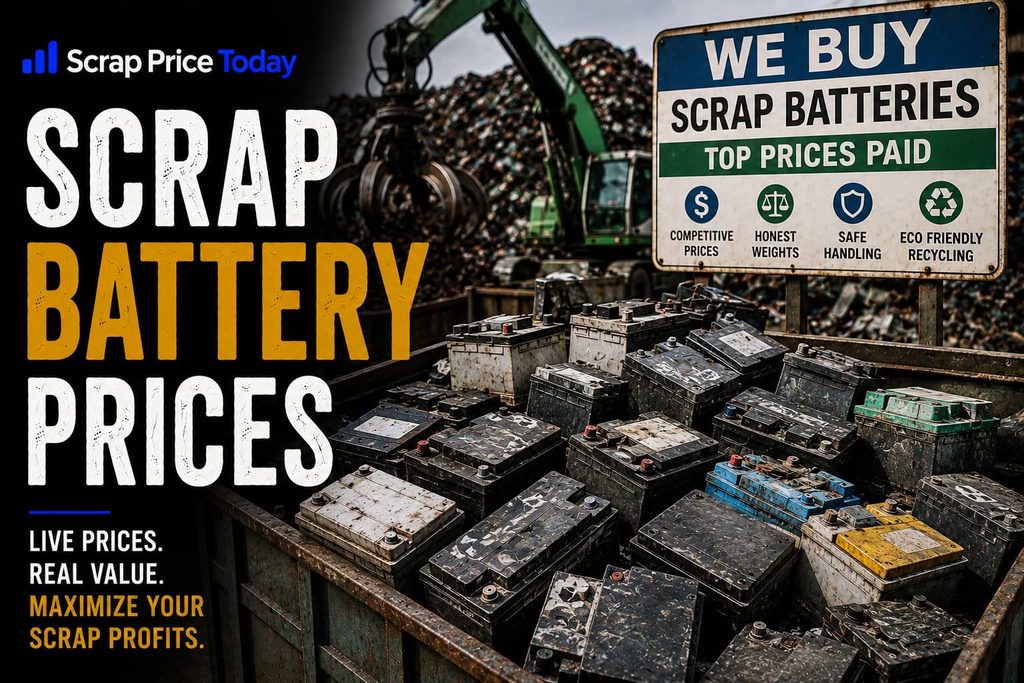
Lead-acid batteries are bought by weight, not by the unit, at about $0.23 a pound on our board today. A passenger car battery of 40 pounds is worth roughly $9, a truck battery about $16, and a forklift battery around $276. Lead is the one metal on our board lower than a year ago, down 5.8 percent, while copper rose 52.6 percent over the same period, which is why battery scrap feels flat while everything else has run.
Scrap Price Today market analysis, written from exchange settlement data, mill and refiner pricing practice and published policy documents. Figures are examples; today’s numbers are on the live scrap price board.
The other thing worth knowing before you load a van: lithium batteries are a different market with different buyers, and mixing them into a lead-acid load is the mistake that gets a load refused.
What a battery is actually worth
Yards price lead-acid by the pound and deduct for the plastic case, acid and terminals, which is why the battery grade sits well below the clean lead grade.
| Motorcycle | Passenger car | Light truck | Commercial truck | UPS or telecom AGM | Forklift | |
|---|---|---|---|---|---|---|
| Measurement | Typical weight and value at today’s board | Same | Same | Same | Same | Same |
| Typical weight | About 12 lb | About 40 lb | About 50 lb | About 70 lb | About 60 lb | Around 1,200 lb |
| Value at $0.23 a pound | About $2.76 | About $9.20 | About $11.50 | About $16.10 | About $13.80 | About $276 |
| Notes | Barely worth a trip alone | The common case | Often overlooked in fleet work | Sealed units, similar pricing | Steel case deducted |
That forklift line is the one people miss. A single industrial battery is worth more than every car battery most scrappers will handle in a year, and they turn up in warehouse and plant clearances.
Why the battery grade is so far below lead
Our board carries clean lead at $0.59 a pound and battery scrap at $0.23, which is 39 percent of it.
The gap is processing, not margin. A recycler can melt clean lead with minimal handling, while a battery has to be broken, the acid neutralised, the polypropylene case separated and the lead paste and grids recovered. Published trade commentary describes the same operational reality: clean lead moves in bulk with little sorting, battery cores take labour before any metal appears.
So the practical rule is to keep clean lead, wheel weights and batteries in three separate piles, because they are three different prices.
Why lead is the metal going nowhere
Lead is the only benchmark on our board below where it was twelve months ago. Over three years it is down 13.6 percent and over five years down 20.9 percent, against copper’s 57.3 percent gain over the same five-year window.
The reason is structural rather than cyclical. Lead demand is dominated by the starter battery, a product being displaced at the margin in electric vehicles, while recycled supply keeps arriving from the existing fleet in a mature, efficient collection system. A market with steady supply and slowly eroding demand does not run.
That context matters for timing. Holding batteries waiting for a lead rally has been a losing position for five years, and our five-year price history shows the shape of it.
Lithium is not a lead-acid battery
This is the operational point that costs people money and occasionally causes fires.
Lithium-ion batteries follow entirely separate buyer channels, with payout depending on cathode chemistry rather than on a lead price. Nickel-based batteries are specialty priced again. A yard set up for lead-acid will refuse them, and a lithium cell damaged in a load of car batteries is a genuine ignition risk.
Identify before you load. If it came out of a power tool, a laptop, an e-bike or an electric vehicle, it is not going in the lead-acid pile.
Handling, which every yard will ask about
- Never drain, puncture or open a battery. Yards require them intact and acid handling is not a task for a driveway.
- Transport upright in a leak-proof container or tray, with terminals protected against shorting.
- Separate damaged, swollen, burned or leaking units and tell the yard about them before arrival; they may need different packaging.
- Wear rubber-coated gloves and old clothing, and carry absorbent pads for spills.
- Do not stack loose batteries where terminals can touch metal.
Where batteries come from in volume
Garages, fleet workshops, marinas, telecom sites, data centres and warehouses all replace batteries on a schedule and generally treat disposal as a chore. A standing arrangement is worth far more than occasional finds, and the approach is the same one described in where scrap metal comes from.
Be aware that several states require identification for battery loads over a modest weight threshold, and that scrap income is taxable, so keeping transaction records is sensible for anyone doing this regularly.
Key numbers
- Battery scrap is $0.23 a pound on our board, 39 percent of the clean lead grade at $0.59 (Scrap Price Today series).
- Lead is down 5.8 percent over twelve months, 13.6 percent over three years and 20.9 percent over five, the only metal on our board below its level of a year ago.
- Copper rose 52.6 percent over the same twelve months, which is the contrast driving most of the disappointment at the scale.
- A 40 pound car battery is worth about $9; a 1,200 pound forklift battery about $276.
- Published market reference prices for car batteries have recently sat around $0.21 a pound, with lead-acid ranges commonly quoted at $0.15 to $0.22 (trade price listings).
- Lead-acid batteries are among the most recycled consumer products in the world, with recycling rates above 95 percent in the United States and Europe (industry data).
What this metal pays around the world
Scrap is a global market priced in US dollars, but what reaches a seller depends on trade position, freight to the nearest consumer and how many buyers compete locally. The table below converts the same grade into each market’s own currency and units at the day’s exchange rate, and shows the factor we apply.
| Market | Local price | USD per lb | Market factor |
|---|---|---|---|
| Turkey | ₺26.18 / kg | $0.24 | 1.04 |
| Germany | €0.46 / kg | $0.23 | 1.02 |
| United States | $0.23 / lb | $0.23 | 1.00 |
| China | CN¥3.32 / kg | $0.23 | 0.98 |
| Canada | C$0.31 / lb | $0.22 | 0.97 |
| United Kingdom | £0.36 / kg | $0.22 | 0.96 |
| Australia | A$0.69 / kg | $0.22 | 0.95 |
| United Arab Emirates | AED1.77 / kg | $0.22 | 0.95 |
| Saudi Arabia | SAR1.77 / kg | $0.21 | 0.93 |
| India | ₹44 / kg | $0.21 | 0.92 |
| Bangladesh | ৳55 / kg | $0.20 | 0.88 |
| South Africa | R7.06 / kg | $0.20 | 0.85 |
Where this goes in other countries
The route depends on which national system covers you. Most markets place the duty on producers and retailers rather than on households, which is why free drop-off points exist at all. The table below sets out the system, the rule that creates it, and the official locator for each market we cover.
| Market | National system | What creates it | What a household does | Official locator |
|---|---|---|---|---|
| United States | State producer responsibility programmes | Several states advanced battery producer responsibility laws this year, shifting collection cost onto producers | Retail drop-off box, or a household hazardous waste site | National battery collection network locator |
| United Kingdom | Waste Batteries and Accumulators Regulations | Shops selling more than 32 kg of batteries a year must provide a free in-store collection point | Supermarket or electricals shop collection box | Recycle Your Electricals and council listings |
| Germany | Batteriegesetz | Retailers must take back portable batteries free of charge | In-store collection box | Retail and municipal points |
| India | Battery Waste Management Rules with EPR | Producers must meet collection and recycling targets on a central portal | Authorised recycler or producer collection point | CPCB portal listings |
| Australia | B-cycle national battery scheme | Industry-funded stewardship scheme for loose batteries | Free drop-off at participating retailers | Scheme locator |
| Canada | Provincial battery stewardship | Producer-funded collection required provincially | Retail and depot drop-off | Provincial programme locator |
How we produced this
The per-unit values are our current battery grade multiplied by typical unit weights, which vary by manufacturer and application; weigh your own rather than relying on the table. Our lead series comes from a monthly published international price series rather than a daily exchange feed, so its short-term movements are smoother than copper’s, a limitation documented on the editorial policy page.
The trade price references are named as market listings rather than presented as our own measurements, and they sit close to our derived level, which is a reasonable cross-check.
We do not buy batteries or take referral fees. Live prices are on the board, the calculator converts weights, and the handling points are included because acid and lithium are the two ways this material hurts someone rather than merely disappointing them.