There is no single law covering where you may collect scrap. Outcomes turn on ownership, access and intent, and the assumption most scrappers make is backwards: the more systematic you are, the more exposure you carry. In New York, material placed out for collection becomes the property of the sanitation department, and enforcement focuses on people loading trucks with recyclables for resale rather than someone taking one item off a kerb.
Scrap Price Today market analysis, written from exchange settlement data, mill and refiner pricing practice and published policy documents. Figures are examples; today’s numbers are on the live scrap price board.
The reliable sources are the permissioned ones, and they produce better material anyway. Here is the legal position stated honestly, then where the metal actually comes from.
The legal position, without the myths
There is no federal rule. Three questions decide every case: who owns the material at that moment, how you reached it, and what you intended to do with it.
| Kerbside on collection day | Business skip on private ground | Locked or fenced enclosure | Active construction site | |
|---|---|---|---|---|
| Measurement | Ownership status and the risk it creates | Same | Same | Same |
| Who owns it | Often treated as abandoned, but in some cities it passes to the municipality | The business, until it says otherwise | The business, with access controlled | The contractor or client, always |
| Main risk | Local ordinance, particularly where recycling is contracted out | Trespass and theft | Breaking into a secured area, a more serious charge | Theft, trespass and site safety liability |
| Enforcement pattern | Low for one item, higher for systematic truck collection | Complaint driven | Actively pursued | Actively pursued |
| The fix | Check the local ordinance | Ask, and get a name | Ask, and get it in writing | Ask, and get a job sheet |
A recycling bin at a business is the clearest example of the misunderstanding. It looks discarded, but the business put material there deliberately because it has value, and people have been charged with theft by unauthorised taking for emptying one.
Why systematic collecting carries more risk, not less
A single item taken from a kerb rarely interests anyone. A van appearing on the same route every week, taking recyclables a council or contractor has already sold forward, is a different proposition.
That is the inversion worth internalising. Scale is what turns an overlooked activity into an enforcement target, and scale is exactly what a serious scrapper is building toward. The way through is not to be quieter about it; it is to convert the route into permissions.
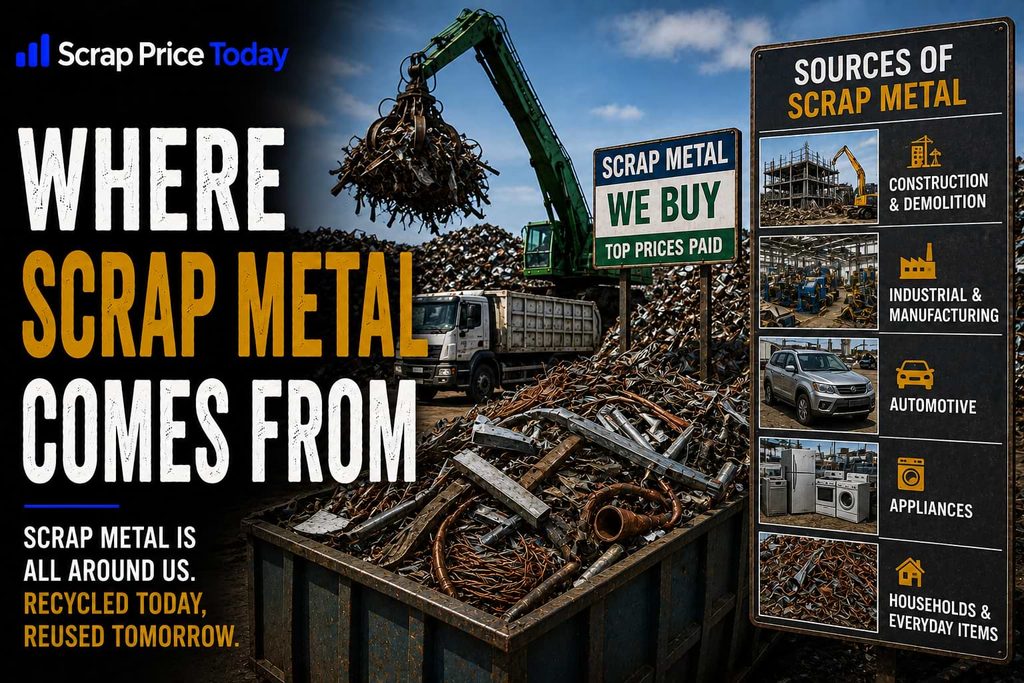
Where scrap legitimately comes from
Every one of these produces better material than a bin, because it is sorted, dry and known.
- Renovation and demolition contractors, who pay to remove waste and are usually glad to hand metal to someone reliable.
- Electrical, plumbing and HVAC firms, which generate clean copper, brass and coils daily and rarely want to run their own scrap logistics.
- Machine shops and fabricators, whose offcuts and turnings are single-alloy and consistent.
- Farms and rural properties, where machinery, fencing, tanks and implements accumulate for decades.
- Estate and property clearances, particularly for executors who want the job done rather than the money.
- Licensed auctions and government surplus sales, which come with paperwork by definition.
- Appliance removal services, where the metal is a byproduct of a service someone is already paying for.
The common feature is that someone with authority has said yes, which is also what a yard will want to hear about if a load raises questions.
The conversation that turns a source into a supply
Most scrappers never ask, and it is a short conversation.
Find the person who owns the problem, usually a site manager, workshop foreman or office manager. Explain that you will collect on a regular day, leave the area clean, and take the whole lot rather than only the valuable parts. That last point is what closes it, because their problem is disposal cost, not metal price.
Ask for a name, a phone number and something in writing, even a text message. That record is what makes the load ordinary at the scale, and it is the same documentation our note on copper selling rules describes for cable.
What no source makes acceptable
Some material is refused wherever it came from, and claiming permission does not change that.
- Anything with utility, municipal, rail or telecoms markings.
- Manhole covers, fire hydrant fittings, backflow preventers, street lighting and traffic signal components, which several states list specifically.
- Beer kegs, which belong to the brewery regardless of who left one behind.
- Vehicles without title or deregistration paperwork.
- Catalytic converters without proof of ownership, now regulated in most markets.
A yard that accepts these is not a yard to build a business around.
Safety, which decides more than the law
Bins contain sharps, broken glass, chemicals and biohazards, and business owners cite that as often as theft when they object. Construction sites have their own liability regime, and an uninsured person on site is a problem for the contractor before it is a problem for you.
Carry gloves and eye protection, do not climb into containers, and do not enter sites without someone knowing you are there.
Key numbers
- There is no federal statute governing collection from waste containers in the United States; outcomes depend on state and local law, property rights and intent (published legal summaries).
- New York City’s administrative code provides that material placed out for collection becomes the property of the sanitation department.
- Several states specifically restrict manhole covers, fire hydrant valves, backflow preventers and similar infrastructure items regardless of who presents them.
- Sorting a mixed load returns 15 to 25 percent more than selling it at one price, which is why permissioned, sorted sources outperform scavenged ones (Recycled Materials Association grade definitions).
- Clean copper is $5.82 a pound on our board today against about $0.15 a pound for ferrous scrap, which is why the source of your copper attracts the most scrutiny.
What this metal pays around the world
Scrap is a global market priced in US dollars, but what reaches a seller depends on trade position, freight to the nearest consumer and how many buyers compete locally. The table below converts the same grade into each market’s own currency and units at the day’s exchange rate, and shows the factor we apply.
| Market | Local price | USD per lb | Market factor |
|---|---|---|---|
| Turkey | ₺633.98 / kg | $5.79 | 1.04 |
| Germany | €11.15 / kg | $5.68 | 1.02 |
| United States | $5.57 / lb | $5.57 | 1.00 |
| China | CN¥80.50 / kg | $5.46 | 0.98 |
| Canada | C$7.59 / lb | $5.40 | 0.97 |
| United Kingdom | £8.80 / kg | $5.35 | 0.96 |
| Australia | A$16.60 / kg | $5.29 | 0.95 |
| United Arab Emirates | AED42.84 / kg | $5.29 | 0.95 |
| Saudi Arabia | SAR42.83 / kg | $5.18 | 0.93 |
| India | ₹1,069 / kg | $5.12 | 0.92 |
| Bangladesh | ৳1,337 / kg | $4.90 | 0.88 |
| South Africa | R170.92 / kg | $4.73 | 0.85 |
For copper specifically, where to find scrap copper ranks the sources by how much they actually yield.
For industrial sources rather than the jewellery drawer, where to find scrap silver covers contacts, relays and brazing rod, and the cadmium rule that applies to all of them.
Before you build a round
The legal picture above describes how the risk is structured, not the rule in any one place. Ownership of discarded material, scavenging ordinances and theft thresholds are set locally and vary between neighbouring municipalities, let alone between states.
This is general information and not legal advice. Check your own city and state before you build a collection round, and where a source feels ambiguous the answer is to ask the owner rather than to assume abandonment. That conversation costs nothing and settles the question permanently.
For what to do with the material once you have it, the best metals guide covers which of it is actually worth carrying, and the minimum load calculator works out whether a given trip clears its own cost.
Frequently asked questions
Is it legal to take scrap metal left out for collection?
It depends on where you are, and there is no single rule. In some places material placed out for collection becomes the property of the sanitation authority the moment it is set down. Ownership of discarded material and scavenging ordinances are set locally and differ between neighbouring municipalities.
Does collecting more systematically make it safer?
No, and the assumption that it does is backwards. Enforcement generally focuses on people loading vehicles with recyclables for resale rather than someone taking a single item. Scale and routine increase exposure rather than reducing it.
Where does scrap metal legitimately come from?
Your own property, material you have been given permission to take, demolition and renovation sites where the contractor has agreed, trade sources such as electricians and plumbers disposing of offcuts, and buying it outright. Permission is what separates a source from a risk.
What material is restricted regardless of who has it?
Infrastructure items are restricted in many jurisdictions: manhole covers, fire hydrant valves, backflow preventers, rail and utility components. Restrictions apply to the item rather than to how it was obtained, so a yard will refuse them and should.
How do I ask a business for their scrap?
Ask about their disposal problem rather than about the metal. Contractors and maintenance firms mostly regard getting rid of it as a chore, and reliable collection on a predictable day is worth more to them than the scrap is to you.
Do I need a licence to collect scrap?
Selling your own scrap occasionally does not require one anywhere. Buying scrap from others to resell is dealing, and that is licensed in most jurisdictions, with identification and record-keeping requirements attached.
Is sorting worth the time before selling?
Yes, and it is usually the highest-paid work available. A sorted load returns meaningfully more than the same material sold at one mixed price, because a mixed load is paid at the lowest grade present.
What identification will a yard ask for?
In most regulated markets, photographic identification and often proof of address. Yards are required to record who they bought from, and in some jurisdictions cash payment for scrap is prohibited outright.