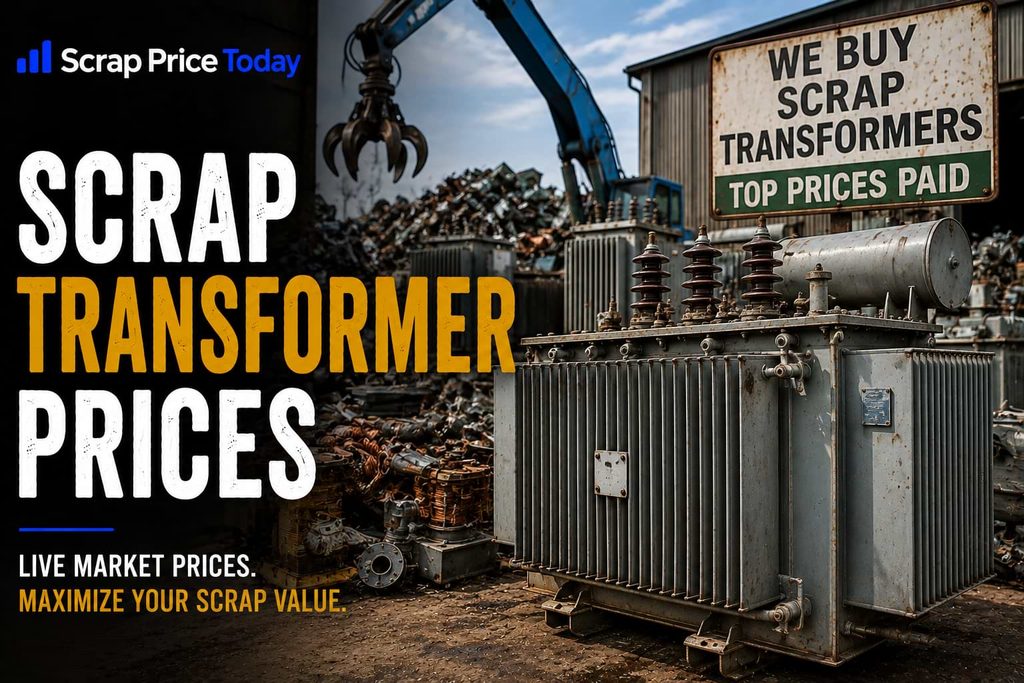
A transformer’s scrap value is set by one question: copper windings or aluminium windings. At today’s board a copper-wound unit at 20 percent copper by weight contains about $1.28 of metal per pound of unit, while an aluminium-wound unit at 12 percent contains about $0.23. That is a five and a half times difference for two objects that look identical from the outside, which is why yards quote a cautious flat rate until they cut one open.
Scrap Price Today market analysis, written from exchange settlement data, mill and refiner pricing practice and published policy documents. Figures are examples; today’s numbers are on the live scrap price board.
The second question decides whether there is any value at all. Units built before 1979 are likely to contain PCBs in their oil, and PCB disposal costs can exceed everything the metal is worth.
What is inside
Strip a distribution transformer and there are four things: windings of copper or aluminium, a laminated silicon steel core, a steel tank with radiators and bushings, and insulating oil.
Windings are typically quoted at 25 to 45 percent copper by weight as a winding, which translates to a much lower share of the whole unit once the core, tank and oil are counted. That share is the number that matters, and it is what a yard is estimating when it quotes you.
The arithmetic per hundred pounds of unit
| 10% copper | 15% copper | 20% copper | 25% copper | Aluminium wound, 12% | |
|---|---|---|---|---|---|
| Measurement | Metal content per 100 lb of unit and its value at today’s board | Same | Same | Same | Same |
| Winding metal value | $58 | $87 | $116 | $146 | $10 |
| Steel value at $300 a ton | $14 | $13 | $12 | $11 | $13 |
| Total per 100 lb | About $72 | About $100 | About $128 | About $157 | About $23 |
| Value per pound of unit | $0.72 | $1.00 | $1.28 | $1.57 | $0.23 |
For comparison, 100 pounds of plain steel scrap is worth about $15. So a copper-wound transformer is worth five to ten times its weight in ordinary steel, and an aluminium-wound one is worth barely more than the steel it is built from.
That gap is the whole reason to identify the winding before you accept a price.
How to tell copper from aluminium, and the trick in between
Cut a coil and look at the cross-section. Copper is unmistakably copper coloured through the section; aluminium is silver throughout.
The trap is copper-clad aluminium, used by some manufacturers to save cost. It looks like copper on the outside and is aluminium inside, and it is only visible on a cut face. Dismantlers check the cross-section for exactly this reason, and a seller who has not checked is negotiating blind.
Weight is a rough second check. Copper is about three times as dense as aluminium, so two units of the same physical size with very different weights are usually wound differently.
Why yards quote a flat per-pound rate
A yard buying a sealed transformer cannot see the windings, does not know the oil status, and carries the cost of dismantling and disposal. So it quotes a rate that assumes the worst case and prices its risk in.
That is not unreasonable, and it is also why an identified, drained, dismantled unit sold as separate copper, steel and aluminium lines is worth substantially more than the same transformer sold whole. The trade-off is that dismantling brings the oil and the regulation onto your side of the transaction.
The oil, and the date that changes everything
Units manufactured before 1979 are likely to contain polychlorinated biphenyls in their insulating oil. PCBs are a regulated hazardous substance and the rules govern testing, handling, transport and disposal.
The practical consequences are severe enough to invert the economics.
- Testing establishes PCB concentration and is the first step for any older unit; sellers should verify status before offering a transformer at all.
- Contaminated oil must go to permitted disposal, and the cost can exceed the value of the recovered metal.
- Transport of hazardous material requires licensed carriers, compliant vehicles and manifest documentation, and international movement engages the Basel Convention.
- Non-compliant units are refused by legitimate buyers, and mishandling attracts penalties.
A sound rule for anyone who is not a licensed processor: do not open, drain or transport an oil-filled transformer of unknown vintage. Sell it whole to a buyer equipped for it, and accept the lower rate as the price of not owning the liability.
Small transformers are a different item
Dry-type units, microwave transformers, welder and audio transformers and the small potted transformers in equipment contain no oil and no PCB question. They are bought on winding content in the same way, and they are where most household scrappers actually encounter this material.
They are also heavy for their size and easy to accumulate. A drum of small copper-wound transformers is a real line on a ticket rather than a curiosity, and the same identification rule applies.
Selling well
- Establish the winding type before asking for a price.
- Ask whether the quote is per pound of whole unit or per pound of recovered metal, because they are very different numbers.
- Separate small dry-type units from oil-filled units; they are different transactions.
- Do not drain oil yourself unless you are equipped and permitted to.
- For anything that predates 1979, raise the PCB question first rather than waiting for the yard to.
- Keep the steel core with the unit; it is low value but it is weight the buyer expects.
Key numbers
- Transformer windings are commonly quoted at 25 to 45 percent copper by weight as a winding (trade specification summaries).
- A copper-wound unit at 20 percent copper by unit weight holds about $1.28 of metal per pound at today’s board; an aluminium-wound unit at 12 percent holds about $0.23.
- Our board today: copper $5.82 a pound, aluminium $0.84 a pound, ferrous scrap $300 a short ton (Scrap Price Today series).
- Transformers manufactured before 1979 are likely to contain PCBs and require testing before disposal (US Environmental Protection Agency PCB regulations).
- Hazardous transport requires licensed carriers and manifest tracking, with the Basel Convention applying to transboundary movement.
- Copper is roughly three times the density of aluminium, which is the quick physical check on winding type.
What this metal pays around the world
Scrap is a global market priced in US dollars, but what reaches a seller depends on trade position, freight to the nearest consumer and how many buyers compete locally. The table below converts the same grade into each market’s own currency and units at the day’s exchange rate, and shows the factor we apply.
| Market | Local price | USD per lb | Market factor |
|---|---|---|---|
| Turkey | ₺633.98 / kg | $5.79 | 1.04 |
| Germany | €11.15 / kg | $5.68 | 1.02 |
| United States | $5.57 / lb | $5.57 | 1.00 |
| China | CN¥80.50 / kg | $5.46 | 0.98 |
| Canada | C$7.59 / lb | $5.40 | 0.97 |
| United Kingdom | £8.80 / kg | $5.35 | 0.96 |
| Australia | A$16.60 / kg | $5.29 | 0.95 |
| United Arab Emirates | AED42.84 / kg | $5.29 | 0.95 |
| Saudi Arabia | SAR42.83 / kg | $5.18 | 0.93 |
| India | ₹1,069 / kg | $5.12 | 0.92 |
| Bangladesh | ৳1,337 / kg | $4.90 | 0.88 |
| South Africa | R170.92 / kg | $4.73 | 0.85 |
How we produced this
The per-hundred-pound values are calculated from our own board prices multiplied by published content bands, and are presented as a range because winding share varies enormously with unit size, voltage class and manufacturer. Weigh and identify your own unit rather than reading a figure off the table.
The PCB and transport requirements are drawn from published EPA regulations and industry compliance guidance and are summarised here rather than reproduced. They differ by jurisdiction and by concentration threshold, so verify against your own regulator.
This is general information, not environmental or legal advice, and we do not buy transformers or take referral fees. Metal prices come from our daily series, documented on the editorial policy page, with live figures on the board and grade definitions in the copper grades guide.