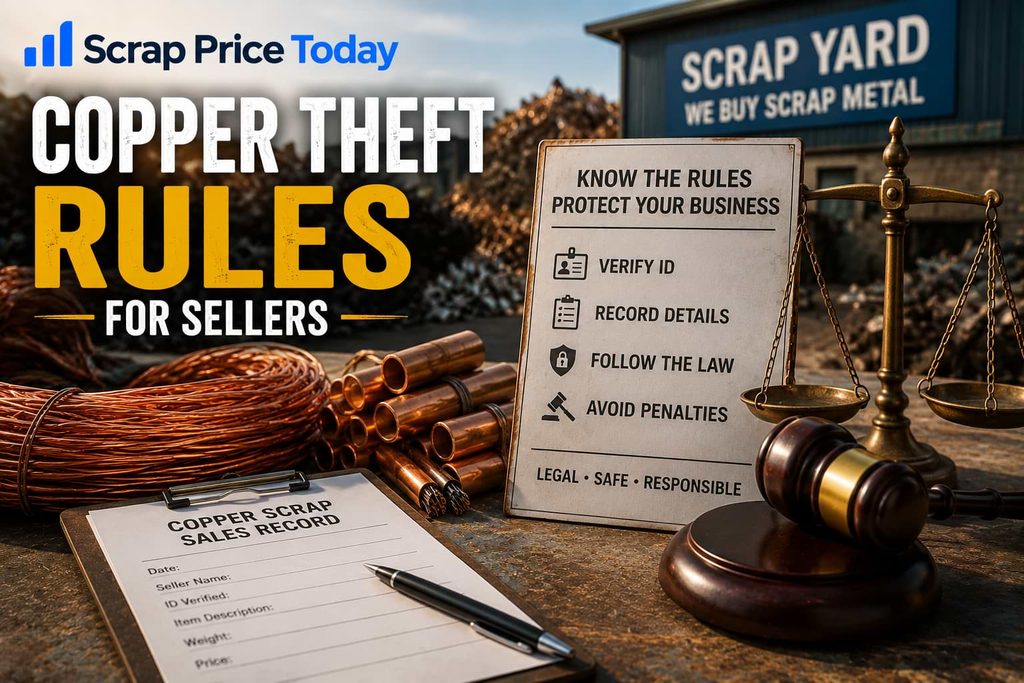
Selling copper legally now means photo identification, a signed statement that you own the material, and payment by traceable means at a licensed yard. In California the bar rose further at the start of the year: under a new law, anyone selling scrap copper needs a licence from the Contractors State License Board, at up to $500 a year, unless they hold a qualifying trade licence already.
Scrap Price Today market analysis, written from exchange settlement data, mill and refiner pricing practice and published policy documents. Figures are examples; today’s numbers are on the live scrap price board.
Honest sellers carry the cost of a problem they did not create. An electrician with a van of stripped cable and a homeowner clearing a renovation both face questions designed for someone else. Knowing what a yard must collect turns a difficult visit into a five minute one.
Why the rules keep tightening
The economics of copper theft are brutally asymmetric, and two documented cases show it better than any statistic.
Thieves stripped 38,000 feet of copper wire, about seven miles, from a landmark Los Angeles bridge. The scrap value of that wire was around $11,000. The bridge went dark and the repair bill ran far beyond it.
In South Carolina, a 12-foot length of grounding wire worth roughly $10 caused a substation fault that cut power to more than 15,000 Duke Energy customers.
The Department of Energy has estimated copper theft costs US businesses in the region of $1 billion a year. Legislators concluded that the way to stop it was to make stolen metal unsellable, which is why the burden landed at the point of sale rather than on the thief.
What every licensed yard must now do
The details vary by state and country, but the shape is consistent.
- Verify identity from a government photo document, recorded and often photographed.
- Obtain a signed statement that the seller owns the material or a transfer document naming who they got it from.
- Record the transaction in detail, and keep the record for inspection.
- Pay by traceable means for regulated metals; cash is prohibited outright in Britain and several other markets.
- Refuse material that appears to belong to a utility, railway, road authority or telecoms network without documentation.
A buyer who skips these is not doing you a favour. They are risking a licence you also depend on.
What changed in California
The new law took effect at the start of the year and is the strictest package in the country. For anyone selling in the state, these are the practical changes.
| Before | Now | |
|---|---|---|
| Measurement | Requirements per transaction and per seller | Requirements per transaction and per seller |
| Seller licence for copper | None | CSLB licence required, annual fee up to $500, with exemptions for qualifying trade licence holders and EPA-certified technicians |
| Seller details recorded | Identification | Legal name, date of birth, residence address, signed ownership statement |
| Transaction record | Basic details | Adds timestamp, amount paid, and the name of the employee handling it |
| Fine for knowingly buying stolen metal | Up to $1,000 | Up to $10,000 |
| Possessing protected infrastructure material without papers | Up to $3,000 | Up to $5,000 |
| Protected items list | Fire hydrants, manhole covers and similar | Expanded to include streetlights, traffic signals, EV chargers, solar lighting components and air quality sensors |
The law also bars purchases from anyone under 18, requires records to be kept and made available for inspection, and creates a separate organised metal theft offence for coordinated rings.
If you work in California and generate copper as a byproduct, the licence question is worth resolving before your next trip to the yard. Licensed electricians and plumbers are generally exempt, but the exemption language leaves room for interpretation, so confirm your own position with the board rather than assuming. Our Los Angeles page covers local practice.
What counts as proof of origin
There is no single document. What satisfies a yard is anything that plausibly connects the material to lawful work.
- A trade invoice or job sheet naming the site the cable came from.
- A demolition or renovation contract.
- A purchase receipt if you bought the material or the building.
- A letter from the property owner for a domestic clearance.
- An established business account with the yard, which replaces the paperwork on each visit.
The material that will be refused
Anything carrying utility, municipal or transport markings is refused everywhere, and increasingly so is anything on the expanded protected list. Bare heavy earthing wire with no obvious domestic source draws questions because it is exactly what comes out of a substation or a lightning protection system.
It is also what an electrician legitimately strips from a large job. Yards cannot tell those apart by looking, so they ask, and a job sheet settles it in seconds.
The industry runs a shared alert system for stolen material, operated by the Recycled Materials Association, which dealers and police both use. It works: one reported case using the system led to arrests over roughly $18,000 of stolen wiring.
Practical advice for tradespeople
- Keep the job sheet with the load. One sheet of paper turns a suspicious quantity of cable into an ordinary commercial sale.
- Open an account rather than selling anonymously. Account holders get better prices, faster turnaround and fewer questions.
- Strip on site where practical and keep bare copper separate; it grades better, as the copper grades guide explains.
- Never buy copper from someone who turns up offering it cheaply. Handling it is an offence in most places and it puts your own account at risk.
- Check your state’s current requirements before a first sale. They have changed twice in two years in several states.
Key numbers
- Around 38,000 feet of copper wire, worth about $11,000 as scrap, was stolen from a single Los Angeles bridge, which then went dark (California legislative record).
- A 12-foot grounding wire worth roughly $10 caused a substation fault affecting more than 15,000 utility customers.
- Copper theft costs US businesses roughly $1 billion a year on Department of Energy estimates.
- California’s maximum fine for knowingly purchasing stolen metal rose from $1,000 to $10,000 (AB 476, Chapter 694).
- Cash payment for scrap is prohibited for licensed dealers across England and Wales under the Scrap Metal Dealers Act (UK government guidance).
- Clean copper grades recover roughly 85 to 98 percent of the exchange price at the refinery, which is both why the metal is worth stealing and why the paperwork exists (Recycled Materials Association).
What this metal pays around the world
Scrap is a global market priced in US dollars, but what reaches a seller depends on trade position, freight to the nearest consumer and how many buyers compete locally. The table below converts the same grade into each market’s own currency and units at the day’s exchange rate, and shows the factor we apply.
| Market | Local price | USD per lb | Market factor |
|---|---|---|---|
| Turkey | ₺633.98 / kg | $5.79 | 1.04 |
| Germany | €11.15 / kg | $5.68 | 1.02 |
| United States | $5.57 / lb | $5.57 | 1.00 |
| China | CN¥80.50 / kg | $5.46 | 0.98 |
| Canada | C$7.59 / lb | $5.40 | 0.97 |
| United Kingdom | £8.80 / kg | $5.35 | 0.96 |
| Australia | A$16.60 / kg | $5.29 | 0.95 |
| United Arab Emirates | AED42.84 / kg | $5.29 | 0.95 |
| Saudi Arabia | SAR42.83 / kg | $5.18 | 0.93 |
| India | ₹1,069 / kg | $5.12 | 0.92 |
| Bangladesh | ৳1,337 / kg | $4.90 | 0.88 |
| South Africa | R170.92 / kg | $4.73 | 0.85 |
How we produced this, and its limits
The California provisions are taken from the enacted bill and from compliance guidance published by scrap dealers operating in the state; the incidents are drawn from the legislative record and utility reporting. UK requirements come from government guidance.
This is a summary for sellers, not legal advice. Requirements differ by state and change frequently, and the exemption language in the California licence provision is open to interpretation. Confirm your own position with the licensing board or your local authority before selling, and treat any yard that tells you the rules do not apply as the warning sign it is.
Today’s indicative copper levels are on the live board, local practice by market is on the city pages, and the converter equivalent of these rules is covered in our converter laws article.