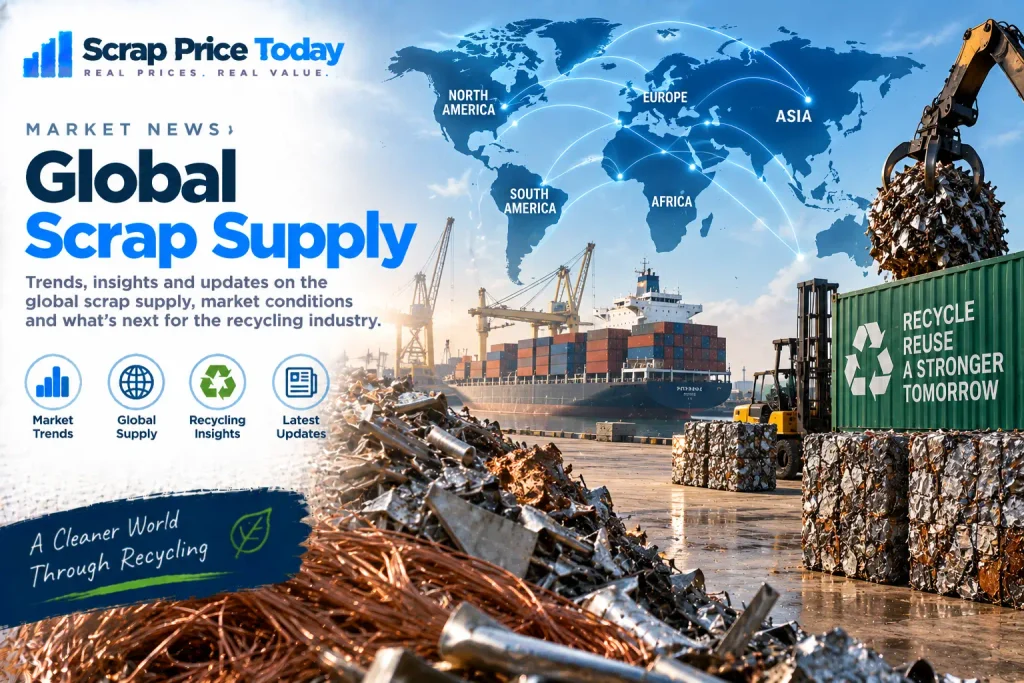
About 630 million tonnes of recycled steel go into world steelmaking each year, preventing close to 950 million tonnes of carbon dioxide, and roughly 40 percent of global crude steel is now made from it. Turkey remains the largest importer of recycled steel at 18.768 million tonnes, ahead of India at 8.040 million. Those are the numbers behind the price on your ticket, and they explain why a household load in one country is worth 22 percent more than the same metal in another.
Scrap Price Today market analysis, written from exchange settlement data, mill and refiner pricing practice and published policy documents. Figures are examples; today’s numbers are on the live scrap price board.
This is the supply picture the rest of this site sits inside.
Steel: the largest recycled material on earth
Steel is by a wide margin the most recycled material in the world, and the volumes are not close to anything else.
| Measure | Volume |
|---|---|
| Recycled steel used in world steelmaking | About 630 million tonnes a year |
| Additional scrap consumed by iron and steel foundries | About 70 million tonnes a year |
| Carbon dioxide prevented | Nearly 950 million tonnes a year |
| Share of global crude steel made from recycled steel | About 40 percent |
| Share of US crude steel using recycled metal | Nearly 42 percent |
That 40 percent figure is the one worth holding onto. Two fifths of the world’s steel already comes from material that somebody, somewhere, carried to a scale.
Who buys, and how much
The trade is concentrated, and the concentration is why import market prices set the world reference.
| Importer | Recent annual volume | Change |
|---|---|---|
| Turkey | 18.768 million tonnes | Down |
| India | 8.040 million tonnes | Down 5% |
| EU-27 | 4.991 million tonnes | Up 28.8% |
| United States | 4.662 million tonnes | Up 5.1% |
| Pakistan | 3.022 million tonnes | Up 39.8% |
| Taiwan | 1.853 million tonnes | Down 38.1% |
Turkey’s principal suppliers were the United States at 3.608 million tonnes and the Netherlands at 2.764 million. India drew notably from the United States and the United Kingdom.
Read those movement figures together and you can see the redirection our freight analysis describes: volumes falling into Turkey and Taiwan while rising sharply into Pakistan and the EU. Cargo goes where the arithmetic works.
China consumed 50.64 million tonnes of recycled steel in a single recent quarter, which is more than Turkey imports in two and a half years.
Non-ferrous: smaller volumes, larger values
The non-ferrous picture is the mirror image: a fraction of the tonnage carrying a large share of the value.
Industry research recorded copper scrap usage rising 41 percent from 5.9 to 8.3 million tonnes over a fifteen year period, and aluminium production from scrap rising 86 percent from 8.4 to 15.6 million tonnes over the same window.
More recently, one year of Chinese recycled non-ferrous output totalled 17.6 million tonnes, comprising 9.5 million tonnes of aluminium, 3.85 million of copper, 2.95 million of lead and 1.3 million of zinc.
US recovery data gives a useful detail that most summaries omit: of 275,000 metric tonnes of aluminium recovered from scrap in one month, 143,000 came from new scrap, meaning manufacturing offcuts, and 132,000 from old scrap, meaning end-of-life material. Roughly half of what gets recycled never reached a consumer at all.
Why the collection problem is the real problem
The chemistry has been solved for decades. The constraint is getting material to a furnace.
Less than a third of global metal is currently recovered through formal channels on one industry assessment, and the figure for electronic waste is 22.3 percent formally collected. That gap is not technical; it is logistical and economic, and it is why prices matter so much.
Our recycled supply analysis shows the same relationship at household level: recycling rates track the value of the material almost exactly, from lead-acid batteries at 99 percent down to post-consumer plastic at 5 to 6 percent.
What is changing now
Three forces are reshaping these flows, and all three reach your local price.
Trade policy. Tariff measures applying 50 percent to the full customs value of many aluminium, steel and copper products, with 25 percent on certain derivatives, are pushing manufacturers to reassess domestic secondary sourcing. Europe is moving to protect access to its own recyclable feedstock. Our tariff analysis shows where the resulting margin actually landed.
Steel capacity. Global steelmaking capacity reached 2,445 million tonnes with excess capacity at 640 million tonnes on one intergovernmental assessment. Excess capacity chasing scrap is a different market from tight capacity.
Electric arc growth. Recycled steel is increasingly described within the industry as a strategic resource rather than a secondary raw material, and the electric arc route is expanding on emissions grounds.
One industry leader put the current environment plainly: global ferrous markets remain highly exposed to geopolitical instability, energy disruption, protectionism, freight volatility and changing trade dynamics.
What it means at the scale
Four things follow from all of this for anyone selling.
- Your price is an import price, minus freight, minus margin. That is the whole chain, and it is why our country pages apply a market factor rather than quoting one global number.
- Import markets pay more. Turkey sits above parity on our board and South Africa well below it, a 22.4 percent spread for the same metal on the same day.
- Half of recycled aluminium never reached a household. Industrial offcuts are a large and stable supply that competes with what you collect, which is part of why non-ferrous prices are less local than ferrous ones.
- Volatility is structural. Scrap prices can swing sharply within a month, which is the honest context for our finding that timing a sale is the smallest lever available to a seller.
What this metal pays around the world
Scrap is a global market priced in US dollars, but what reaches a seller depends on trade position, freight to the nearest consumer and how many buyers compete locally. The table below converts the same grade into each market’s own currency and units at the day’s exchange rate, and shows the factor we apply.
| Market | Local price | USD per ton | Market factor |
|---|---|---|---|
| Turkey | ₺16,927 / tonne | $312 | 1.04 |
| Germany | €301 / tonne | $306 | 1.02 |
| United States | $300 / ton | $300 | 1.00 |
| China | CN¥2,175 / tonne | $294 | 0.98 |
| Canada | C$414 / ton | $291 | 0.97 |
| United Kingdom | £240 / tonne | $288 | 0.96 |
| Australia | A$451 / tonne | $285 | 0.95 |
| United Arab Emirates | AED1,154 / tonne | $285 | 0.95 |
| Saudi Arabia | SAR1,153 / tonne | $279 | 0.93 |
| India | ₹29,459 / tonne | $276 | 0.92 |
| Bangladesh | ৳35,798 / tonne | $264 | 0.88 |
| South Africa | R4,677 / tonne | $255 | 0.85 |
Method
Volumes and trade figures are attributed in the text to the Bureau of International Recycling, worldsteel calculations, the US Geological Survey and intergovernmental capacity assessments as reported in trade press. Data years differ between sources and several are lagged, because the underlying collection is annual or quarterly.
We have quoted each figure with its source rather than blending them into a single number, and where a source describes a range or a change we have kept it as stated. Market size estimates for the recycling industry vary by a factor of ten between commercial research firms depending on what they count, so we have not used them.
Our own price figures are documented on the editorial policy page with live levels on the board.
Questions people ask
How much steel is recycled worldwide?
About 630 million tonnes of recycled steel go into global steelmaking each year, with a further 70 million tonnes consumed by iron and steel foundries. That prevents close to 950 million tonnes of carbon dioxide, and roughly 40 percent of world crude steel is now made from recycled material.
Which country imports the most scrap metal?
Turkey, at 18.768 million tonnes of recycled steel in a recent year, ahead of India at 8.040 million. Turkey’s largest suppliers were the United States at 3.608 million tonnes and the Netherlands at 2.764 million.
Why do import markets pay more for scrap?
Because they melt more than they generate and have to bid material in. That is why the Turkish import assessment functions as the world ferrous reference and why our board shows Turkey above parity and South Africa well below, a 22.4 percent spread for the same metal on the same day.
How much non-ferrous scrap is recycled?
Copper scrap usage rose 41 percent to 8.3 million tonnes and aluminium production from scrap rose 86 percent to 15.6 million tonnes over a fifteen year period on industry research. One year of Chinese recycled non-ferrous output totalled 17.6 million tonnes across aluminium, copper, lead and zinc.
Does most recycled aluminium come from households?
No, roughly half comes from manufacturing. Of 275,000 tonnes of aluminium recovered from scrap in one month of US data, 143,000 tonnes came from new scrap, meaning industrial offcuts, and 132,000 tonnes from old scrap, meaning end-of-life material.
If recycling technology is solved, why are rates still low?
Because the constraint is collection rather than chemistry. Less than a third of global metal is recovered through formal channels on one assessment, and only 22.3 percent of electronic waste is formally collected. The gap is logistical and economic, which is why price drives recycling rates so strongly.
What is changing in the global scrap trade?
Trade policy, with tariffs at 50 percent of full customs value on many steel, aluminium and copper products; steelmaking capacity, which reached 2,445 million tonnes with 640 million of excess; and the growth of electric arc steelmaking, which has moved recycled steel from a secondary raw material to a strategic one.
How does any of this reach my local price?
Your price is an import market price, less freight, less the exporter and yard margin. That is why our country pages apply a market factor rather than quoting one global number, and why two yards at different distances from a mill or dock quote differently for identical metal.
Frequently asked questions
How much steel is recycled worldwide?
About 630 million tonnes of recycled steel go into global steelmaking each year, with a further 70 million tonnes consumed by iron and steel foundries. That prevents close to 950 million tonnes of carbon dioxide, and roughly 40 percent of world crude steel is now made from recycled material.
Which country imports the most scrap metal?
Turkey, at 18.768 million tonnes of recycled steel in a recent year, ahead of India at 8.040 million. Turkey's largest suppliers were the United States at 3.608 million tonnes and the Netherlands at 2.764 million.
Why do import markets pay more for scrap?
Because they melt more than they generate and have to bid material in. That is why the Turkish import assessment functions as the world ferrous reference and why our board shows Turkey above parity and South Africa well below, a 22.4 percent spread for the same metal on the same day.
How much non-ferrous scrap is recycled?
Copper scrap usage rose 41 percent to 8.3 million tonnes and aluminium production from scrap rose 86 percent to 15.6 million tonnes over a fifteen year period on industry research. One year of Chinese recycled non-ferrous output totalled 17.6 million tonnes across aluminium, copper, lead and zinc.
Does most recycled aluminium come from households?
No, roughly half comes from manufacturing. Of 275,000 tonnes of aluminium recovered from scrap in one month of US data, 143,000 tonnes came from new scrap, meaning industrial offcuts, and 132,000 tonnes from old scrap, meaning end-of-life material.
If recycling technology is solved, why are rates still low?
Because the constraint is collection rather than chemistry. Less than a third of global metal is recovered through formal channels on one assessment, and only 22.3 percent of electronic waste is formally collected. The gap is logistical and economic, which is why price drives recycling rates so strongly.
What is changing in the global scrap trade?
Trade policy, with tariffs at 50 percent of full customs value on many steel, aluminium and copper products; steelmaking capacity, which reached 2,445 million tonnes with 640 million of excess; and the growth of electric arc steelmaking, which has moved recycled steel from a secondary raw material to a strategic one.
How does any of this reach my local price?
Your price is an import market price, less freight, less the exporter and yard margin. That is why our country pages apply a market factor rather than quoting one global number, and why two yards at different distances from a mill or dock quote differently for identical metal.