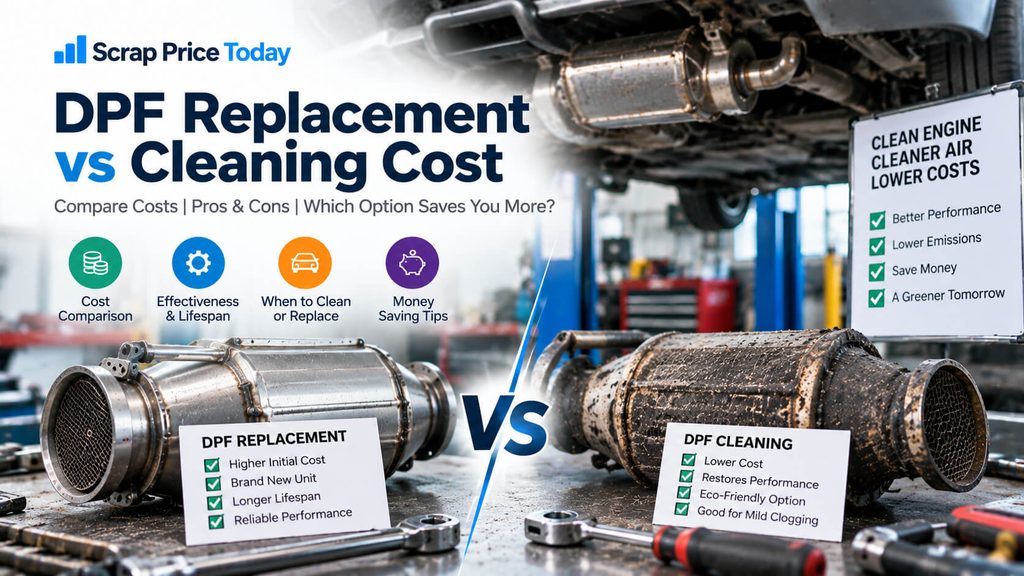
Cleaning a diesel particulate filter costs $150 to $900 depending on method. Replacing one costs $2,400 to $6,500 on a pickup and up to $15,000 on a commercial vehicle. The filter you are replacing is worth $20 to $700 to a precious metals recycler and $0.50 to $3.00 to a scrap yard. That third number appears in no other cost guide, and on a fleet it is the difference between disposal and revenue.
Three decisions, not one
A DPF warning light produces three different questions that most guides answer as if they were one.
Is this actually the filter? A differential pressure sensor or a cracked hose can make a healthy filter look plugged. Repeated forced regens on a truck whose real problem is a sensor waste shop time and your money.
Clean or replace? Soot burns off; ash does not. Which one is loading your filter decides the answer, and the two look identical on a dashboard warning.
What happens to the old unit? This is the part nobody prices. A DPF and the diesel oxidation catalyst ahead of it carry platinum and palladium, and they have a value that depends entirely on who you sell them to.
Delete is a fourth question, and it is a legal one rather than a cost one. It is covered below because people ask, not because it is an option on a road vehicle.
Soot or ash: the check that decides everything
The distinction is physical and it is the whole clean-versus-replace decision.
Soot is fine carbon from incomplete combustion. It burns off during regeneration when the engine raises exhaust temperature. A soot-loaded filter is a cleaning candidate.
Ash is non-combustible residue, mostly from engine oil additives plus fuel, engine wear and corrosion. It never burns off. It accumulates permanently, raises pressure drop, hurts fuel economy and eventually ends the filter’s service life.
So the rule is: soot-loaded and structurally sound means clean; ash-packed or cracked means replace. No amount of regeneration recovers an ash-loaded filter, and no cleaning method restores a cracked or melted substrate.
One curious consequence worth knowing: after extended service the ash layer itself becomes the filter medium, physically separating soot from the channel walls, with the substrate acting as a support. The filter is still working, but it is working on borrowed time.
What cleaning costs, by method
Quotes range from $50 to $900 and the spread is not shop margin. It is four genuinely different processes.
| Method | Cost | What it does | When it fits |
|---|---|---|---|
| Chemical additive | $20 to $100 | Additive in the fuel tank or solvent sprayed into the filter | Light soot loading, early symptoms, DIY |
| Forced regeneration | $100 to $300 | Technician triggers a regen cycle with diagnostic equipment | Soot loading where the automatic cycle has failed |
| Pneumatic or hydro-cycle | $300 to $500 | Compressed air or high-pressure water with solvents | Light to moderate clogging, fast turnaround |
| Thermal bake with ultrasonic | $600 to $900 | 8 to 12 hour kiln cycle oxidises soot to ash, then ultrasonic removal | Heavy loading; the only method that restores over 95 percent of factory flow |
| Fleet forced regen per filter | $500 to $1,000 | Service provider regen depending on buildup | Fleet maintenance schedules |
Two notes on that table.
Forced regeneration treats the symptom. If the automatic cycle is failing because of a sensor fault, a leak, low exhaust temperature or an ash load, forcing a regen does not fix the cause and you will be back.
Only the thermal bake restores flow properly. The cheaper methods are preventative maintenance rather than recovery. Choosing a $300 method on a filter that needs a $700 one is how people end up paying twice.
Add a diagnostic fee of $100 to $200, which owners commonly resent and which is the cheapest part of the job when it prevents a wrong repair.
What replacement costs
| Vehicle class | Replacement cost |
|---|---|
| Diesel pickup, dealer | $2,400 to $6,000 for Powerstroke, Duramax and Cummins platforms |
| Most diesel trucks, 2026 average | $3,500 to $6,500 |
| Commercial vehicles | up to $15,000 |
| Aftermarket or independent | often below dealer, with fitment caveats |
Fitment is where quotes diverge. Long bed, short bed, cab chassis, dually, 4-inch against 5-inch pipe and sensor bung positions all change the job, so a quote that has not confirmed your exact configuration is a guess.
The number no other guide gives you: what your old filter is worth
Both parts of the system carry precious metal, and the buyer decides almost everything.
| Part | To a PGM recycler | To a general scrap yard |
|---|---|---|
| Diesel oxidation catalyst (DOC) | $50 to $700 | $0.50 to $3.00 |
| High-grade DPF | $40 to $500 | $0.50 to $3.00 |
| Low-grade or lightly coated DPF | $10 to $60 | $0.50 to $3.00 |
| Steel canning after de-canning | shred rate by weight | shred rate by weight |
The counterintuitive part: the DOC is usually worth more than the DPF, despite being the smallest component in the system. It carries the highest concentration of platinum and palladium because it does the catalytic work, while the filter’s primary job is trapping soot.
Values are set by part number, not by size or weight. There is a vast range in PGM content between one unit and another, which is why a reputable buyer quotes against a part-number list and a general yard, having no assay capability, grades the whole thing as a steel canister. The DPF price page sets out how assay-based settlement works.
For a fleet, this is not a rounding error. Twenty trucks through a replacement cycle is a five-figure asset if the units go to a specialist and a disposal cost if they go in a skip.
The cost cleaning shops do not always mention: ash disposal
When a filter is cleaned, the ash comes out and has to go somewhere.
The EPA issued a technical bulletin on diesel particulate ash disposal in 2009. DPF ash may contain trace precious metal dislodged from the substrate during cleaning, which is the same material recyclers reclaim.
In California it has become industry standard to treat DPF ash as hazardous waste and manage it accordingly. A generator has two options: assume the ash is hazardous based on knowledge that other tests have found it so, or have it tested by a state-authorised facility, with test data below threshold allowing free shipment.
For a workshop cleaning filters regularly, that is a cost line that varies by state, and it is worth asking whether a cleaning quote includes it.
Delete: the legal position, plainly
People ask, so here is the answer without hedging.
Removing, bypassing or disabling a DPF on a road vehicle violates federal law. The Clean Air Act prohibits tampering with or removing emissions control devices, and the EPA has increased enforcement penalties in recent years. Published penalty figures reach $4,500 per violation for DPF deletion, and shops performing delete services face substantially larger exposure.
Three practical consequences follow, beyond the legal one.
Many states test for it. Emissions programmes specifically check for DPF presence and function, which makes a deleted vehicle impossible to register in those states.
The real cost is not the pipe. A delete pipe looks like a few hundred dollars. Add labour, ECU tuning, diagnostics, damaged sensors, inspection failure, warranty loss, resale loss and return-to-stock repairs, and the figure runs into the thousands.
You throw away the core. A deleted DPF and DOC still carry their PGM value, and owners who cut them out frequently discard units worth several hundred dollars.
Delete information belongs to documented closed-course race builds, permitted export use and legally allowed off-road applications. A street truck should be diagnosed, cleaned, repaired or replaced with compliant parts.
Making the filter last
Prevention is dramatically cheaper than any of the above, and the measures are unglamorous.
- Drive at highway speed at least weekly. Regeneration needs sustained exhaust temperature, which short trips never reach.
- Use low-ash oil. CJ-4 or CK-4 rated oil for DPF-equipped engines reduces the ash that ends the filter’s life.
- Fix EGR faults immediately. Contamination from turbo seal leaks, injector faults or coolant entering the exhaust ruins a cleaned or new filter.
- Watch the regen cycles. Repeated incomplete regens are a warning, not a nuisance.
First cleaning at 80,000 to 100,000 miles commonly extends filter life by another 50,000 miles or more, which is what makes the clean-first approach cost-effective when the filter is sound.
A clogged filter also costs you continuously: heavy carbon loading increases fuel consumption by 3 to 5 percent, so delaying a cleaning for three months can cost more in fuel than the cleaning would have.
Around the world
The economics travel; the regulations differ.
In the United Kingdom and European Union, removing a DPF makes a vehicle fail its roadworthiness test, and Euro 7 enforcement from late 2026 tightens the standards new vehicles must meet. The core value of a removed unit follows the same logic as in the US, priced on PGM content rather than on regulation.
In markets without an assay-based recycling network, the DOC and DPF frequently go to general scrap and are paid as steel canisters. That is the largest single value loss in this whole area, and it is a buyer problem rather than a metal problem. The country pages set out how buyer depth varies by market.
The same pattern repeats across the vehicle. The buyer routing guide sets out what a general yard pays against a specialist, part by part.
The clean or replace tool works the soot-or-ash question from your own symptoms and shows the net cost once the old filter core is counted.
Questions people actually ask
Is DPF cleaning cheaper than replacement?
Substantially, at $150 to $900 against $2,400 to $6,500, but only when the filter is soot-loaded and structurally sound. A cracked, melted or ash-packed filter cannot be cleaned, and paying for a cleaning that fails means paying twice.
How do I know whether my filter needs cleaning or replacing?
Soot loading responds to cleaning; ash loading and physical damage do not. A proper diagnosis distinguishes them, and it also catches the cases where a differential pressure sensor or cracked hose is making a healthy filter look plugged.
What is my old DPF worth?
To a precious metals recycler, $10 to $700 depending on part number. To a general scrap yard, $0.50 to $3.00, because they grade it as a steel canister. The buyer matters far more than the part, which is unusual even in scrap.
Is the DOC worth more than the DPF?
Usually yes. The diesel oxidation catalyst is the most compact part of the system and carries the highest concentration of platinum and palladium, because it does the catalytic work while the filter traps soot.
Is a DPF delete legal?
Not on a road vehicle in the United States. It violates the Clean Air Act tampering prohibition, penalties reach $4,500 per violation, many state emissions programmes test for filter presence, and the true cost including tuning, sensors, inspection failure and resale loss runs into thousands.
Why does cleaning cost vary from $50 to $900?
Because they are different processes. A chemical additive is $20 to $100 and treats light soot. A thermal bake with ultrasonic recovery is $600 to $900 and is the only method that restores over 95 percent of factory flow. Matching the method to the loading is the whole skill.
How often should a DPF be cleaned?
Commonly every 100,000 to 150,000 miles, with first cleaning around 80,000 to 100,000 miles often extending life by another 50,000 or more. Duty cycle matters more than the odometer: short-trip vehicles load faster.
Does a clogged filter cost me anything before it fails?
Yes. Heavy carbon loading raises fuel consumption by 3 to 5 percent, so three months of delay can cost more in diesel than the cleaning. For fleets, downtime from a clogged filter averages far more again.
Who pays to dispose of the ash?
Whoever cleans the filter, and it is passed on in the quote. In California, DPF ash is treated as hazardous waste by industry standard because it can contain trace precious metal, so disposal costs differ by state.
Cost figures are from published 2026 repair and fleet-service sources reviewed between January and July 2026, and vary by vehicle, region and shop. Core values are indicative part-number bands; a specific unit is priced from its part number by an assay-based recycler. Emissions law is federal and state; verify locally before any work that alters emissions equipment. Nothing here is legal advice.
Frequently asked questions
Is DPF cleaning cheaper than replacement?
Substantially, at $150 to $900 against $2,400 to $6,500, but only when the filter is soot-loaded and structurally sound. A cracked, melted or ash-packed filter cannot be cleaned, and paying for a cleaning that fails means paying twice.
How do I know whether my filter needs cleaning or replacing?
Soot loading responds to cleaning; ash loading and physical damage do not. A proper diagnosis distinguishes them, and it also catches the cases where a differential pressure sensor or cracked hose is making a healthy filter look plugged.
What is my old DPF worth?
To a precious metals recycler, $10 to $700 depending on part number. To a general scrap yard, $0.50 to $3.00, because they grade it as a steel canister. The buyer matters far more than the part, which is unusual even in scrap.
Is the DOC worth more than the DPF?
Usually yes. The diesel oxidation catalyst is the most compact part of the system and carries the highest concentration of platinum and palladium, because it does the catalytic work while the filter traps soot.
Is a DPF delete legal?
Not on a road vehicle in the United States. It violates the Clean Air Act tampering prohibition, penalties reach $4,500 per violation, many state emissions programmes test for filter presence, and the true cost including tuning, sensors, inspection failure and resale loss runs into thousands.
Why does cleaning cost vary from $50 to $900?
Because they are different processes. A chemical additive is $20 to $100 and treats light soot. A thermal bake with ultrasonic recovery is $600 to $900 and is the only method that restores over 95 percent of factory flow. Matching the method to the loading is the whole skill.
How often should a DPF be cleaned?
Commonly every 100,000 to 150,000 miles, with first cleaning around 80,000 to 100,000 miles often extending life by another 50,000 or more. Duty cycle matters more than the odometer: short-trip vehicles load faster.
Does a clogged filter cost me anything before it fails?
Yes. Heavy carbon loading raises fuel consumption by 3 to 5 percent, so three months of delay can cost more in diesel than the cleaning. For fleets, downtime from a clogged filter averages far more again.
Who pays to dispose of the ash?
Whoever cleans the filter, and it is passed on in the quote. In California, DPF ash is treated as hazardous waste by industry standard because it can contain trace precious metal, so disposal costs differ by state.